







In today’s hyper-competitive landscape, marketers are under constant pressure to do more with less—to deliver personalized experiences, optimize budgets, and demonstrate clear return on investment (ROI). The traditional approach of looking at past campaign performance to plan future activities is no longer sufficient. This is where predictive analytics enters the picture, fundamentally transforming marketing from a reactive discipline into a proactive, forward-looking powerhouse. At its core, predictive analytics in marketing is the practice of using data, statistical algorithms, and machine learning techniques to identify the likelihood of future outcomes based on historical data. Instead of asking “What happened?”, marketers can now ask, “What is most likely to happen next?” and “What can we do to influence that outcome?”
This powerful capability allows businesses to forecast customer behavior, market trends, and campaign performance with a significant degree of accuracy. Imagine being able to identify which customers are about to churn before they even consider leaving, which leads are most likely to convert into high-value clients, or what product a specific customer segment will want to buy next week. This is not science fiction; it is the practical application of data science to solve everyday marketing challenges. By harnessing the power of prediction, marketing teams can make smarter, data-driven decisions that drive growth, enhance customer loyalty, and create a significant competitive advantage.
For decades, marketing operated in a reactive mode. A campaign would run, and marketers would analyze the results afterward—click-through rates, conversion numbers, and sales figures. This historical analysis was valuable, but it only told the story of what had already occurred. It was like driving a car by looking only in the rearview mirror. This approach often led to missed opportunities and inefficient resource allocation, as strategies were based on past behaviors that might not hold true in the future.
Predictive analytics flips this paradigm on its head. It enables a shift to proactive marketing, where strategies are informed by what is likely to happen. By analyzing patterns in historical and real-time data, machine learning models can anticipate future actions. For example, instead of waiting for a customer to become inactive for 90 days to label them as “at risk,” a churn prediction model can flag them the moment their behavior begins to deviate from the norm. This allows the marketing team to intervene with a targeted retention offer or a personalized message, preventing the churn before it happens. This proactive stance applies across the board, from personalizing website content for a visitor’s first session to optimizing ad spend in real-time based on predicted conversion rates.
To fully grasp the value of predictive analytics, it’s essential to understand how it differs from other forms of data analysis, particularly descriptive analytics, which is the most common type used in marketing. Descriptive analytics focuses on summarizing historical data to provide a clear picture of what has happened. Predictive analytics uses that historical data to forecast what will happen. Prescriptive analytics takes it a step further by recommending actions to take based on the predictions.
Here is a table comparing the different types of analytics:
| Type of Analytics | Core Question | Marketing Example | Business Value |
|---|---|---|---|
| Descriptive | What happened? | A dashboard showing website traffic and conversion rates from last month’s campaign. | Provides a baseline understanding of past performance. |
| Diagnostic | Why did it happen? | Drilling down into the data to see that a drop in conversions coincided with a website bug. | Identifies root causes of problems and successes. |
| Predictive | What will happen? | A model forecasting which customer segments will have the highest lifetime value over the next year. | Enables proactive planning and resource allocation. |
| Prescriptive | What should we do about it? | An automated system that recommends the next best offer for a customer based on their predicted interests. | Automates and optimizes decision-making to achieve specific goals. |
While all types of analytics are valuable, predictive analytics serves as the crucial bridge between understanding the past and shaping the future. It empowers marketers to move beyond simple reporting and start making strategic decisions that directly influence future outcomes.

Predictive analytics might seem like a black box, but its underlying mechanics are based on established principles of data science, statistics, and computer science. It involves a systematic process of collecting data, identifying patterns, and building a mathematical model that can generate a prediction about a future or otherwise unknown event. The engine driving this process is a combination of data mining and machine learning, which work together to turn raw data into actionable foresight.
Understanding this process helps demystify the technology and allows marketers to better collaborate with data science teams and evaluate potential tools and solutions. It’s not about becoming a data scientist, but about understanding the core components that make accurate predictions possible. The goal is to build a reliable, repeatable system that learns from new data and continuously improves its forecasting accuracy over time.
Data mining and machine learning are two intertwined disciplines that form the foundation of predictive analytics. Data mining is the process of discovering patterns, anomalies, and correlations within large datasets to predict outcomes. Think of it as the exploratory phase where you sift through your data to find hidden gems of information. For example, a data mining process might reveal that customers who buy product A and product B together are 90% more likely to purchase product C within 30 days. This is a valuable pattern.
Machine learning (ML) takes this a step further. It is a subset of Artificial Intelligence (AI) that involves building algorithms that can learn from data without being explicitly programmed. In the context of predictive analytics, an ML model would be “trained” on historical data containing these discovered patterns. Once trained, the model can take new, unseen data (e.g., a new customer who just bought products A and B) and make a prediction (e.g., forecast a high probability of them buying product C). The model’s performance is evaluated, and it can be retrained with new data to become more accurate over time.
Several statistical algorithms are commonly used in predictive marketing models. While the mathematics can be complex, understanding their basic purpose is helpful for any marketer.
Creating a predictive model is a structured, iterative process. While the specifics can vary, it generally follows these key stages:

The success of any predictive analytics initiative hinges on one critical component: data. The quality, quantity, and variety of the data you feed into your models will directly determine the accuracy and reliability of their predictions. The principle of “garbage in, garbage out” has never been more relevant. A robust predictive marketing strategy requires consolidating data from multiple sources to create a comprehensive, 360-degree view of the customer. This unified data profile is the fuel for the machine learning engine, enabling it to uncover subtle patterns and make nuanced forecasts.
Marketers need to think beyond traditional datasets and consider a wide range of information that can provide context and signal intent. This involves a strategic blend of internal first-party data, which you own and collect directly, and external third-party data, which can enrich your understanding of the customer and the market.
First-party data is your most valuable asset for predictive modeling. It is data you collect directly from your audience and customers, making it highly relevant and reliable. Key sources include:
By integrating these sources, you can build a rich historical record of how customers interact with your brand across different touchpoints, which is essential for predicting future behaviors like churn or purchase likelihood.
While first-party data is foundational, third-party and contextual data can add significant depth and predictive power to your models. This is data acquired from external sources that provides broader context about your customers and the environment they operate in.
Combining these external signals with your internal first-party data allows models to understand the “why” behind customer actions and make more accurate predictions, especially when dealing with new customers for whom you have limited historical data.
The most sophisticated algorithm in the world will fail if it’s trained on poor-quality data. Data quality and hygiene are non-negotiable prerequisites for successful predictive analytics. This involves several key practices:
Investing time and resources in data governance and preparation is not just a preliminary step; it’s an ongoing commitment that pays massive dividends in the form of more accurate models, more reliable insights, and ultimately, better business outcomes.

Predictive analytics is not a single tool but a collection of different modeling techniques, each designed to answer a specific type of business question. For marketers, certain models have proven to be particularly effective at driving growth and efficiency. These models translate raw data into specific, actionable insights that can be directly applied to marketing campaigns and strategies. Understanding these common models and their applications helps in identifying the best starting points for implementing predictive analytics in your organization.
Customer Lifetime Value (CLV or LTV) is a metric that represents the total net profit a company can expect to make from a single customer account throughout their entire relationship. A predictive CLV model forecasts this value for individual customers or segments. It goes beyond historical CLV by using behavioral data (e.g., purchase frequency, recency, monetary value) and demographic data to predict future spending patterns. Marketers use these predictions to:
Customer churn, or attrition, is a major concern for any subscription-based or repeat-purchase business. A churn prediction model is a classification model that calculates the probability of a customer discontinuing their service or stopping purchases within a specific timeframe. These models analyze signals like declining usage, reduced engagement with marketing communications, recent support complaints, or changes in purchase frequency. The applications are direct and impactful:
In both B2B and B2C environments, not all leads are created equal. Predictive lead scoring models use machine learning to assign a numerical score to each lead, representing their likelihood to convert into a paying customer. The model analyzes a wide range of attributes, including demographic information, firmographic data (for B2B), and behavioral signals (e.g., website pages visited, content downloaded, email engagement). This allows marketing and sales teams to:
Market basket analysis is a data mining technique used to discover co-occurrence relationships among items. It seeks to identify which products are frequently purchased together. The classic example is the discovery that diapers and beer are often bought together by men on Friday nights. This insight powers the recommendation engines seen on virtually every major e-commerce site. These models predict which other products a customer is likely to be interested in based on the items in their current shopping cart or their past purchase history. Key applications include:

The true power of predictive analytics is realized when its insights are embedded directly into marketing workflows and campaigns. Moving beyond theoretical models to practical application is where businesses see tangible results in customer engagement, conversion rates, and ROI. By leveraging predictive insights, marketers can craft campaigns that are more relevant, timely, and efficient than ever before. These use cases demonstrate how forecasting can be applied across the entire customer lifecycle, from acquisition to retention.
Personalization has evolved far beyond using a customer’s first name in an email. Predictive analytics enables hyper-personalization at scale, tailoring every interaction to the individual’s predicted needs and preferences. A predictive model can forecast the “next best action” or “next best offer” for each customer. For an e-commerce site, this could mean dynamically changing the homepage banner to feature products a specific user is most likely to buy. For a content-driven business, it could mean recommending the articles or videos that align with a user’s predicted interests. This level of personalization makes customers feel understood, increasing engagement and fostering loyalty.
Digital advertising often involves significant investment, and predictive analytics can ensure that every dollar is spent as effectively as possible. Predictive models can analyze historical campaign data to forecast the performance of different channels, audiences, and ad creatives. This allows marketers to:
As discussed with churn models, identifying at-risk customers is only half the battle. The real value comes from acting on that prediction. Predictive analytics allows for the creation of sophisticated, proactive retention programs. Instead of a one-size-fits-all discount, a model can predict which type of intervention is most likely to work for a specific at-risk customer. For one customer, it might be a special offer; for another, it might be a call from customer support or an invitation to a webinar. By tailoring the retention effort to the individual, companies can significantly reduce churn and build stronger, more resilient customer relationships.
Traditional customer segmentation often relies on simple demographic or geographic data. Predictive analytics enables a much more sophisticated approach based on future value and behavior. Using clustering algorithms and CLV forecasting, marketers can identify hidden segments within their customer base. For example, a model might uncover a segment of “High-Potential, Low-Engagement” customers who have the characteristics of top-tier clients but are not yet fully engaged. This insight allows marketers to create targeted campaigns specifically designed to nurture this group and unlock their full potential value. This data-driven segmentation ensures that marketing resources are focused where they will have the greatest impact.

Adopting predictive analytics is not just a technological upgrade; it’s a strategic business decision that yields substantial and measurable benefits. By shifting from a reactive to a proactive marketing posture, organizations can drive significant improvements in efficiency, customer satisfaction, and profitability. These benefits are not abstract concepts but tangible outcomes that directly impact the bottom line and create a long-term competitive moat.
Perhaps the most immediate and compelling benefit of predictive marketing is its ability to directly increase Marketing Return on Investment (ROI). By focusing resources on the leads most likely to convert, the customers most likely to buy, and the channels most likely to perform, waste is drastically reduced. Predictive models for media mix optimization ensure that advertising budgets are allocated with surgical precision. Lead scoring ensures that the sales team’s valuable time is spent on high-potential prospects. Personalization engines increase conversion rates by presenting the right offer at the right time. Each of these applications contributes to running leaner, more effective campaigns that generate more revenue from the same or even a reduced marketing spend.
In the modern economy, customer experience is a key differentiator. Predictive analytics allows companies to create experiences that are not just personalized but also preemptive and empathetic. By anticipating a customer’s needs, you can provide solutions before they even ask. A churn model that triggers a helpful support call, a recommendation engine that surfaces the perfect product, or a personalized journey that removes friction are all examples of a superior customer experience. This enhanced experience leads to greater customer satisfaction and loyalty. Happy, loyal customers are less likely to churn, tend to spend more over time, and become brand advocates, all of which directly contributes to a higher Customer Lifetime Value (CLV).
In a crowded marketplace, the ability to anticipate and react to market shifts and customer behavior faster than the competition is a powerful advantage. Predictive analytics provides the foresight needed to stay ahead of the curve. Companies that leverage these techniques can identify emerging trends, spot new market opportunities, and mitigate risks before they escalate. While a competitor is analyzing last quarter’s sales data, a predictive-driven organization is already acting on a forecast of next quarter’s demand. This agility and data-driven decision-making culture becomes a core competency that is difficult for rivals to replicate, creating a sustainable competitive advantage that drives long-term growth and market leadership.
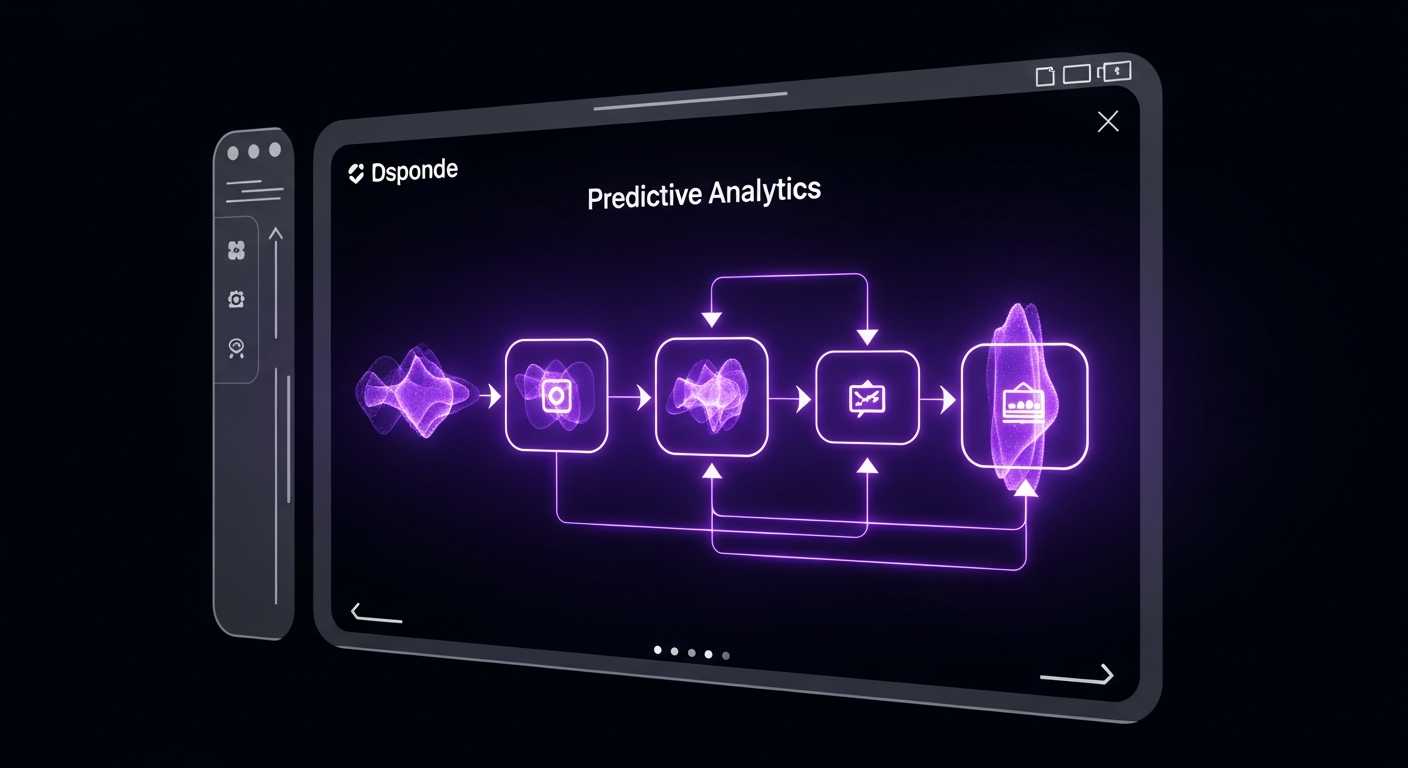
Embarking on a predictive analytics journey can seem daunting, but it can be broken down into a manageable, logical process. Success depends less on having the most complex algorithms and more on having a clear strategy, clean data, and a focus on solving specific business problems. Following a structured approach ensures that your efforts are aligned with business goals and that you build a scalable, effective capability over time.
Before writing a single line of code or evaluating any software, start with the business. What specific problem are you trying to solve or what opportunity are you trying to capture? A vague goal like “we want to use AI” is destined to fail. A clear objective is actionable and measurable. Examples of strong objectives include:
Once you have an objective, define the Key Performance Indicators (KPIs) you will use to measure success. This initial step provides focus and ensures that your predictive model will deliver real business value.
This is the foundational and often most challenging step. As outlined earlier, you need to identify and gather all relevant data sources. This typically involves breaking down data silos and integrating information from your CRM, web analytics, transactional systems, and marketing platforms into a centralized repository like a data warehouse or customer data platform (CDP). The next crucial phase is data preparation. This involves cleaning the data to handle errors and inconsistencies, transforming it into a usable format, and engineering features—creating new input variables from existing data that can help the model make better predictions.
With a clear objective and a clean dataset, you can now select the right predictive model. The choice of algorithm depends on your goal. If you’re predicting a binary outcome (e.g., churn/no churn), you might use logistic regression or a random forest. If you’re forecasting a continuous value (e.g., customer spend), linear regression might be appropriate. Using your prepared historical data, you’ll train the model, allowing it to learn the patterns that connect your input variables to the outcome you want to predict. This is followed by a rigorous evaluation phase where you test the model’s accuracy on a separate set of data it has never seen before.
A successful model isn’t one that sits on a data scientist’s laptop; it’s one that’s integrated into your business processes. Deployment involves putting the model into a live environment where it can make real-time or batch predictions on new data. For example, a lead scoring model would be integrated with your CRM to score new leads as they come in. The work doesn’t end at deployment. You must continuously monitor the model’s performance to ensure its predictions remain accurate. Over time, customer behavior changes, and the model will need to be retrained with fresh data to adapt and maintain its effectiveness.

The market for predictive analytics tools has matured significantly, offering a range of options for businesses of all sizes and technical capabilities. The right choice depends on your budget, the skills of your team, and your existing technology stack. The options generally fall into three main categories: integrated marketing clouds, standalone platforms, and open-source libraries.
Major marketing technology providers like Salesforce (with its Einstein AI), Adobe (with Sensei), and HubSpot have integrated predictive capabilities directly into their platforms. These tools are often the easiest entry point for marketing teams.
There are numerous specialized platforms designed specifically for building and deploying machine learning models. Tools like DataRobot, Alteryx, and SAS offer powerful, often low-code or no-code, environments for creating sophisticated predictive models.
For organizations with in-house data science talent, open-source libraries offer the ultimate in flexibility and power. Programming languages like Python (with libraries such as Scikit-learn, TensorFlow, and PyTorch) and R are the industry standard for custom model development.
| Feature | Open-Source Solutions (e.g., Python, R) | Commercial Solutions (e.g., Salesforce, DataRobot) |
|---|---|---|
| Cost | No licensing fees for the software itself. | Often significant subscription or licensing fees. |
| Flexibility | Complete control and customization over algorithms and processes. | Limited to the features and models provided by the vendor. |
| Required Skills | Requires deep expertise in programming, statistics, and machine learning. | Often designed for business users and analysts with user-friendly interfaces. |
| Support | Relies on community forums and documentation. | Comes with dedicated customer support, training, and professional services. |
| Speed to Value | Can be slower to implement due to the need for custom development. | Designed for faster deployment and quicker time to initial results. |

While the benefits of predictive analytics are immense, the path to successful implementation is not without its challenges. Being aware of these common pitfalls can help organizations plan more effectively and avoid costly mistakes. Proactively addressing these issues is key to building a sustainable and impactful predictive marketing program.
This is arguably the most common and significant hurdle. Many organizations suffer from data silos, where customer information is fragmented across dozens of disconnected systems (CRM, email platform, e-commerce, etc.). Without a unified view of the customer, building an accurate model is impossible. Furthermore, the data within these systems is often inconsistent, incomplete, or inaccurate. Addressing this requires a concerted effort in data governance, the implementation of a central data repository like a Customer Data Platform (CDP), and a commitment to ongoing data hygiene processes.
Predictive analytics requires a unique blend of skills that bridge marketing, data analysis, and computer science. Many marketing teams lack in-house data scientists or analysts with experience in machine learning. This skills gap can be a major barrier. Organizations can address this by:
A predictive model is only as good as the data it’s trained on. If historical data contains biases, the model will learn and often amplify them. For example, if a past sales process unintentionally favored one demographic, a lead scoring model trained on that data will perpetuate the bias, unfairly scoring down leads from other demographics. This is not only unethical but also bad for business, as it can lead to missed opportunities. To avoid this, it’s crucial to audit data for potential biases, ensure models are tested for fairness across different segments, and maintain human oversight to question and validate the model’s outputs.

The field of predictive analytics is evolving at a breathtaking pace, driven by advances in artificial intelligence and machine learning. Marketers who keep an eye on emerging trends will be best positioned to capitalize on the next wave of innovation. The future promises even more powerful, automated, and integrated predictive capabilities that will further blur the lines between data science and marketing execution.
The rise of Generative AI, exemplified by models like GPT-4, is set to revolutionize predictive marketing. The future lies in the synergy between predictive and generative models. A predictive model might identify a customer segment at high risk of churn and forecast that a 20% discount offer is the most effective retention tool. A generative AI model could then instantly write a personalized email to that segment, incorporating the offer with empathetic language tailored to the customer’s known pain points. This combination will enable the automated creation of hyper-personalized campaign assets at an unprecedented scale.
Historically, many predictive models operated in batches, with scores and predictions updated daily or weekly. The trend is moving rapidly towards real-time prediction. This means a customer’s behavior on a website during a single session can be used to generate instant, on-the-fly predictions. This allows for dynamic personalization where the website content, product recommendations, and offers can change in real-time to match the user’s immediate intent. This real-time capability will be crucial for delivering truly seamless and responsive customer experiences across all digital touchpoints.
The ultimate future of predictive marketing is for its insights to break out of the marketing department silo and inform the entire business strategy. A churn prediction model doesn’t just help marketing; its insights into why customers are leaving can be invaluable for the product development team. Customer Lifetime Value forecasts can inform financial planning and corporate strategy. Lead scoring insights can help shape sales training and territory planning. In the future, a central predictive insights engine will serve multiple departments, creating a truly data-driven organization where customer-centric decisions are made collaboratively across the entire company.
As marketers gain more power to predict and influence customer behavior, a discussion of the ethical implications and the paramount importance of data privacy is essential. The goal of predictive analytics should be to create better, more relevant experiences for customers, not to manipulate them. Building and maintaining customer trust is the foundation of any sustainable business, and this requires a responsible and transparent approach to using data.
There is a fine line between a personalized offer that feels helpful and an interaction that feels intrusive or “creepy.” Customers are increasingly aware of how their data is being used and value their privacy. The key to striking the right balance is transparency and control. Marketers should be clear about what data they are collecting and how they are using it to improve the customer’s experience. Furthermore, customers should be given easy-to-use controls to manage their data and preferences, including the ability to opt-out of certain types of personalization. The best personalization feels like great service, not surveillance.
Data privacy is no longer just an ethical consideration; it is a legal requirement. Regulations like the General Data Protection Regulation (GDPR) in Europe and the California Consumer Privacy Act (CCPA) have established strict rules for how companies must collect, store, process, and protect personal data. These regulations grant consumers specific rights, such as the right to access their data and the right to have it deleted. Any predictive analytics initiative must be built on a foundation of compliance. This means ensuring that data is collected with proper consent, that it is used only for the stated purposes, and that robust security measures are in place to protect it. Failure to comply can result in severe financial penalties and irreparable damage to a brand’s reputation.
Predictive analytics represents a monumental shift in the field of marketing, moving it from an art based on intuition to a science grounded in data. By forecasting future customer behaviors and trends, it empowers marketers to make smarter, more strategic decisions that drive measurable results. From hyper-personalizing the customer journey and optimizing ad spend to proactively retaining valuable customers, the applications are as vast as they are impactful.
The journey to adopting predictive analytics may seem complex, but it is an accessible and necessary evolution for any modern business. By starting with clear business objectives, focusing on building a foundation of high-quality data, and choosing the right tools for your team’s capabilities, you can unlock this powerful new capability. The ultimate goal is not just to predict the future, but to actively shape it—creating better experiences for your customers and driving sustainable growth for your business. In an increasingly competitive world, predictive analytics is no longer a luxury for the few; it is the marketing superpower that will define the leaders of tomorrow.