




In digital marketing, a well-defined strategy is the bedrock of sustainable growth. Central to this strategy is the marketing funnel, a framework that visualizes the customer’s journey from their first interaction with your brand to becoming a loyal advocate. It acts as a roadmap, guiding potential customers through a series of steps designed to build trust and move them closer to a purchase. Without this structured approach, marketing efforts can be disjointed, leading to wasted resources and missed opportunities.
A marketing funnel, sometimes used interchangeably with a sales funnel, is a model illustrating the theoretical path consumers follow from brand awareness to purchase. The term “funnel” is used because the number of people at the top is large but gradually narrows as they move through the stages. Not everyone who discovers your brand will become a customer, which is expected. The funnel’s purpose is to help you understand this process, identify where potential customers disengage, and optimize each stage to maximize conversions.
The power of the marketing funnel lies in its ability to bring structure and measurability to your marketing activities. It allows you to segment your audience based on their stage in the journey and deliver the right message at the right time. For example, a prospect who has never heard of you needs educational content that addresses their problems, not a hard sales pitch. Conversely, a lead who has downloaded a case study is likely ready for a more direct offer. The funnel provides the clarity needed to execute these targeted communications, ultimately improving lead quality, increasing conversion rates, and boosting your return on investment (ROI).
[[INNER_IMAGE]]
The concept of a purchase funnel is not new. Its origins trace back to 1898 with E. St. Elmo Lewis’s AIDA model, a foundational principle in advertising and marketing. AIDA stands for Awareness, Interest, Desire, and Action. This simple, linear model described a four-step process: grab the consumer’s attention, pique their interest in the product, create a desire for it, and finally, prompt them to take action. For over a century, the AIDA model served as the primary framework for understanding customer acquisition.
However, the modern customer journey is far more complex and non-linear than it was in Lewis’s time. The rise of the internet, social media, and content marketing has empowered consumers with vast amounts of information. They no longer follow a predictable, straight path. They might discover a brand on Instagram, read reviews on a third-party site, watch a YouTube tutorial, and then visit the company blog before ever considering a purchase. This new reality exposed the limitations of the traditional, transaction-focused funnel.
In response to this shift, the Flywheel concept, popularized by HubSpot, has gained significant traction. Unlike a funnel, which loses momentum at the bottom, a flywheel is designed to store and release energy, using the momentum of happy customers to drive referrals and repeat sales. The Flywheel model focuses on three phases: Attract, Engage, and Delight. By delighting customers, you turn them into advocates who, in turn, help attract new prospects, creating a self-sustaining cycle of growth. The modern five-stage marketing funnel explored in this guide is an evolution that incorporates the wisdom of both models. It extends beyond the initial purchase to include crucial post-sale stages like Loyalty and Advocacy, acknowledging that the customer relationship is the true engine of growth.
[[INNER_IMAGE]]
The Awareness stage, or Top of the Funnel (TOFU), is the widest part of your marketing funnel and your first introduction to potential customers. At this point, they are experiencing a problem or have a need and are beginning their search for a solution. They are not yet looking for specific brands; they are seeking information and answers. Your goal is not to sell but to help. By providing valuable, non-promotional content, you attract a broad audience and establish your brand as a helpful, authoritative resource.
The primary objective of the Awareness stage is to attract new visitors and make them aware of both their problem and potential solutions. You want to capture the attention of your target audience by addressing their pain points and questions. This is about building brand recognition and initial trust. Success at this stage means your brand becomes a familiar name associated with a particular topic, making them more likely to engage further as they move down the funnel.
To reach a wide audience in the TOFU stage, you must be present where they are searching for information. Tactics focus on broad-reach, high-value content. Key strategies include:
Measuring success at the Awareness stage is about reach and engagement, not sales. You need to track metrics that indicate how many people you are attracting and whether they find your content valuable.
| Metric | Description | Why It Matters |
|---|---|---|
| Website Traffic | The total number of visitors to your site, particularly to your blog and informational pages. | Indicates the overall size of the audience you are attracting. |
| Impressions & Reach | The number of times your content is displayed (impressions) and the number of unique people who see it (reach). | Measures the effectiveness of your social media and ad campaigns in capturing attention. |
| Keyword Rankings | Your position in search engine results pages (SERPs) for target keywords. | Shows how visible your brand is to people actively searching for information. |
| New Users | The number of first-time visitors to your website. | Helps differentiate new audience growth from returning visitors. |
| Bounce Rate | The percentage of visitors who leave your site after viewing only one page. | A high bounce rate can indicate that your content isn’t relevant or engaging enough to prompt further exploration. |
[[INNER_IMAGE]]
Once you capture someone’s attention, they move into the Middle of the Funnel (MOFU), the Interest and Consideration stage. At this point, the prospect is no longer a stranger; they are a lead. They have identified their problem and are now actively researching and comparing potential solutions. They have moved from asking, “What is my problem?” to “What are the possible solutions to my problem?” Your brand is now one of the options they are evaluating.
The primary goal during the Consideration stage is lead nurturing. Your objective is to build a deeper relationship with your leads, educate them on why your specific solution is the best fit, and establish your brand as the leading authority. This stage is about demonstrating value and building trust by providing in-depth, targeted content that helps them evaluate their options. This is where you transform a passive visitor into an engaged, qualified lead.
Content at the MOFU stage should be more specific and solution-oriented than TOFU content. It often requires the user to provide contact information in exchange for access, officially converting them into a lead. Effective strategies include:
At the MOFU stage, your metrics shift from broad reach to specific engagement and lead generation. You are measuring how effectively you convert anonymous visitors into known leads and nurture them toward a decision.
| Metric | Description | Why It Matters |
|---|---|---|
| Lead Generation Rate | The percentage of website visitors who convert into leads by filling out a form. | The primary indicator of your MOFU content’s effectiveness at capturing interest. |
| Email Open & Click-Through Rates (CTR) | The percentage of recipients who open your nurture emails and click on a link within them. | Measures how engaged your leads are with your email marketing efforts. |
| Content Downloads | The number of times your gated assets (e.g., white papers, case studies) are downloaded. | Shows which topics and formats are most compelling to your audience. |
| Cost Per Lead (CPL) | The total marketing spend divided by the number of new leads generated. | Helps you understand the efficiency of your lead generation campaigns. |
| Lead-to-Marketing Qualified Lead (MQL) Rate | The percentage of leads that meet specific criteria and are deemed ready for the sales team. | Indicates the quality of the leads you are generating. |
[[INNER_IMAGE]]
The Bottom of the Funnel (BOFU) is the final stage before a prospect becomes a customer. In this decision-making phase, leads are highly qualified and have a clear intent to buy. Having done their research, they are ready to make a final choice. They are no longer asking, “What are my options?” but rather, “Is this specific product the right choice for me?” Your marketing efforts must be highly targeted, persuasive, and designed to overcome final objections and simplify the path to purchase.
The singular goal of the BOFU stage is to drive a purchase. All activities focus on converting a marketing qualified lead (MQL) or sales qualified lead (SQL) into a paying customer. This involves demonstrating your product’s unique value, building confidence in the purchase decision, and creating a sense of urgency. You need to prove that your solution is not just a good option but the best option for their specific problem.
At the bottom of the funnel, your tactics should be product-focused and offer direct proof of your value proposition. These high-intent offers help bridge the final gap between consideration and purchase:
BOFU metrics are directly tied to sales and revenue. They measure the ultimate effectiveness of your entire marketing and sales process.
| Metric | Description | Why It Matters |
|---|---|---|
| Conversion Rate | The percentage of leads or website visitors who complete a desired action (e.g., make a purchase, sign up for a trial). | The ultimate measure of your funnel’s success in generating customers. |
| Customer Acquisition Cost (CAC) | The total cost of sales and marketing to acquire one new customer. | A critical metric for understanding the profitability and scalability of your business model. |
| Sales Volume / Revenue | The total number of sales or revenue generated over a specific period. | The top-line indicator of business performance. |
| Trial/Demo Sign-up Rate | The percentage of leads who request a demo or start a free trial. | A key indicator of purchase intent and the effectiveness of your BOFU offers. |
| Shopping Cart Abandonment Rate | For e-commerce, the percentage of users who add items to a cart but do not complete the purchase. | Highlights friction in the final checkout process that needs to be optimized. |
[[INNER_IMAGE]]
Many traditional marketing funnels end the moment a purchase is made—a shortsighted view in today’s competitive landscape. The most successful businesses understand that acquiring a customer is just the beginning. The Loyalty and Retention stage is where you turn a one-time buyer into a repeat customer and a long-term asset. This stage focuses on delivering an exceptional post-purchase experience that validates their decision and encourages them to continue doing business with you.
The funnel must extend beyond conversion because retaining an existing customer is significantly more cost-effective than acquiring a new one. Studies consistently show that it can cost five times more to attract a new customer than to keep an existing one. Furthermore, loyal customers tend to spend more over time, increasing their Customer Lifetime Value (CLV). A strong retention strategy creates a stable revenue base and provides a buffer against market fluctuations. Ignoring this stage means you are constantly refilling a leaky bucket, a costly and unsustainable approach to growth.
Loyalty is not built by accident; it’s the result of a deliberate, consistent effort to provide value after the sale is complete. Trust is solidified when you meet and exceed expectations. This involves a seamless onboarding process, proactive communication, and responsive customer support. When customers feel valued and supported, they are more likely to forgive minor issues, try new products you offer, and remain customers for the long haul. This ongoing relationship is the foundation upon which brand advocacy is built.
[[INNER_IMAGE]]
The final and most powerful stage of the modern marketing funnel is Advocacy. This is where the flywheel concept truly comes to life. In this stage, your loyal, satisfied customers become an extension of your marketing team. They actively promote your brand to their networks, not because they are paid to, but because they genuinely believe in your product. Brand advocates provide the most authentic and effective form of marketing: word-of-mouth. Their unsolicited praise can have a massive impact on your growth, creating a virtuous cycle that feeds new prospects back into the top of your funnel.
The transition from a loyal customer to a brand advocate occurs when an experience is so positive that they feel compelled to share it. This doesn’t happen automatically. While a great product is a prerequisite, you can actively encourage this behavior by creating opportunities for customers to share their stories. This means going beyond satisfaction to create moments of delight—unexpected gestures, exceptional service, or results that far exceed their expectations. When you make a customer feel like a hero, they will want to tell others about it.
To cultivate advocacy, you need to make it easy for customers to spread the word. This involves implementing structured programs and simple prompts:
A strong advocacy program has a profound impact. It directly reduces your Customer Acquisition Cost (CAC), as referrals are often the highest-converting and lowest-cost source of new leads. It builds a powerful moat of social proof around your brand, making it more difficult for competitors to win over your audience. Most importantly, it fuels a sustainable growth loop. Each new advocate brings in more prospects at the Awareness stage, who then travel through the funnel, with a percentage becoming advocates themselves. This exponential, customer-powered growth is the ultimate goal of a well-optimized marketing funnel.
[[INNER_IMAGE]]
A marketing funnel is a theoretical framework, but its real power is unlocked when you map it to the actual journey your customers take. A Customer Journey Map is a visualization of the process a person goes through to accomplish a goal with your company. By creating this map, you can gain a deep understanding of your customers’ thoughts, feelings, and pain points at each stage, allowing you to align your marketing efforts with their needs precisely.
The process begins with developing detailed buyer personas—semi-fictional representations of your ideal customers based on market research and real data. A good persona includes demographics, goals, challenges, and motivations. Once you have your personas, you can map their specific journey. For each stage of the funnel, identify the key touchpoints where they interact with your brand. What questions are they asking? What channels are they using? What are their primary concerns?
By answering these questions, you can tailor your content, messaging, and calls-to-action to be maximally effective at each step. For example, a persona in the Awareness stage might search for “how to improve team productivity” on Google. Your journey map would identify this touchpoint and prescribe creating a blog post titled “10 Tips for Boosting Team Productivity.” A persona in the Conversion stage might wonder about implementation support. Your map would highlight the need for a clear FAQ on your pricing page and a prominent call-to-action for a free consultation. This alignment ensures a seamless and relevant experience, dramatically increasing the likelihood they will move to the next stage.
| Funnel Stage | Customer Actions | Customer Thoughts/Questions | Brand Touchpoint/Content |
|---|---|---|---|
| Awareness | Searches “project management tips for small teams” on Google. Reads a few blog posts. | “My team is so disorganized. How can we manage our projects better?” | SEO-optimized blog post: “The Ultimate Guide to Project Management for Small Teams.” |
| Consideration | Sees a CTA in the blog post, downloads an ebook on “Choosing the Right PM Tool.” Receives a follow-up email. | “Software seems like a good solution. Which one is best for us? What features do we need?” | Gated ebook with comparison checklist. Email nurture sequence with case studies. |
| Conversion | Visits the pricing page. Watches a product demo video. Signs up for a free trial. | “This looks promising and the price is right. Is it easy to use? Will it integrate with our other tools?” | Clear pricing page, on-demand demo video, frictionless free trial sign-up. |
| Loyalty | Receives onboarding emails. Contacts support with a question and gets a fast response. | “This is great! I’m glad we chose this. How do I use the advanced features?” | Automated onboarding sequence, responsive customer support, user community/knowledge base. |
| Advocacy | Receives an email asking for a review after 3 months of successful usage. Tells a colleague about the tool. | “I love this product. It’s made our lives so much easier. I should tell others about it.” | Automated review request email. In-app prompt to join referral program. |
[[INNER_IMAGE]]
Executing a multi-stage marketing funnel strategy requires a robust set of tools to automate processes, gather data, and optimize performance. Manually managing every lead through each stage is not scalable. A well-curated marketing technology (MarTech) stack is essential for building, managing, and analyzing your funnel effectively. These tools can be broadly categorized into three key areas: CRM and automation, analytics and user behavior, and lead capture and email marketing.
Customer Relationship Management (CRM) and marketing automation platforms are the central nervous system of your funnel. A CRM stores all your customer and lead data, while automation platforms execute workflows based on user behavior. Together, they allow you to deliver personalized experiences at scale.
You cannot optimize what you cannot measure. Analytics tools are crucial for understanding how users interact with your website and campaigns, while heatmap tools provide visual data on where they click, scroll, and focus their attention. This data helps you identify friction points and areas for improvement in your funnel.
These tools are focused on the top and middle of the funnel. Lead capture tools help you convert anonymous website visitors into leads with pop-ups, forms, and other interactive elements. Email marketing platforms are then used to communicate with and nurture these leads until they are ready to buy.
[[INNER_IMAGE]]
Building a marketing funnel is both an art and a science, and even experienced marketers can make mistakes that hinder performance. Being aware of these common pitfalls is the first step toward avoiding them. An ineffective funnel can lead to wasted ad spend, low conversion rates, and frustrated teams. By proactively addressing these issues, you can ensure your funnel operates as a smooth, efficient engine for growth.
[[INNER_IMAGE]]
A high-performing marketing funnel is not a “set it and forget it” project. It is a dynamic system that requires continuous monitoring, testing, and refinement. The market changes, customer behaviors evolve, and new competitors emerge. To maintain and improve your results, you must treat funnel optimization as an ongoing process. This commitment to continuous improvement is what separates good marketers from great ones and is the key to maximizing your return on investment.
The core of funnel optimization is data-driven decision-making. Start by analyzing your metrics to identify the biggest areas of opportunity. Where is the most significant drop-off occurring? Is it the conversion from visitor to lead (TOFU to MOFU), or from lead to customer (MOFU to BOFU)? Once you identify a weak point, form a hypothesis about why it is underperforming. For example, “I believe the conversion rate on our landing page is low because the headline is not compelling enough.”
With a hypothesis in hand, you can begin A/B testing. This involves creating a variation of a page or email (e.g., with a new headline or a different CTA button color) and testing it against the original to see which one performs better. This discipline, known as Conversion Rate Optimization (CRO), allows you to make incremental, data-backed improvements that can have a substantial cumulative impact on your funnel’s performance. By constantly testing, learning, and iterating, you transform your funnel from a static model into a powerful, adaptive growth engine.
[[INNER_IMAGE]]
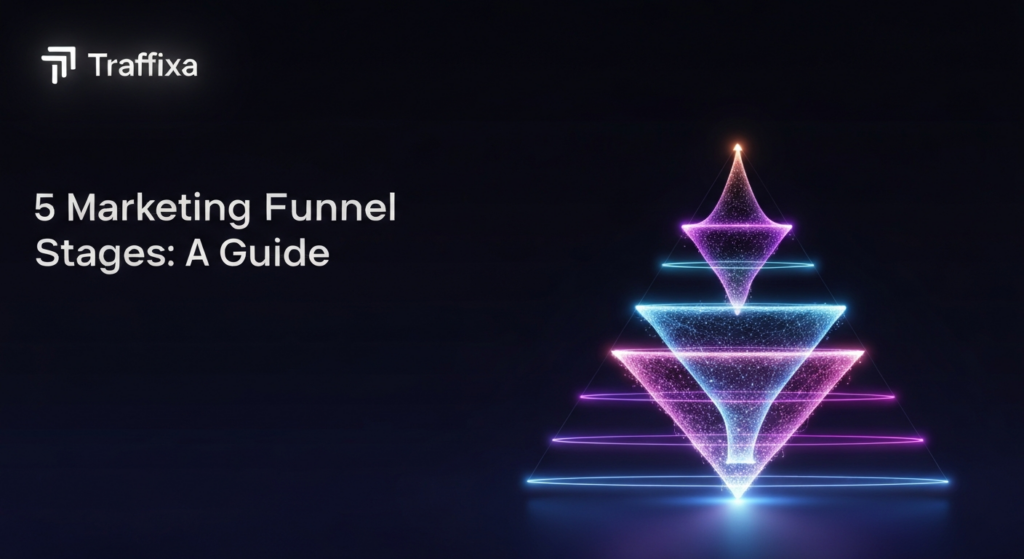
The 5 modern stages of a marketing funnel are: 1. Awareness, where prospects first learn about your brand; 2. Interest & Consideration, where they research solutions and evaluate your brand; 3. Conversion, where they make a purchase decision; 4. Loyalty, where you nurture them into repeat customers; and 5. Advocacy, where satisfied customers actively promote your brand to others.
The terms are often used interchangeably, but there is a subtle distinction. A marketing funnel encompasses the entire customer journey, from initial awareness to brand advocacy, focusing on generating and nurturing leads. A sales funnel is typically a subset of the marketing funnel, focusing on the later stages where a qualified lead is passed to the sales team. It covers the specific steps a salesperson takes to close a deal, such as demos, proposals, and negotiations.
The success of a marketing funnel is measured by tracking key performance indicators (KPIs) at each stage. Overall success is often judged by metrics like Customer Acquisition Cost (CAC), Customer Lifetime Value (CLV), and the overall visitor-to-customer conversion rate. It is also crucial to measure micro-conversions between stages, such as visitor-to-lead and lead-to-customer rates, to identify and fix leaks.
While every stage is critical to a healthy funnel, no single stage is the “most” important. A funnel is a connected system, and a weakness in any one stage will impact the entire process. However, many modern marketers emphasize the post-purchase stages of Loyalty and Advocacy because retaining customers and turning them into promoters creates a sustainable, cost-effective growth loop that is more powerful than focusing solely on top-of-funnel acquisition.
Yes, absolutely. It’s common and often necessary for a business to have multiple marketing funnels. You might have different funnels for different products, services, or customer segments. For example, a software company might have one funnel to attract enterprise clients (which is longer and more high-touch) and another funnel for individual self-serve users (which is more automated and low-touch).
A classic example is Dropbox. For Awareness, they relied heavily on PR and word-of-mouth. For Consideration and Conversion, they offered a simple, powerful free plan (a freemium model) that allowed users to experience the product’s value directly. Their masterstroke was in the Loyalty and Advocacy stages: they built a referral program directly into the product, offering both the referrer and the new user extra free storage. This created a viral loop that fueled explosive growth, turning their user base into a massive, motivated sales force.