



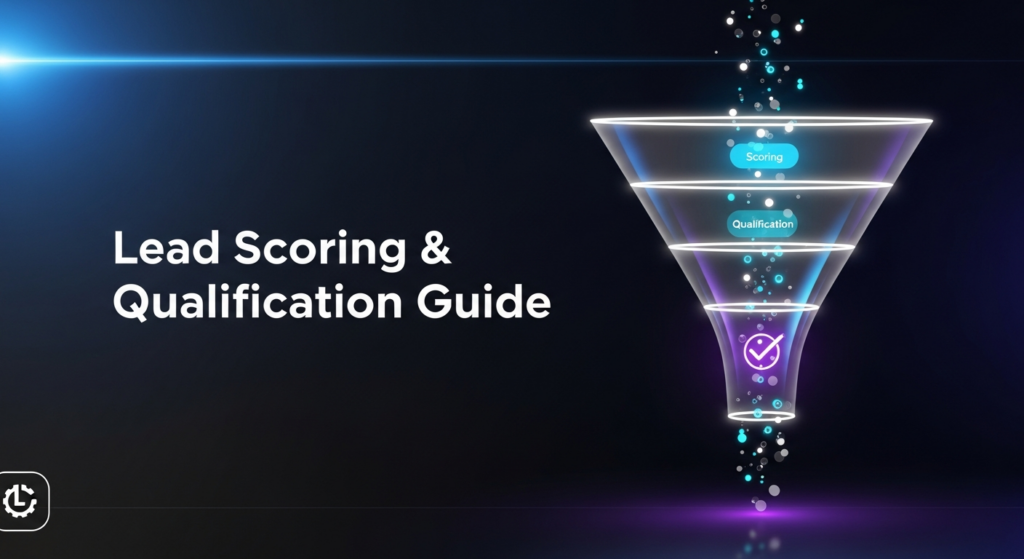

In a competitive market, generating leads is only half the battle. The real challenge lies in identifying which leads are most likely to become customers. Sales teams are often inundated with contacts, but their time is a finite, valuable resource. Wasting it on unqualified prospects hurts morale and directly impacts the bottom line. This is where a systematic approach to lead management becomes essential. By implementing a robust lead scoring and qualification process, you can transform your sales funnel from a wide net into a streamlined, efficient pipeline.
This guide will walk you through every aspect of building and maintaining a powerful lead management system. We will explore the fundamental concepts of lead scoring and qualification, detail the steps to create a custom model, examine popular frameworks, and discuss best practices for long-term success. By the end, you will have the knowledge and tools to align your sales and marketing teams, shorten your sales cycle, and significantly boost conversion rates.

At its core, lead scoring is a methodology used to rank prospects on a scale representing their perceived value to your organization. Instead of treating every lead as equal, this system assigns points based on various attributes and behaviors, creating a hierarchy of priority. For instance, a lead who has visited your pricing page multiple times and downloaded a case study is more valuable in that moment than someone who simply subscribed to a newsletter. Lead scoring quantifies this difference, allowing your team to focus its energy where it will have the greatest impact.
In modern sales and marketing, lead scoring is an automated process, typically managed within a Customer Relationship Management (CRM) or marketing automation platform. It assigns positive or negative point values to leads based on specific criteria. These criteria fall into two main categories: explicit data, such as information provided on a form (job title, company size), and implicit data, which is behavioral information tracked by your systems (website visits, email opens). A lead’s cumulative score determines their rank. When a lead reaches a predetermined threshold, they are flagged as a Marketing Qualified Lead (MQL), signaling that they are ready for sales engagement.
The primary benefit of lead scoring is a significant boost in efficiency. Without a scoring system, sales representatives often follow up on leads chronologically or based on intuition. This approach is highly inefficient and creates several problems. First, genuinely interested buyers ready to make a decision may be left waiting, potentially turning to a more responsive competitor. Second, sales reps can spend much of their day pursuing prospects who have little interest or are a poor fit for the product, which wastes time and can be demotivating. By implementing lead scoring, you ensure that your sales team consistently engages with the most promising leads first, maximizing productivity and dramatically increasing the chances of closing a deal.

While lead scoring is a powerful tool for identifying interest, it doesn’t tell the whole story. A high-scoring lead might be very engaged but still not be the right fit for your product. This is where lead qualification comes in. Qualification is the process of vetting leads to determine if they have a genuine need for your solution, the authority to purchase, and the budget to afford it. It is the crucial human element that validates the automated scoring process, separating true prospects from unqualified suspects.
Qualification is an ongoing conversation, not a one-time event. It begins the moment a sales development representative (SDR) or account executive first interacts with a lead. The goal is to dig deeper than the data provided by the scoring model. Through targeted questions, the sales rep confirms the lead’s challenges, goals, and decision-making power. This process ensures that sales reps invest significant time and resources only into opportunities with a realistic chance of closing. Effective qualification prevents the sales pipeline from being clogged with dead-end deals and allows the team to focus on building relationships with high-potential buyers.
It’s easy to confuse lead scoring and lead qualification, but they are distinct, complementary processes. Scoring measures a lead’s *interest level* and *fit* based on data, while qualification confirms that interest and fit through direct conversation. Scoring is quantitative and automated; qualification is qualitative and human-driven. A lead might have a high score because they are a competitor researching your content or a student working on a project. The qualification process uncovers this context, saving the sales team from a fruitless pursuit. Think of it this way: lead scoring tells you who to talk to *first*, while lead qualification tells you if you should *keep talking* to them.
| Aspect | Lead Scoring | Lead Qualification |
|---|---|---|
| Nature | Quantitative and automated | Qualitative and manual (human-driven) |
| Purpose | To measure a lead’s interest and rank them by priority | To verify a lead’s fit and readiness to buy |
| Method | Assigns points based on demographic, firmographic, and behavioral data | Uses conversational frameworks (like BANT or MEDDIC) to ask probing questions |
| Output | A numerical score that triggers an MQL status | A decision to advance the lead to an SQL status or disqualify them |
| Focus | Efficiency and prioritization at scale | Effectiveness and validation in one-on-one interactions |

When lead scoring and qualification work in harmony, they create a powerful engine for growth. This integrated system does more than organize leads; it fundamentally improves the performance of your entire revenue operation. The benefits are felt across departments, from marketing to sales, and ultimately translate into a healthier bottom line. By creating a clear, data-driven path from initial contact to a closed deal, you eliminate guesswork and foster a culture of efficiency and collaboration.
One of the most significant benefits of an integrated system is the alignment it creates between sales and marketing teams. Historically, these departments have often been at odds, with marketing complaining that sales doesn’t follow up on their leads and sales arguing that marketing leads are low quality. A shared lead scoring and qualification framework forces both teams to agree on a concrete definition of a “good lead.” Marketing becomes accountable for delivering MQLs that meet the agreed-upon criteria, and sales commits to following up within a certain timeframe via a Service Level Agreement (SLA). This shared language and accountability bridges the gap, fostering a collaborative relationship focused on generating revenue.
A direct consequence of improved alignment and efficiency is a significant increase in conversion rates. When sales reps are consistently fed high-quality, well-vetted leads, they can have more meaningful and productive conversations. They spend less time on prospects who are not a good fit and more time solving problems for interested buyers. This focus on quality over quantity means a higher percentage of initial conversations turn into qualified opportunities, and more of those opportunities convert into deals. This improvement at each stage of the funnel has a compounding effect, leading to substantial revenue growth.
The sales cycle is the average time it takes to close a deal, from initial contact to final signature. A long sales cycle can tie up resources and delay revenue. An integrated lead management system helps shorten this cycle in several ways. First, by prioritizing the hottest leads, you engage with buyers at the peak of their interest when they are most motivated to decide. Second, the qualification process ensures that sales reps aren’t wasting weeks or months nurturing a lead who lacks the budget or authority to purchase. By focusing exclusively on viable opportunities, the entire process accelerates, allowing your team to close deals faster.

Creating a lead scoring model can be broken down into a logical, step-by-step process. The key is to start with a clear understanding of your best customers and the behaviors that indicate strong buying intent. A successful model is not built in a vacuum; it requires collaboration between sales and marketing to ensure the criteria are relevant and the point values accurately reflect a lead’s potential. This initial investment of time and effort will pay dividends in the form of a more efficient and predictable sales pipeline.
Before you can score leads, you must know what a good lead looks like. This starts with defining your Ideal Customer Profile (ICP), a detailed description of the type of company that derives the most value from your product and provides the most value to your business. This is a firmographic definition, focusing on company attributes. Key elements of an ICP include:
Analyze your best current customers to identify common traits. Use this data to build a clear, concise ICP that will serve as the foundation of your scoring model.
With your ICP defined, you can identify the specific data points for scoring. These fall into two categories:
This is where the model takes shape. Assign a point value to each criterion based on how strongly it correlates with a lead becoming a customer. High-intent actions should receive more points than low-intent ones. For example:
Similarly, assign points for demographic and firmographic data based on your ICP. A C-level executive might get +20 points, while a student gets 0 or a negative score. The goal is to create a system where a lead who fits your ICP and shows strong buying signals quickly accumulates enough points to reach the MQL threshold (e.g., 100 points).
An effective scoring model not only adds points but also subtracts them. Negative scoring is crucial for filtering out poor-fit leads and preventing inflated scores, which helps maintain the quality of MQLs. Common criteria for negative scores include:

Once a lead meets the MQL score threshold, it’s time for a sales representative to qualify them. This is a strategic conversation guided by a framework, not an unstructured chat. These frameworks provide a structured way to ask the right questions, ensuring every critical aspect of a potential deal is explored. Using a consistent framework across the team helps standardize the qualification process and provides a common language for evaluating opportunities.
Developed by IBM, BANT is the most traditional and widely known qualification framework. It’s simple, memorable, and covers the four classic pillars of a sales deal:
While effective for straightforward sales processes, some find BANT too rigid and seller-centric for the modern, buyer-empowered world.
For more complex, high-value enterprise sales, the MEDDIC framework offers a more robust and detailed approach. It compels reps to dig deeper into the customer’s organization and decision-making process.
Beyond BANT and MEDDIC, several other frameworks have gained popularity, each offering a slightly different perspective on qualification.
| Framework | Acronym Stands For | Best For |
|---|---|---|
| CHAMP | Challenges, Authority, Money, Prioritization | A modern alternative to BANT that leads with the customer’s challenges rather than the seller’s need for a budget. |
| GPCTBA/C&I | Goals, Plans, Challenges, Timeline, Budget, Authority, Negative Consequences, and Positive Implications | A comprehensive framework from HubSpot, designed for complex, consultative sales where the rep acts as an advisor. |
The right framework depends on your sales process, market, and product complexity. The key is to choose one, train your team on it, and apply it consistently.
[[INNER_IMAGE]]
The transition of a lead from marketing to sales is a critical moment in the customer acquisition process. To manage this handoff effectively, it’s essential to have clear, universally understood definitions for each stage of the lead lifecycle. The two most important definitions are Marketing Qualified Lead (MQL) and Sales Qualified Lead (SQL). These labels represent key milestones that signify a lead’s progression through the sales funnel.
A Marketing Qualified Lead (MQL) is a lead who has shown significant engagement with your marketing efforts and, based on your lead scoring model, is deemed ready for a sales conversation. The MQL threshold is the specific score a lead must reach to be passed to sales. For example, your organization might decide that any lead with a score of 100 or more is an MQL. This status indicates that marketing has attracted and nurtured the lead to a point of demonstrated interest. They fit the basic demographic profile and have taken actions suggesting they are actively exploring a solution.
A Sales Qualified Lead (SQL) is an MQL that a sales representative has vetted and accepted as a legitimate, viable sales opportunity. This transition from MQL to SQL occurs after the sales rep conducts an initial qualification call. During this conversation, the rep uses a framework like BANT or MEDDIC to confirm that the lead has a real business need, the authority to buy, and a potential timeline for purchase. If the lead meets these criteria, the rep formally accepts them, converting them to an SQL and moving them into the active sales pipeline. If not, the lead is either disqualified or sent back to marketing for further nurturing.
A seamless handoff is vital for success, as a breakdown at this stage can lead to lost opportunities and friction between teams. Best practices for managing the MQL-to-SQL handoff include:
[[INNER_IMAGE]]
Implementing a lead scoring and qualification system is not a one-time project but an ongoing process of refinement. Markets shift, customer needs evolve, and your products and messaging will change. A model that was effective last year might be outdated today. To ensure long-term success, you must commit to regularly maintaining your system through data analysis, clean data practices, and open communication.
Your lead scoring model should be a living document. Schedule regular reviews—at least quarterly—to analyze its performance. The most important analysis is to compare the scores of leads who became customers versus those who did not. Did your closed-won deals consistently have high scores? Did any low-scoring leads convert? This win/loss analysis will reveal which criteria are truly predictive of success and which might be over- or undervalued. Use these insights to adjust point values, add new criteria, or remove irrelevant rules.
The adage “garbage in, garbage out” is especially true for lead scoring. Your model is only as good as the data that fuels it. Inaccurate or incomplete data in your CRM can lead to mis-scored leads and missed opportunities. Implement processes to maintain data hygiene, such as standardizing data entry (e.g., using dropdowns instead of free text fields), regularly de-duplicating records, and using data enrichment tools to append missing information. Clean data ensures your scoring is accurate and your sales team has the correct context for their conversations.
While technology and data are critical, human collaboration remains the cornerstone of a successful lead management program. The feedback loop between sales and marketing must be constant and constructive. Sales reps are on the front lines, and their qualitative insights are invaluable. They can provide context that data alone cannot, such as emerging customer pain points or competitor messaging. Schedule regular meetings where sales can share feedback on lead quality and marketing can explain upcoming campaigns or changes to the scoring model. This partnership ensures the system remains aligned with real-world business dynamics.
[[INNER_IMAGE]]
While a well-executed lead management system can be transformative, several common pitfalls can derail your efforts. Being aware of these potential mistakes can help you navigate the implementation process more effectively. Avoiding these traps is key to building a system that your teams trust and that delivers consistent, measurable results.
The most common mistake is treating lead scoring as a “set it and forget it” initiative. A model built on last year’s data may not reflect your current market or ideal customer. Without regular review, your scoring accuracy will degrade over time, leading to poor-quality MQLs and a loss of trust from the sales team. You must commit to ongoing optimization to ensure the model remains relevant and effective.
In an effort to be perfectly precise, it’s easy to create a scoring model that is overwhelmingly complex. A model with hundreds of rules is difficult to manage, troubleshoot, and explain. Start simple. Identify the 10-15 most impactful attributes and behaviors and build your initial model around them. You can add more nuance later as you gather data. A simpler model that is well-understood and consistently applied is far more valuable than a complex one that no one trusts.
Ignoring feedback from your sales team is the fastest way to ensure your lead scoring program fails. If sales reps consistently report that MQLs are low quality, listen to them. Dive into specific examples. Is the scoring model flawed? Is there a misunderstanding of the MQL definition? Or is there a need for better sales training? Treating the sales team as a crucial partner and taking their feedback seriously is essential for building a system that everyone believes in. Their insights from real conversations are the ultimate validation of your model’s accuracy.
[[INNER_IMAGE]]
Manually scoring and tracking leads is not feasible at scale. Modern lead management relies on a technology stack designed to automate the process, provide deep insights, and ensure seamless integration between teams. Your CRM and Marketing Automation platform are the heart of this stack, working together to track behavior, apply scoring rules, and manage the handoff from MQL to SQL.
Most modern marketing automation platforms (like HubSpot, Marketo, or Pardot) include robust lead scoring capabilities. When evaluating a tool, look for these key features:
Tight integration between your systems is where the magic happens. Your marketing automation platform acts as the brain, tracking website visits, email opens, and form submissions, then applying scoring rules in real-time. When a lead reaches the MQL threshold, the integration automatically creates a task for a sales rep in the CRM, assigns the lead, and syncs all relevant data. The sales rep can then work the lead entirely within the CRM, and when they update the status to SQL, that information syncs back to the marketing platform. This closed-loop system provides full visibility into the entire funnel.
The next evolution in lead management is predictive lead scoring. Instead of having humans manually create rules and assign points, predictive models use machine learning and artificial intelligence (AI) to analyze historical data. The AI identifies complex patterns and attributes that your most successful customers had in common—often uncovering correlations a human would miss. It then builds a model that scores new leads based on their statistical probability of converting. This approach can be more accurate and dynamic than traditional rules-based scoring, representing the future of lead prioritization.
[[INNER_IMAGE]]
To justify the investment in your lead scoring and qualification program, you must measure its business impact. Tracking the right Key Performance Indicators (KPIs) will not only demonstrate ROI but also provide insights into what’s working and where there are opportunities for improvement. These metrics provide a clear, data-driven view of the health and efficiency of your sales funnel.
This is arguably the most important KPI for measuring the effectiveness of your lead management system. The MQL-to-SQL conversion rate is the percentage of MQLs that sales accepts as SQLs. A high conversion rate indicates that marketing is delivering high-quality leads and that the scoring model is accurately identifying sales-ready prospects. A low or declining rate is a red flag signaling a misalignment between sales and marketing or a flaw in the scoring criteria. This metric is a direct measure of lead quality.
Lead Velocity Rate (LVR) measures the period-over-period growth in the number of qualified leads in your pipeline. It’s a powerful predictor of future revenue. Instead of just looking at the absolute number of leads, LVR focuses on the growth rate (e.g., “Our number of SQLs grew by 10% this month compared to last month”). A healthy LVR indicates that your sales pipeline is not just full but expanding, which is a leading indicator of future sales growth. It shows that your marketing and sales engine is successfully generating an increasing number of qualified opportunities over time.
The ultimate goal of a business is not just to acquire customers, but to acquire the *right* customers—those who are profitable and loyal. A sophisticated way to measure your lead management program is to analyze its impact on Customer Lifetime Value (CLV). By tracking cohorts of customers over time, you can determine if leads that came through your refined scoring and qualification process have a higher CLV than those acquired before the system was in place. Do they buy more, stay longer, or have higher satisfaction rates? Connecting your lead management efforts to long-term customer value provides the most powerful evidence of its strategic importance.