






In digital marketing, your technology stack is your arsenal, comprising tools for analytics, email automation, social media, and customer relationship management (CRM). At the center of this ecosystem is the Content Management System (CMS). More than a simple publishing platform, your CMS is the foundation of your digital presence. It dictates your efficiency in creating and managing content, your effectiveness in optimizing for search engines, and your ability to deliver personalized experiences.
Consider your CMS the engine of your digital marketing strategy. A powerful, flexible engine enables agility, rapid testing of new ideas, and frictionless scaling. It empowers content creators, streamlines workflows, and integrates smoothly with other marketing tools to create a cohesive, results-driven system. Conversely, an outdated or ill-fitting CMS becomes a bottleneck. It stifles creativity with rigid templates, creates developer dependencies for simple updates, hinders SEO with poor technical architecture, and prevents you from delivering the dynamic user experience modern consumers expect.
The choice of a CMS has far-reaching consequences across every marketing function. It impacts website speed and Core Web Vitals—direct Google ranking factors. It determines your ability to implement personalization and A/B testing to optimize conversion rates. It also governs digital asset management, brand consistency, and user permissions for a growing team. In short, selecting the right CMS is not merely an IT decision; it is one of the most strategic marketing decisions you will make. It is an investment in your team’s productivity, your brand’s agility, and your company’s long-term growth.

Before you get dazzled by feature lists and vendor demos, the most crucial step in the CMS selection process is to look inward. A successful choice is not about finding the “best” CMS on the market, but about finding the best CMS for *your* specific needs, goals, and workflows. Rushing this foundational step is one of the most common mistakes marketers make, often leading to a costly mismatch between the tool and the team.
Your first task is to create a comprehensive map of your existing content landscape. This audit goes beyond simply listing your blog posts; it involves a deep analysis of everything you create, manage, and publish. Start by creating a content inventory, cataloging all your content types, such as web pages, landing pages, articles, case studies, white papers, videos, and product descriptions. For each type, document its purpose, target audience, and current performance metrics.
Next, analyze the pain points of your current system. Where are the bottlenecks? Do simple text edits require a developer? Is your team frustrated by a clunky user interface? Are you unable to integrate with a new marketing automation tool? Document these frustrations in detail. This audit provides a clear, data-backed picture of what works, what doesn’t, and which capabilities you are missing. This information will form the bedrock of your requirements list.
A CMS serves multiple audiences, both internal and external. To choose the right one, you must understand the needs of each group. Begin by mapping out your primary customer journeys. How do users discover your brand, engage with your content, and convert into leads or customers? Identify the key content touchpoints along this journey. This process helps define the functional requirements needed to support and optimize these paths, such as the ability to create dynamic landing pages or personalize content based on user behavior.
Simultaneously, identify all internal stakeholders who will interact with the CMS. This includes content creators, marketing managers, SEO specialists, developers, IT staff, and even sales teams who might use content from the website. Conduct interviews with each group to understand their specific needs, workflows, and frustrations. For example:
Compiling these diverse requirements ensures the chosen CMS will be adopted successfully across the organization and won’t just solve one department’s problems while creating new ones for another.
With a clear understanding of your current state and stakeholder needs, you can define what success will look like with a new CMS. Vague goals like “improve our website” are not helpful. Instead, use the SMART (Specific, Measurable, Achievable, Relevant, Time-bound) framework to create concrete objectives. These goals will serve as your north star during the evaluation process, helping you prioritize features and measure the ultimate ROI of your investment.
Examples of SMART goals for a CMS migration include:
Other examples could be “Improve our website’s Core Web Vitals scores to ‘Good’ for 95% of indexed pages within six months of launch” or “Increase marketing-qualified leads generated from organic traffic by 25% in the first year by leveraging improved SEO and personalization features.”

Once you have defined your requirements, you can begin evaluating platforms based on their feature sets. While every organization’s needs are unique, a set of core capabilities is non-negotiable for any modern digital marketing team. These features are the difference between a CMS that simply holds content and one that actively helps you grow your business.
Search Engine Optimization (SEO) is not an afterthought; it must be baked into the core of your CMS. A marketing-friendly CMS provides granular control over all critical on-page and technical SEO elements without requiring you to file a ticket with the development team. Key features to look for include:
Your content team will spend most of their time in the CMS editor, where a poor user experience can cause frustration and inefficiency. Prioritize a system with an intuitive interface, such as a block-based editor or a true What You See Is What You Get (WYSIWYG) visual builder. This empowers marketers to create complex, appealing layouts without writing code.
Beyond the editor, strong workflow management is essential for teams to collaborate effectively and maintain quality standards. Look for features like:
In today’s market, a one-size-fits-all approach to content is no longer effective. Your CMS should enable you to deliver personalized experiences that resonate with different audience segments. This could be as simple as changing a headline based on a visitor’s geographic location or as complex as showing entirely different content based on their past behavior or data from your CRM. Look for native personalization features or seamless integrations with third-party personalization engines.
Similarly, continuous improvement is the hallmark of a great marketing team. A/B testing is fundamental to this process. The ability to easily test variations of headlines, copy, images, and calls-to-action is crucial for optimizing conversion rates. A good CMS will have built-in A/B testing functionality or a one-click integration with leading testing platforms like Google Optimize, Optimizely, or VWO.
Your CMS does not operate in a vacuum. It is the hub of your martech stack and must communicate effectively with your other critical systems. The quality of its integrations will determine whether you have a streamlined, data-driven marketing machine or a collection of disconnected data silos. Before choosing a platform, map out all the tools you need to connect, including your:
Evaluate the depth and reliability of these integrations. Does the CMS offer pre-built connectors, or will you need to rely on a third-party service like Zapier or custom API development? A robust Application Programming Interface (API) is a must-have for ensuring you can build any custom integrations you might need in the future.

The underlying architecture of a CMS has a profound impact on its flexibility, performance, and suitability for different marketing strategies. The three primary models are traditional, headless, and hybrid. Understanding the differences is key to choosing a platform that aligns with your technical resources and omnichannel ambitions.
A traditional CMS, also known as a monolithic system, bundles the back-end (where content is created and stored) and the front-end (the design and presentation layer) into a single, tightly coupled application. When a user requests a page, the CMS retrieves the content from the database, combines it with a template, and delivers a fully rendered HTML page to the browser.
Platforms like WordPress and Drupal are classic examples. Their all-in-one nature makes them relatively straightforward to set up and manage, especially for standard websites. They offer vast ecosystems of themes and plugins, allowing non-developers to add functionality easily. However, this tight coupling can also be a limitation. Customizing beyond the provided templates can be difficult, and delivering content to non-website channels (like mobile apps or IoT devices) is often clunky or impossible.
A headless CMS completely decouples the back-end content repository (the “body”) from the front-end presentation layer (the “head”). It does not have a built-in front-end or templating system. Instead, it makes content available via an API. Developers are free to build any front-end they want, using any technology they prefer (like React, Vue, or Angular), and simply pull content from the CMS API.
This approach offers unparalleled flexibility and is ideal for omnichannel marketing. The same content from the CMS can be seamlessly delivered to a website, a mobile app, a smartwatch, a digital kiosk, or any other internet-connected device. This ensures brand consistency and efficiency. Headless architectures also tend to offer better performance and security, as the back-end and front-end are separated. The main drawback is the increased reliance on development resources to build and maintain the front-end experiences.
A hybrid CMS, sometimes called a decoupled CMS, seeks to offer the best of both worlds. It functions like a traditional CMS with its own front-end templating system, but it also provides a robust API for delivering content to other channels, just like a headless system. This allows marketers to use the familiar, built-in tools for managing the main website while developers can simultaneously use the API to power other digital experiences.
Newer versions of platforms like Drupal and even WordPress (with its REST API) can operate in a hybrid model. This approach provides a good balance, giving marketing teams the autonomy they are used to while still enabling the flexibility needed for more complex, multi-channel projects.
| Feature | Traditional (Monolithic) | Headless (API-First) | Hybrid (Decoupled) |
|---|---|---|---|
| Ease of Use for Marketers | High (WYSIWYG editors and visual builders are common) | Lower (Often lacks a visual preview of the final content) | High (Provides traditional editing experience for the website) |
| Developer Dependency | Low for standard tasks, high for major customizations | High (Front-end must be custom-built) | Moderate (Depends on the project’s needs) |
| Flexibility | Low (Tied to a specific front-end technology and templates) | Very High (Content can be delivered to any channel or device) | High (Supports both a native front-end and API delivery) |
| Performance | Good to Moderate (Can be slowed by plugins and themes) | Excellent (Optimized front-ends can be built for speed) | Good to Excellent (Performance depends on the implementation) |
| Omnichannel Support | Poor (Designed primarily for websites) | Excellent (Designed for multi-channel content delivery) | Good (Supports website and other channels via API) |

Alongside architecture, another critical decision is how the CMS will be hosted and maintained. The two primary models are Software as a Service (SaaS), where the vendor manages everything for you, and self-hosted, where you take on the responsibility for the software and infrastructure.
SaaS CMS platforms are cloud-based solutions that you access on a subscription basis. The vendor is responsible for all hosting, maintenance, security, and software updates. This model is incredibly popular because it simplifies the technical overhead and allows marketing teams to focus on marketing, not server management.
Benefits of SaaS:
Drawbacks of SaaS:
Examples include HubSpot CMS, Webflow, and many headless platforms like Contentful and Sanity.
A self-hosted CMS is one where you download the software (often free, in the case of open-source platforms) and install it on your own server or a hosting environment of your choice. This gives you complete control over every aspect of the platform and your website.
Benefits of Self-Hosted:
Drawbacks of Self-Hosted:
The most popular open-source, self-hosted platforms are WordPress.org and Drupal.
To make an informed decision between SaaS and self-hosted, you must look beyond the initial price tag and calculate the Total Cost of Ownership (TCO) over a 3-5 year period. A seemingly “free” open-source CMS is never truly free. Be sure to factor in all potential costs:
By mapping out these expenses for each option, you will get a much more accurate picture of the true financial investment required.

With your requirements defined and a clear understanding of the different types of CMS platforms, you can begin the process of shortlisting and evaluating specific vendors. A structured approach is essential to ensure you make an objective, data-driven decision.
The best way to compare different platforms objectively is with an evaluation scorecard. This is a spreadsheet that lists all of your key requirements, which you identified in Step 1. Assign a weight to each requirement based on its importance to your business (e.g., on a scale of 1 to 5, where 5 is critical). As you evaluate each vendor, score them on how well they meet each requirement.
Your scorecard should include categories like:
This weighted scoring system will help you move beyond gut feelings and compare vendors on an apples-to-apples basis, making your final decision much clearer and more defensible.
Never choose a CMS based on a marketing website and a features list alone. You must see the platform in action. Schedule live demos with your shortlisted vendors, but don’t let them drive the entire presentation. Come prepared with a list of specific use cases and scenarios that are relevant to your daily workflows. Ask them to show you exactly how you would accomplish these tasks in their system.
For example, ask them to demonstrate:
A hands-on free trial or a sandbox environment is even more valuable than a demo. Encourage key stakeholders—content creators, marketers, and developers—to spend time using the platform. This is the only way to truly assess its usability and power. Have them perform common tasks like building a page, creating content, or testing an API call. This real-world testing reveals strengths and weaknesses that a scripted demo cannot.
When you adopt a CMS, you are not just buying software; you are entering into a long-term partnership. The quality of the vendor’s support and resources can make or break your experience. Investigate their support options: Do they offer 24/7 phone support, or is it email only? What are their guaranteed response times (SLAs)? Read reviews and talk to current customers about their support experiences.
Thorough documentation is also critical. A well-organized, comprehensive knowledge base empowers your team to solve problems independently and learn the platform’s advanced features. For developers, clear and detailed API documentation is non-negotiable.
If you are considering an open-source solution like WordPress or Drupal, the community *is* your support system. Evaluate the health and activity of the community. Are the forums active? Are there frequent meetups and conferences? Is there a large ecosystem of third-party developers and agencies you can hire if you need help? A vibrant community is a strong indicator of a platform’s long-term viability.

A CMS can be your greatest ally or your worst enemy when it comes to SEO. A technically sound CMS provides the foundation for high rankings, while a poorly architected one can create constant roadblocks. During your evaluation, put on your technical SEO hat and scrutinize these critical areas.
Google’s Core Web Vitals (Largest Contentful Paint, First Input Delay, and Cumulative Layout Shift) are direct ranking factors, and your website’s performance is heavily influenced by your CMS. A high-quality CMS generates clean, lightweight code and provides tools to optimize for speed. Look for features such as:
A headless architecture often provides a significant advantage here, as developers can build a highly optimized, custom front-end using modern, fast frameworks.
Clean, logical, and permanent URLs are crucial for both users and search engines. Your CMS must provide complete control over the URL structure. You should be able to define custom permalinks that are descriptive and keyword-rich, and you must be able to edit the slug for any individual piece of content. Avoid systems that generate cryptic URLs with numbers or parameters that you cannot change.
Equally important is a built-in redirect manager. Over the lifecycle of a website, content will inevitably be moved, renamed, or deleted. To preserve your hard-earned SEO authority, you must implement permanent (301) redirects from the old URL to the new one. A CMS that forces you to manage redirects via server configuration files (like .htaccess) creates a major dependency on developers. Look for a user-friendly interface within the CMS that allows marketers to manage redirects easily.
Structured data (using vocabulary from Schema.org) is the code you add to your website to help search engines understand the context of your content. It is the powerhouse behind rich snippets like star ratings, FAQs, and event information appearing directly in the search results. A modern CMS should make implementing structured data as easy as possible. Look for platforms that offer:
The easier it is to manage schema, the more likely your team is to use it effectively, giving you a competitive edge in the SERPs.

Selecting the perfect CMS is only half the battle. A poorly planned migration can derail the entire project, leading to lost SEO traffic, broken user experiences, and frustrated team members. A strategic approach to implementation is essential for a successful transition.
Moving content from your old system to your new one is a complex task. First, decide whether you will use an automated, manual, or hybrid approach. Automated migration using scripts can be fast for large sites, but often requires significant technical expertise. Manual migration (copy-pasting) is time-consuming but allows for content cleanup and reformatting along the way.
Before you move a single page, conduct a pre-migration content audit. This is the perfect opportunity to prune your content. Identify content that is outdated, underperforming, or redundant. Decide what needs to be kept as-is, what should be updated/rewritten, and what can be deleted entirely. For all content being moved, create a detailed URL mapping spreadsheet. This document should list every URL on the old site and its corresponding new URL. This map serves as the blueprint for your 301 redirect strategy and is critical for preserving SEO value.
A powerful new tool is useless if your team doesn’t know how to use it or resists the change. User adoption is paramount. Plan a comprehensive training program tailored to the different user groups you identified earlier. Content creators need different training than administrators or developers. Leverage the vendor’s training resources, but also develop your own internal documentation and best-practice guides that are specific to your workflows and content strategy.
Involve your team early in the selection and implementation process. Getting their buy-in and making them feel like part of the decision will significantly increase the chances of a smooth adoption. Designate several “power users” who can become internal champions for the new system and act as the first line of support for their colleagues.
The day your new site goes live is not the end of the project; it’s the beginning of a new phase. Meticulous post-launch monitoring is crucial to catch any issues early. Use a checklist to verify that everything is working as expected:
Plan for a continuous cycle of optimization. The launch is your new baseline. Use the advanced features of your new CMS—like A/B testing and personalization—to iteratively improve performance and achieve the SMART goals you set at the very beginning of the process.

Choosing a CMS is a long-term commitment. To ensure your selection remains viable for years to come, it’s important to consider the major trends that are shaping the future of content management and digital experiences.
Artificial Intelligence (AI) is rapidly being integrated into CMS platforms to enhance efficiency and effectiveness. AI-powered features are moving from novelty to necessity. When evaluating platforms, look for a roadmap that includes AI capabilities such as:
The move away from monolithic, all-in-one suites is accelerating. The future is composable. This approach, often guided by MACH principles (Microservices-based, API-first, Cloud-native SaaS, and Headless), is about building a digital experience stack by selecting the “best-of-breed” tool for each specific job and connecting them via APIs. Your headless CMS manages content, a separate e-commerce platform handles transactions, a different search provider powers site search, and so on. This approach gives businesses the flexibility to swap components as their needs change, helping to avoid vendor lock-in and adapt to new technologies quickly.
As the line between content and commerce blurs, the CMS is evolving into the Digital Experience Platform (DXP). A DXP is a more integrated suite of tools that goes beyond simple content management. It aims to manage the entire customer journey by combining the CMS with capabilities like customer data management, advanced analytics, personalization, and e-commerce. While a full DXP might be overkill for some businesses, the trend highlights the increasing need for the CMS to be the central hub for customer data and experience delivery. When choosing a CMS, consider its ability to grow into a DXP or to serve as the core of a composable DXP architecture.
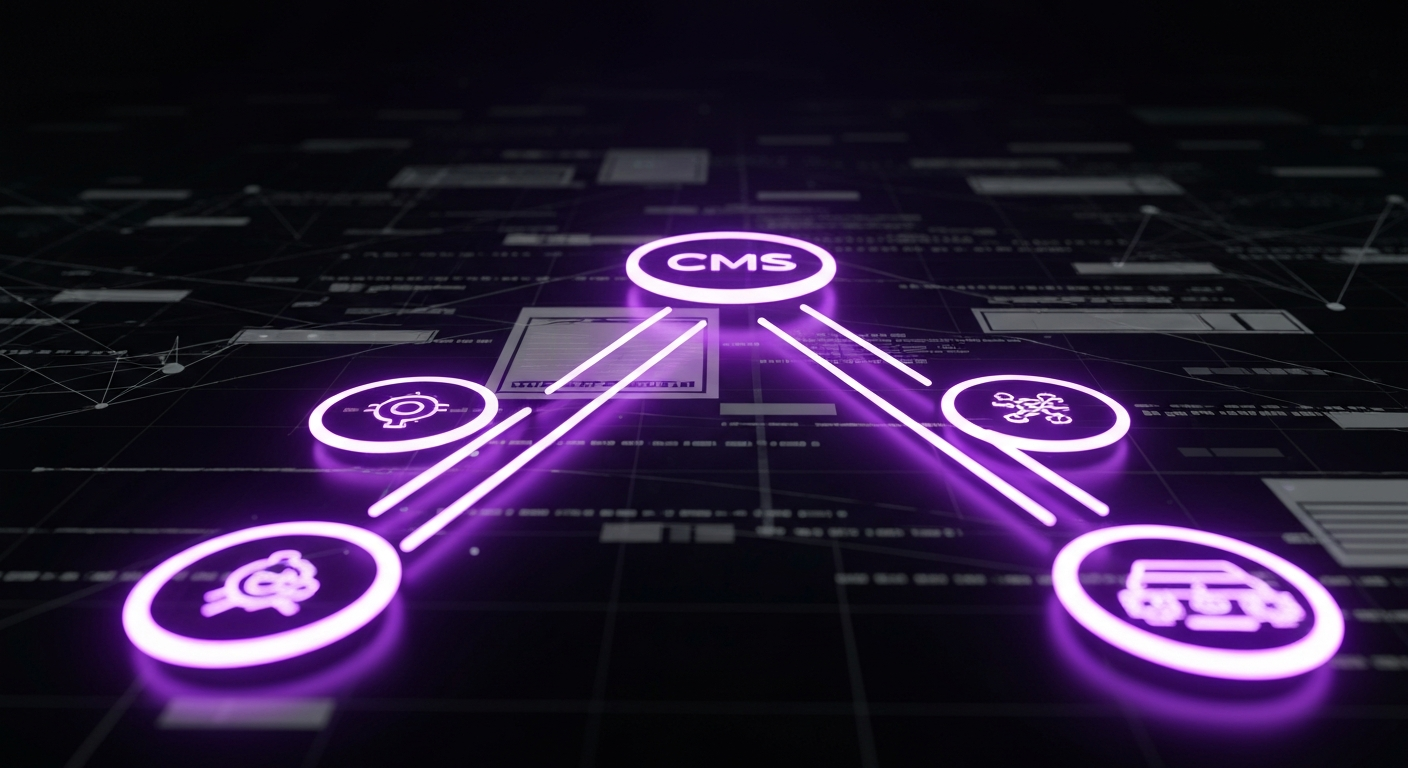
Choosing a Content Management System is one of the most consequential decisions a digital marketer can make. This investment defines your team’s capabilities, agility, and effectiveness for years to come. The right platform can unlock creativity, streamline operations, and become a powerful engine for growth, while the wrong one can create constant friction, technical debt, and missed opportunities.
Success requires a methodical, strategic approach. Begin by deeply understanding your business: audit your content, map user journeys, and set clear, measurable goals. Evaluate platforms based on their ability to meet your specific requirements—from granular SEO control to seamless martech integrations—not on marketing hype. Carefully consider the architectural and deployment models (Traditional vs. Headless, SaaS vs. Self-Hosted) and analyze the Total Cost of Ownership, not just the sticker price. Finally, plan for a smooth migration and foster enthusiastic adoption within your team.
By following these best practices, you can move beyond simply selecting software. You can choose a strategic partner that empowers your marketing team, delights your audience with exceptional digital experiences, and provides a flexible, scalable foundation for future growth.