



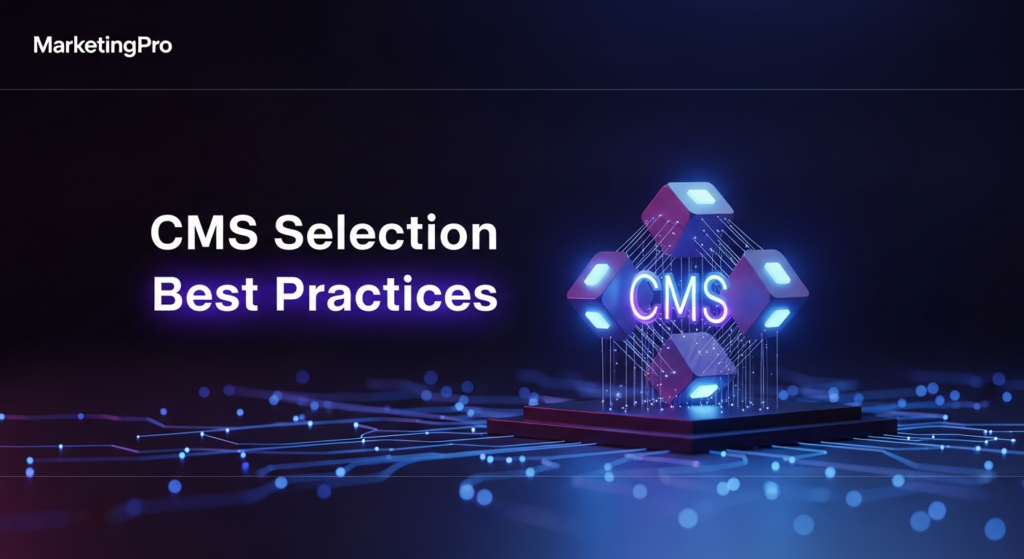


In the digital landscape, a Content Management System (CMS) is more than a tool for publishing blog posts—it is the operational hub of your entire digital marketing strategy. Every piece of content, customer journey, and conversion is intrinsically linked to your CMS’s capabilities. Consequently, choosing the right platform is a critical strategic decision with long-term implications for growth, efficiency, and competitive advantage.
Consider your CMS the foundation of your digital presence. A weak foundation limits your ability to expand or adapt, while a strong one supports every initiative. The right CMS empowers your team to execute sophisticated campaigns, from personalized user experiences to omnichannel content distribution. It directly impacts SEO, conversion rates, lead generation, and customer data management. Conversely, a platform that is difficult to use or lacks key integrations creates bottlenecks, frustrates your team, and hinders your ability to connect with your audience.
A well-chosen CMS acts as a force multiplier for your marketing efforts. It streamlines content workflows, provides actionable insights via integrated analytics, and helps you deliver the right message to the right person at the right time. This guide offers a comprehensive framework for navigating the complex process of CMS selection. We will move beyond surface-level features to explore architecture, total cost of ownership, and a strategic methodology for choosing a platform that aligns with your business goals and future-proofs your marketing operations.

Before evaluating any CMS vendor, you must first look inward. The most common mistake in CMS selection is focusing on features before defining the problems you need to solve. A successful selection process is rooted in a deep understanding of your business needs, team workflows, and technical constraints. This foundational step ensures you choose a solution that empowers your organization, not just one that looks impressive in a demo.
Begin with a comprehensive audit of your existing content and technology. Create a detailed inventory of all digital assets—website pages, blog posts, videos, and more—and analyze their performance using metrics like traffic, engagement, and conversion rates. This data will reveal what’s working, informing the strategy your new CMS must support. Concurrently, audit your current technology stack, listing every tool that interacts with your content, such as analytics platforms, CRMs, and marketing automation software. Understanding these connections is crucial for defining the integration capabilities your new CMS will need.
A CMS is ultimately a tool for people, so understanding how your team creates, manages, and publishes content is essential. Map your entire content workflow, from idea generation to publication and analysis. Identify every person involved—writers, editors, designers, SEO specialists, legal reviewers—and document each step, handover, and approval gate. This exercise will illuminate pain points and bottlenecks, such as collaboration difficulties or reliance on developers for simple edits. A clear workflow map provides a blueprint for the user roles, permissions, and collaboration features your new CMS needs to improve team efficiency and content velocity.
With your audit and workflow analysis complete, you can build a prioritized list of requirements. It is critical to distinguish between essential features and desirable extras. A useful framework for this is the MoSCoW method: Must-Have, Should-Have, Could-Have, and Won’t-Have.
This prioritized list becomes your primary tool for evaluating potential platforms, ensuring you make a decision based on strategic needs rather than distracting bells and whistles.

The underlying architecture of a CMS dictates its flexibility, performance, and suitability for different marketing strategies. For decades, the traditional (or monolithic) model dominated, but the rise of mobile apps, IoT devices, and omnichannel marketing has given birth to headless and hybrid approaches. Understanding these fundamental differences is crucial for selecting a system that can support your marketing ambitions now and in the future.
| Architecture | Description | Pros | Cons | Best For |
|---|---|---|---|---|
| Traditional (Monolithic) | The backend (content database) and frontend (presentation layer/website) are tightly coupled in a single application. | All-in-one solution, easier for non-developers to manage, large ecosystem of themes and plugins. | Less flexible, harder to deliver content to non-website channels, can be slower. | Standard websites, blogs, and small to medium-sized businesses with a single primary digital channel. |
| Headless (Decoupled) | The backend (content repository) is separate from the frontend. Content is delivered via an API to any device or platform. | Maximum flexibility, future-proof, faster performance, developers can use any frontend technology. | Requires more development resources, can be more complex to set up, marketers may lose some WYSIWYG control. | Omnichannel brands, mobile apps, complex digital experiences, companies prioritizing performance and flexibility. |
| Hybrid | Combines features of both. A traditional CMS with a presentation layer, but also offers robust API access to deliver content headlessly. | Offers both marketer-friendly templates and developer flexibility, a good transitional model. | Can be complex, potential for vendor lock-in, may not be as purely flexible as a true headless system. | Enterprises wanting to support both a primary website and emerging channels without a full rebuild. |
A traditional CMS, like the classic version of WordPress or Drupal, bundles everything you need to run a website into a single package. The content database, the administrative backend where you create content, and the frontend code that renders the final webpage are all part of the same system. This all-in-one approach is its greatest strength and its primary weakness. For marketers, it offers a straightforward, often WYSIWYG (What You See Is What You Get) experience. You can build pages, apply themes, and manage content without needing a developer for every change. However, this tight coupling makes it difficult to repurpose content for other platforms like a mobile app, a smartwatch, or a digital kiosk. The architecture is website-centric, which can be limiting in an omnichannel world.
A Headless CMS completely decouples the content backend (the \”body\”) from the presentation frontend (the \”head\”). It is purely a content repository that makes content available to any frontend application through an Application Programming Interface (API). This means your marketing team can create a piece of content once and developers can then pull that content to display it on a website built with modern JavaScript frameworks, a native iOS or Android app, an email campaign, or even an in-store digital display. This approach offers unparalleled flexibility and is inherently future-proof, as you can adopt new frontend technologies without having to change your CMS. The trade-off is that it requires more initial development resources to build and connect these frontends, and marketers may lose the familiar page-building experience of a traditional system.
A hybrid CMS seeks to bridge the gap between traditional and headless architectures. These platforms, which include modern enterprise systems like Adobe Experience Manager and even WordPress with its robust REST API, function like a traditional CMS out of the box, with built-in templating and page-building tools for marketers. However, they also provide powerful APIs that allow developers to pull content and use it in a headless fashion for other applications. This model provides a practical solution for organizations that want to maintain a primary, easy-to-manage website while also experimenting with or supporting other digital channels. It gives marketers autonomy for day-to-day web tasks while still providing the flexibility developers need for more complex, omnichannel projects.

While architecture provides the foundation, the daily utility of a CMS comes down to its feature set. A modern digital marketing platform must go beyond basic content creation to be a powerful tool for optimization, personalization, and integration that enables marketers to work efficiently and effectively. When evaluating options, prioritize platforms that excel in the following four critical areas.
Search Engine Optimization (SEO) is not an afterthought; it must be woven into the fabric of your content creation process. A marketing-centric CMS should provide granular control over key on-page SEO elements without requiring developer assistance. Essential features include:
In today’s market, a one-size-fits-all approach to content is no longer effective. Your CMS should empower you to deliver personalized experiences that resonate with different audience segments. Look for a system with a native or tightly integrated personalization engine that allows you to alter content based on user data such as location, browsing history, device type, or CRM data. For example, you could show a different homepage hero banner to a first-time visitor versus a returning customer. Alongside personalization, a robust A/B or multivariate testing capability is crucial. The ability to easily test variations of headlines, calls-to-action, or entire page layouts directly within the CMS allows for continuous optimization and data-driven decision-making.
Your CMS does not operate in a vacuum. It is the hub of your marketing technology (martech) stack and must connect seamlessly with your other critical systems. Native or well-documented API integrations are non-negotiable. Key integrations to look for include:
A CMS with a strong integration marketplace or flexible APIs will save you countless hours and significant development costs.
Finally, never underestimate the importance of usability. The most powerful features are useless if your team finds the platform cumbersome and difficult to use. A modern CMS should offer an intuitive, user-friendly interface that empowers content creators, not hinders them. Look for features like drag-and-drop page builders, a clean WYSIWYG editor, reusable content blocks or components, straightforward media management, and robust version control. The content creation experience should be efficient and collaborative, allowing your team to focus on producing high-quality content instead of fighting with the software.

Choosing a CMS is a long-term commitment. The platform you select today must not only meet your current needs but also be able to grow with your business. Scalability and performance are two of the most critical factors in future-proofing your investment. A system that cannot scale will eventually become a bottleneck to growth, while poor performance will damage user experience and search engine rankings.
Scalability is the CMS’s ability to handle growth in multiple dimensions: increasing traffic volumes, from steady growth to sudden spikes; an expanding library of content and digital assets; and business expansion into new languages or regions. When evaluating a CMS, ask vendors about its architecture’s ability to handle load balancing, its support for Content Delivery Networks (CDNs), and its database optimization. For SaaS solutions, inquire about their service-level agreements (SLAs) for uptime and performance under load.
Performance, particularly page load speed, directly impacts business outcomes. Slow pages lead to higher bounce rates, lower engagement, and decreased conversions. Google also uses page experience, measured by its Core Web Vitals, as a significant ranking factor. An effective CMS should be built for speed, with features like clean code output, automatic image compression, support for modern image formats like WebP, and server-side caching. During your evaluation, use tools like Google PageSpeed Insights to analyze live websites built on the platforms you are considering. Prioritize a CMS that delivers a fast, seamless user experience out of the box.

In an era of increasing cyber threats and stringent data privacy regulations, CMS security cannot be overlooked. A breach can lead to devastating consequences, including downtime, theft of customer data, brand damage, and significant financial penalties. As the gateway to your digital assets, your CMS is a prime target for attackers, making a thorough security evaluation a non-negotiable part of the selection process.
Look for a multi-layered security approach, starting with core platform security. Ask about the vendor’s process for identifying and patching vulnerabilities and the frequency of security updates. For SaaS platforms, the vendor typically manages security, which can be a significant advantage. With open-source platforms, the responsibility to apply patches and manage plugins falls on you. Key security features include granular user roles and permissions, two-factor authentication (2FA), protection against common web vulnerabilities like SQL injection and XSS, and comprehensive audit logs.
Beyond platform features, consider compliance with data privacy regulations like GDPR and CCPA. The CMS should provide tools to help manage user consent and handle data subject requests. Ensure the platform also supports SSL/TLS encryption to secure data in transit. A proactive approach to security protects your digital assets, builds customer trust, and safeguards your business.
One of the biggest mistakes in budgeting for a new CMS is focusing solely on the initial licensing or subscription fee. The true cost of a CMS extends far beyond this \”sticker price.\” To make an accurate financial comparison and avoid unpleasant surprises, you must calculate the Total Cost of Ownership (TCO) over a three- to five-year period. TCO provides a holistic view of all expenses associated with acquiring, implementing, and running the platform, giving you a realistic picture of the long-term investment required.
The initial cost structure varies significantly between CMS types. Open-source software like WordPress is free to license, but this is not the same as being free. SaaS platforms like HubSpot CMS Hub typically involve a recurring monthly or annual subscription fee, often tiered by features, users, or traffic volume. Enterprise-level Digital Experience Platforms (DXP) may involve substantial annual licensing fees or complex, usage-based pricing. It’s crucial to understand what is included in each model—for example, SaaS subscriptions usually bundle hosting, maintenance, and support, whereas with open-source, these are separate costs you must manage.
Implementation is often one of the largest one-time costs. This includes the entire process of setting up the new system to meet your specific needs. Key costs to budget for are:
These costs can range from a few thousand dollars for a simple site to hundreds of thousands for a complex enterprise implementation.
The costs don’t stop once the CMS is live. You must account for ongoing operational expenses. For self-hosted, open-source solutions, this includes server hosting, security monitoring, and the labor costs associated with applying regular software updates and security patches. For all platforms, consider the cost of vendor support plans, which can be essential for troubleshooting critical issues. Finally, don’t forget the human element. Budget for the time and resources required to train your marketing and content teams on how to use the new system effectively. A comprehensive TCO analysis ensures you are making a financially sound decision that aligns with your budget for the entire lifecycle of the platform.

The CMS market can be broadly divided into three main categories: open-source, Software-as-a-Service (SaaS), and Digital Experience Platforms (DXP). Each category serves different business needs, budgets, and technical capabilities. Understanding their core philosophies will help you narrow your search to the most appropriate segment for your organization.
| Category | Key Characteristics | Pros | Cons | Examples |
|---|---|---|---|---|
| Open-Source | The source code is freely available for anyone to inspect, modify, and enhance. You host it on your own servers. | No licensing fees, maximum flexibility and customization, large community support, full control over your data. | Requires technical expertise for setup and maintenance, you are responsible for security and performance, support can be fragmented. | WordPress, Drupal, Joomla |
| SaaS (Software-as-a-Service) | The software is licensed on a subscription basis and is centrally hosted by the vendor. | Easy to set up, vendor handles hosting, maintenance, and security, dedicated customer support, predictable costs. | Less customizable than open-source, recurring subscription fees, potential data lock-in, reliant on vendor’s roadmap. | HubSpot CMS Hub, Webflow, Contentful |
| DXP (Digital Experience Platform) | An integrated suite of tools that goes beyond content management to include analytics, personalization, e-commerce, and more. | All-in-one solution for managing the entire customer journey, powerful enterprise-grade features, unified customer data. | Very high cost, complex implementation and management, can lead to vendor lock-in, may be overkill for smaller companies. | Adobe Experience Manager, Sitecore, Optimizely |
Open-source platforms like WordPress power a massive portion of the web for a reason. Their primary appeal is unparalleled flexibility. With access to the source code, you can customize every aspect of the platform to meet your exact specifications. A vast community of developers creates a rich ecosystem of plugins and themes, allowing you to extend functionality without starting from scratch. This freedom, however, comes with responsibility. You are in charge of hosting, security, performance optimization, and updates. This model is ideal for businesses with access to technical resources (either in-house or through an agency) who need full control over their digital environment.
SaaS CMS solutions offer a trade-off: you exchange some of the limitless flexibility of open-source for simplicity, security, and support. With a SaaS platform, the vendor takes care of all the technical heavy lifting—hosting, maintenance, security patches, and performance—allowing your team to focus purely on marketing. These platforms are typically designed with user-friendliness in mind and come with dedicated customer support. This makes them an excellent choice for marketing teams without dedicated IT support or for businesses that want to launch quickly and have predictable, all-inclusive monthly costs. The main consideration is that you are operating within the vendor’s ecosystem, which can limit certain custom integrations or functionalities.
A DXP is more than just a CMS; it’s a comprehensive suite of integrated technologies designed to manage the entire customer lifecycle across a multitude of touchpoints. A DXP typically bundles a powerful CMS with advanced analytics, AI-driven personalization, marketing automation, e-commerce, and customer data management capabilities. This provides a unified view of the customer and allows for the orchestration of highly sophisticated, personalized digital experiences at scale. DXPs are built for large enterprises with complex digital needs and the significant budget and resources required to implement and manage such a powerful system. For the right organization, a DXP can provide a formidable competitive advantage, but it is often overkill for small and medium-sized businesses.
Once you have defined your requirements and identified the right CMS category, you can begin evaluating specific vendors. A structured vetting process is essential to move beyond marketing hype and determine the right fit. Start by creating a shortlist of 3-5 vendors and scheduling personalized demos. Do not settle for a generic sales pitch; insist on a custom demo that shows how the platform solves your specific challenges and handles key use cases identified in Step 1. This is your opportunity to see the user interface in action and ask pointed questions with your key team members present.
For larger projects, the next step is issuing a Request for Proposal (RFP). This formal document outlines your business goals, technical requirements, and specific questions for the vendor. An RFP forces vendors to provide detailed written responses on how their solution meets your needs, its pricing, and their support process, allowing for a direct, apples-to-apples comparison.
Finally, for your top one or two choices, consider a Proof of Concept (PoC). A PoC is a small-scale trial implementation focused on testing the platform’s most critical functionality, such as building a key page template or testing a crucial integration. A PoC moves from theory to practice, giving your team hands-on experience and validating vendor claims before you sign a contract. This is an effective way to mitigate risk and ensure the chosen CMS will deliver on its promises.
[[INNER_IMAGE]]
After completing demos, reviewing RFPs, and potentially conducting a PoC, you will have a wealth of information. To make a final, objective decision, consolidate this data into a structured format. A CMS selection scorecard is a powerful tool that helps you quantify your findings and make a data-driven choice, minimizing personal bias and ensuring alignment with your strategic priorities.
The scorecard is a spreadsheet where you rate each vendor against a set of weighted criteria drawn directly from your initial requirements gathering. List your criteria in the first column, grouped into categories such as:
Next, assign a weight to each criterion based on its importance to your business. For example, if seamless CRM integration is non-negotiable, you might give it a weight of 20%, while a ‘nice-to-have’ feature might only get 5%. Then, for each CMS you’re evaluating, score it on a scale of 1-5 for each criterion. Multiply the score by the weight to get a weighted score for each item. Finally, sum the weighted scores for each vendor to get a total score. The vendor with the highest score is, logically, the best fit for your organization. This methodical approach not only provides a clear winner but also creates a defensible rationale for your decision that you can confidently present to stakeholders.
[[INNER_IMAGE]]
A traditional CMS couples the backend (content database) with the frontend (presentation layer). In contrast, a headless CMS is ‘frontend-agnostic,’ delivering content via an API to any platform, such as a website, mobile app, or smart device. This provides maximum flexibility for developers and marketers.
Budgets vary widely. Costs can range from minimal for simple open-source setups (plus hosting and development) to six figures annually for enterprise-level DXP solutions. It is crucial to calculate the Total Cost of Ownership (TCO), which includes licensing, implementation, and ongoing maintenance.
No single CMS type is inherently ‘best’ for SEO; success depends on proper configuration and use. A strong CMS for SEO provides features like customizable URLs and meta tags, schema markup support, mobile optimization, fast performance, and easy content updates. Both modern traditional and headless platforms can excel at SEO.
Yes, content migration is a standard part of a CMS implementation project. The complexity depends on the amount of content, its structure, and the differences between the old and new systems. Most projects involve a combination of automated scripts and manual cleanup to ensure a smooth transition.
Extremely important. A CMS should act as the central hub of your martech stack. Seamless integrations with your CRM (like Salesforce or HubSpot), analytics tools (like Google Analytics), and marketing automation platforms (like Marketo) are critical for creating a unified customer experience and gathering actionable data.