






For years, Search Engine Optimization (SEO) revolved around a simple premise: find a keyword, repeat it on a page, and build links to watch your rankings climb. This approach treated search engines like simple text-matching machines by focusing on exact-match keywords and search volume. That era is over. Today, relying on these outdated methods is like trying to navigate a modern city with a 19th-century map—you will get lost.
The digital landscape has undergone a seismic shift. Search engines like Google have evolved from simple ‘string’ matchers into sophisticated ‘thing’ understanders. They no longer just match a sequence of characters; they comprehend the meaning, context, and intent behind a user’s query. This evolution demands a more advanced approach to keyword research—one focused on building comprehensive topic authority rather than ranking for isolated terms.
At the core of this evolution is semantic search. Google’s goal is to understand language as humans do, leveraging massive knowledge bases like its Knowledge Graph. This system understands the relationships between entities—the people, places, concepts, and objects that constitute our world. When you search for “Leonardo da Vinci,” Google doesn’t just find pages with that name. It understands he was an artist, inventor, and a key figure of the Renaissance. It knows he painted the “Mona Lisa” and is related to concepts like “Florence” and “The Last Supper.”
This is the ‘strings to things’ revolution. A ‘string’ is the literal text of a query, while a ‘thing’ is the real-world entity or concept it represents. This understanding allows Google to provide richer, more accurate results by answering complex questions, understanding synonyms, and inferring intent from ambiguous queries. For SEO professionals, this means our focus must shift from optimizing for a single string to creating content that thoroughly covers an entire topic.
In this semantic landscape, Google rewards expertise. It aims to direct users to websites that are genuine authorities on a subject. Authority isn’t measured by how many times a keyword is repeated on a page, but by the breadth and depth of your content on a topic. A site with one article on “email marketing” is far less authoritative than a site with a comprehensive pillar page on the topic, supported by detailed articles on “email deliverability,” “newsletter design,” “A/B testing subject lines,” and “marketing automation workflows.”
By creating a web of interconnected, high-quality content around a central theme—known as a topic cluster—you send powerful signals to Google. You demonstrate that you haven’t just superficially covered a keyword; you’ve exhaustively explored a topic. This builds trust with both users and search engines, leading to higher rankings, more stable traffic, and recognition as a go-to resource in your niche.
The traditional focus on keyword match types (exact, phrase, broad) is now a relic in organic SEO. While these concepts still exist in paid search, they are a distraction for content strategy. Obsessing over whether to target “best running shoes for men” versus “men’s best running shoes” misses the point, as Google understands these queries share the same intent.
The advanced approach is to think in terms of topic coverage. Your goal isn’t just to rank for one keyword, but to be the definitive answer for the entire constellation of questions and queries related to that topic. This means your research process must expand to identify not only primary keywords but also subtopics, user questions, and related entities. It’s a strategic shift from a one-dimensional keyword list to a three-dimensional topic map.

To master advanced keyword research, you must first understand the foundational principles that guide modern SEO strategy. Semantic SEO and topic clusters are not just buzzwords; they represent a fundamental change in how we create and structure content to align with how search engines now operate. Grasping these concepts is the key to unlocking sustainable, long-term organic growth.
Semantic SEO is the practice of creating content optimized around topics rather than individual keywords. It involves building meaning and topical depth to provide the most comprehensive and relevant answers to user queries. The core idea is to go beyond surface-level keyword matching and instead create a rich contextual web of information that helps search engines understand your content’s expertise and relevance.
This involves several key practices:
Ultimately, semantic SEO is about creating content for humans that is so clear and comprehensive that a machine can easily understand its meaning and value.
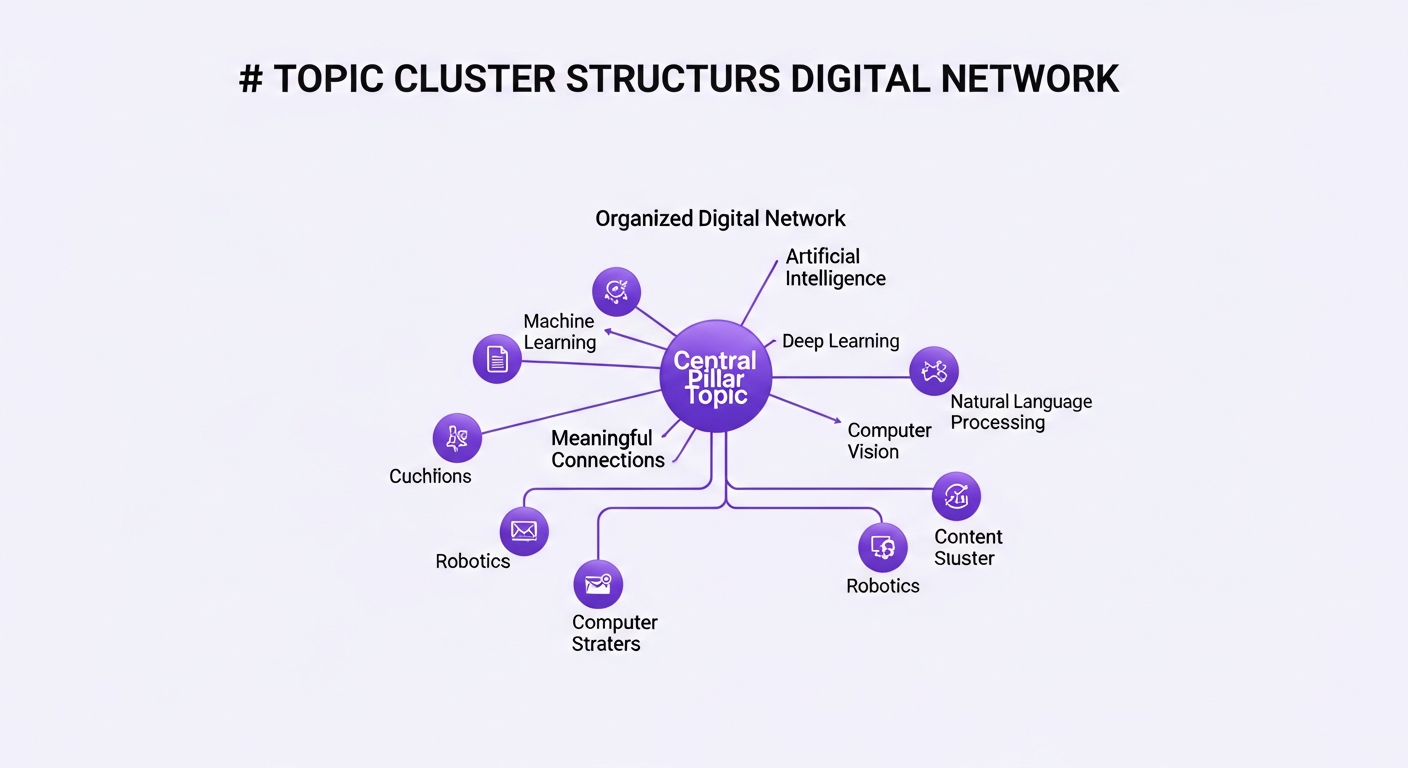
The most effective way to implement semantic SEO is through the topic cluster, or ‘hub-and-spoke,’ model. This content architecture organizes your site’s pages to establish strong topical authority. It consists of two main components:
The strategic value lies in the linking structure. Each cluster content page links up to the central pillar page. In turn, the pillar page links out to all of its supporting cluster pages. This creates a tightly knit structure that signals to Google a deep repository of knowledge on the topic. It improves user navigation and helps search engines understand the relationships between your pages.
Entities are the foundation of Google’s semantic understanding. An entity is a distinct and well-defined thing or concept, such as a person (Steve Jobs), a place (San Francisco), an organization (Apple Inc.), or an idea (user experience design). Google’s Knowledge Graph is a massive database that stores billions of facts about these entities and the relationships between them.
When Google crawls your content, it doesn’t just see words; it identifies the entities you mention. If you write an article about Apple and mention Steve Jobs, Tim Cook, the iPhone, and Cupertino, Google’s algorithm connects these entities. This confirms that your content is highly relevant to the topic of “Apple Inc.” The more relevant entities you include naturally in your content, the more confidence Google has in its understanding of your page’s subject matter.
This is why simply repeating a keyword is ineffective. An authoritative article naturally includes the key people, products, concepts, and locations associated with its topic. Therefore, your keyword research process should include identifying these primary entities to ensure they are covered in your content.

Every powerful topic cluster begins with a single seed. This foundational stage is about identifying the broad, strategic topics that will form the pillars of your content strategy and then uncovering the language your audience actually uses to discuss them.
A pillar topic is a broad subject area central to your business with enough depth to support numerous sub-topics. Think of these as the main chapters of a book about your industry. A good pillar topic should meet several criteria:
Begin by brainstorming 5-10 core topics that define your business. At this stage, focus on relevance and strategic fit rather than search volume.
SEO tools are powerful, but they cannot replicate the raw, unfiltered voice of your customer. To truly understand user intent and the questions people have, you need to go where they have conversations. Online forums and communities are goldmines for semantic keyword research.
Spend time on platforms like:
While browsing, document the exact phrasing, pain points, and follow-up questions people share. This qualitative data is invaluable for creating content that resonates with your audience.
Google’s own SERP features are a direct line into the mind of the searcher. The “People Also Ask” (PAA) box and “Related Searches” section show you what other queries Google’s algorithm has semantically connected to your initial search.
While manual analysis works for a few keywords, an advanced approach involves scaling this process. Begin with a seed pillar topic in Google and document the PAA questions. As you click each question, the box expands with more related queries, allowing you to build a large map of interconnected topics. The “Related Searches” at the bottom of the page provide excellent ideas for subtopics and alternative phrasing.
This process helps you move beyond your own assumptions and build a content plan based directly on the information Google has identified as relevant to a user’s journey around a topic.

Once you have your foundational ideas, it’s time to validate them with data and expand your topic map using specialized SEO tools. These platforms go beyond simple search volume and difficulty metrics, offering features designed specifically for semantic SEO and topic clustering. Mastering them is essential for building a data-driven content strategy.
Semrush’s Topic Research tool is purpose-built for creating topic clusters. You enter a seed keyword, and the tool generates a mind map of related subtopics, headlines, and common questions. It analyzes top-ranking content to show you what is already performing well in the SERPs.
Key features to use:
Use this tool to quickly expand your initial brainstorm into a comprehensive list of data-backed content ideas for your cluster.
Ahrefs’ Keywords Explorer has a powerful feature called “Parent Topic.” This feature helps you understand the true intent behind a long-tail keyword by identifying the broader topic that Google considers it a part of. For example, if you analyze the keyword “how to write a good blog post title,” Ahrefs might show the Parent Topic is “how to write a blog post.”
This is crucial for semantic SEO because it prevents you from creating multiple, redundant articles that target slight variations of the same core intent. Instead of writing separate pieces for “blog post title tips” and “blog headline examples,” the Parent Topic feature suggests they could be combined into a single, more comprehensive article. Use this to group your keyword ideas into more cohesive, authoritative content pieces.
Question-based keywords are the backbone of informational content. Tools like AlsoAsked and AnswerThePublic specialize in uncovering these questions by scraping and visualizing Google’s “People Also Ask” data at a massive scale.
Simply enter your pillar topic, and these tools will generate a branching diagram of questions users are asking. You’ll find queries starting with who, what, where, when, why, and how, as well as comparisons (vs.) and prepositions (for, with). This is an incredibly efficient way to:
While building authority around a high-competition pillar topic is a long-term goal, you can achieve quicker wins by targeting less competitive, long-tail variations. A powerful technique is to append seed keywords with specific modifiers. These often signal a more precise intent and face less competition.
Here are some examples of valuable modifiers:
Use your primary SEO tool to combine your core keywords with these modifiers and look for queries with a decent search volume and a low Keyword Difficulty score. These are often the perfect candidates for your initial cluster articles.

Understanding what a user truly wants when they type a query into a search engine is arguably the most critical skill in modern SEO. This is search intent. Creating content that perfectly matches user intent is non-negotiable for ranking. If your page about “the best coffee machines” is a history of coffee, you will fail, no matter how well-written it is. This step is about systematically decoding intent to ensure your content delivers exactly what the user is looking for.
Search intent is typically broken down into four main categories. Understanding them allows you to create the right type of content for each keyword.
Categorizing your keywords by intent is the first step to mapping them to the right content format and stage of the buyer’s journey.
The best way to understand intent is to look at the Search Engine Results Page (SERP) for your target keyword. Google invests billions of dollars into understanding user intent, and the SERP is a direct reflection of its findings. What you see on page one is what Google believes best satisfies the user’s query.
Look for these clues:
Never create content for a keyword without first analyzing the SERP. The results provide an explicit blueprint for the type of content you need to create.
Once you’ve categorized intent, you can map your keywords to the different stages of the marketing or content funnel. This ensures you’re creating content that guides users from initial awareness to final purchase.
Here’s a simple mapping:
| Funnel Stage | Search Intent | Content Type Examples |
|---|---|---|
| Top of Funnel (ToFu) – Awareness | Informational | Blog posts, guides, how-to articles, infographics |
| Middle of Funnel (MoFu) – Consideration | Commercial Investigation | Product comparisons, case studies, webinars, detailed reviews |
| Bottom of Funnel (BoFu) – Decision | Transactional | Product pages, pricing pages, free trial sign-ups, demo requests |
This strategic mapping ensures you’re not just attracting traffic, but attracting the right traffic at the right time, with content that meets their needs and moves them closer to becoming a customer.

You don’t operate in a vacuum. The SERPs are a competitive landscape, and understanding what your rivals are doing successfully is a critical shortcut to success. A semantic competitor gap analysis goes beyond just seeing which keywords they rank for. It’s about understanding their entire topic strategy, identifying the gaps in your own coverage, and finding opportunities to outperform them.
Your first task is to realize that your business competitors are not always your SERP competitors. A local coffee shop’s business competitor is the cafe across the street. But for the topic “how to make cold brew,” their SERP competitors might be Food & Wine magazine, a popular food blogger, and The New York Times Cooking section. You are competing with whoever currently owns the search results for your target topics.
For each of your pillar topics, perform a few searches for the most important head terms. Note down the domains that consistently appear in the top 5-10 positions. These are your true SERP competitors for that specific topic cluster. You will likely have different sets of competitors for different topics.
Once you’ve identified your SERP competitors, you can use content gap tools (available in Ahrefs, Semrush, and other major SEO suites) to find strategic opportunities. These tools allow you to enter your domain and the domains of several competitors. They then generate a report showing:
Filter these results to find relevant keywords with sufficient search volume and a manageable difficulty score. This process yields a data-driven list of content ideas to close the gap with your competitors.
A list of keywords is only part of the story. The next level of analysis involves manually reviewing the top-ranking pages for your target topics. Don’t just skim them; dissect them. Ask yourself:
This qualitative analysis helps you understand the ‘why’ behind their rankings. The goal is not to copy competitors, but to identify the standard of quality and create something even better, more comprehensive, or with a more compelling angle.
With your extensive keyword research, intent analysis, and competitor insights in hand, it’s time to assemble the pieces. This stage is about architectural planning. You’ll organize your vast list of keywords and ideas into a logical, interconnected structure that is easy for both users and search engines to navigate. A well-structured topic cluster is the physical manifestation of your topic authority.
Your research has likely produced hundreds, if not thousands, of potential keywords. The first step is to bring order to this chaos. Start by grouping keywords based on their shared core intent and subtopic. This is a thoughtful, manual process that keyword tools can assist with but cannot perfect.
For a pillar topic like “Content Marketing,” your groups might look like this:
Each of these groups will become a single, in-depth cluster article. This ensures you create comprehensive content instead of thin, repetitive pages for every minor keyword variation.
The pillar page is the centerpiece of your cluster. It needs to be designed to serve as a definitive guide and a navigational hub. It should broadly cover every subtopic you identified in your grouping exercise, providing a comprehensive overview without going into exhaustive detail on any single one.
Key elements of a strong pillar page include:
The linking structure is what transforms a collection of articles into an authoritative topic cluster. The rules are simple but powerful:
This deliberate internal linking strategy creates a self-reinforcing loop that clearly demonstrates the breadth and depth of your topical expertise to search engines.

To put the finishing touches on your semantic SEO strategy, you need to look beyond primary and secondary keywords. Advanced content optimization involves weaving in related concepts, entities, and semantically-linked terms that provide a richer context for search engines. This helps Google understand your content with greater confidence and can differentiate your page from competitors who are still focused on simple keyword density.
As discussed earlier, entities are the real-world ‘things’ that Google understands. By including relevant entities in your content, you are speaking Google’s language. This moves your content from a simple bag of words to a structured piece of information that aligns with Google’s Knowledge Graph. For example, an article about “Elon Musk” is semantically richer if it also mentions related entities like “Tesla,” “SpaceX,” “PayPal,” and “Neuralink.”
Including these entities does two things:
Identifying relevant entities doesn’t have to be guesswork. You can use several tools to find them:
Latent Semantic Indexing (LSI) is a somewhat outdated term, but the core concept remains valid: use synonyms and related terms to create comprehensive content. The goal is not to “stuff” a list of LSI keywords. Instead, it’s about writing naturally and authoritatively about a subject.
If you’re writing a detailed guide to “car maintenance,” you will naturally use words and phrases like “oil change,” “tire rotation,” “brake pads,” “engine fluid,” “air filter,” and “spark plugs.” You don’t need a special tool to tell you this. The process of covering a topic in depth will automatically lead you to include these semantically related terms. Focus on creating the best, most helpful piece of content for the user. When you do that, you will naturally incorporate the words and concepts that search engines expect to see in an authoritative article on that topic.

You now have a complete architectural plan for your topic clusters, but you cannot create everything at once. Effective strategy requires ruthless prioritization. This step is about transforming your research into an actionable content calendar that focuses your resources on the opportunities that will drive the most significant business results, balancing short-term gains with long-term authority building.
Not all keywords are created equal. To prioritize effectively, you need to evaluate each potential cluster article against three key criteria:
Create a simple scoring system (e.g., a scale of 1-5 for each factor) and apply it to your list of content ideas. This allows you to objectively compare opportunities and decide what to tackle first.
Once you’ve prioritized your list, map it onto a content calendar. A logical approach is to work on one topic cluster at a time. This allows you to build topical momentum and establish your authority in one area before moving to the next.
A typical cluster rollout might look like this:
This structured approach ensures you are methodically building your topical authority and creating a valuable asset over time.
Your content plan should include a mix of short-term and long-term goals. Use your prioritization matrix to identify two types of opportunities:
A balanced strategy that pursues both types of opportunities will deliver consistent results and build a sustainable competitive advantage.

Advanced keyword research doesn’t end when you hit “publish.” The digital landscape is constantly changing, and your strategy must adapt with it. Measuring the right metrics is crucial for understanding what’s working, demonstrating ROI, and making informed decisions about how to refine and expand your content over time. This final step closes the loop, turning your content creation into a continuous cycle of improvement.
The old way of measuring success was to obsess over your rank for a single trophy keyword. In a semantic SEO world, this is shortsighted. Your goal is to achieve topic authority, so your measurement should reflect that. Use a rank tracking tool that allows you to tag or group your keywords by topic cluster.
Instead of tracking your rank for a single term like ‘digital marketing,’ track metrics like average position, search visibility, and share of voice across all keywords in your topic cluster. This provides a more accurate and stable picture of your performance. You’ll see your overall authority on the topic grow, even if individual keyword rankings fluctuate day to day.
Rankings are no longer just about the ten blue links. Modern SERPs are rich with features like Featured Snippets, People Also Ask boxes, video carousels, and image packs. Owning this real estate can drive significant traffic and establish your brand as the definitive answer.
Your monitoring should track not just your organic rank but also your presence in these SERP features. Many modern rank trackers can monitor this automatically. Set goals to increase your ownership of these features for your target topics. If you see a competitor consistently winning a Featured Snippet, analyze their content to understand how they’ve structured their answer and adapt your own page to compete for it.
Your topic clusters are living assets, not static documents. You need a process for maintaining and growing them over time.
By continuously measuring, refining, and expanding your topic clusters, you transform your SEO from a series of one-off campaigns into a sustainable, compounding engine for organic growth.