



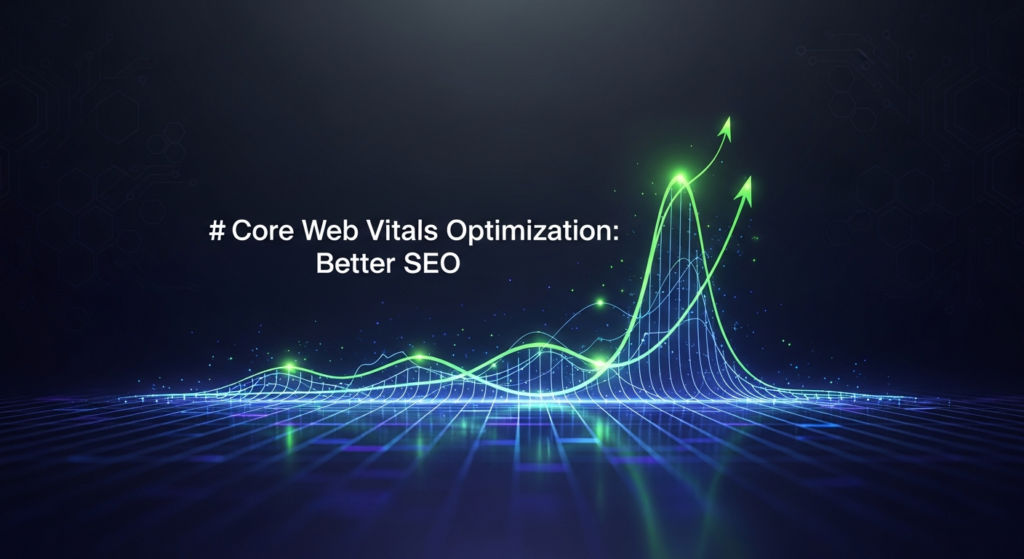


Core Web Vitals (CWV) are a set of specific metrics Google uses to evaluate a webpage’s real-world user experience. They measure how quickly a page loads, how responsive it is to user input, and how visually stable it is during loading. These vitals provide a tangible signal to search algorithms about whether a page is delightful or frustrating to use. Optimizing for CWV is no longer a niche technical task; it’s a fundamental part of modern SEO, as strong performance can provide a competitive ranking advantage, while a poor score can hinder visibility even for high-quality content.
Google’s primary goal is to deliver the most relevant, high-quality results. While content and backlinks remain crucial, Google now considers a user’s direct interaction with a page a powerful indicator of its quality. A slow, unresponsive, or visually unstable site leads to frustration, high bounce rates, and low engagement—all signals that the page is a poor result. Core Web Vitals serve as a standardized proxy for this real-world user experience. By measuring loading performance (LCP), interactivity (INP), and visual stability (CLS), these metrics tell Google if users will have a smooth, frustration-free experience. A passing CWV assessment sends a positive signal that can improve your rankings, making your content more likely to be surfaced in search results.
The significance of Core Web Vitals was solidified with the introduction of the Page Experience update. This update consolidated several UX-related ranking signals into a single, more holistic factor. The Page Experience signal includes Core Web Vitals alongside other crucial checks:
By bundling Core Web Vitals into this larger signal, Google clarified that technical performance is a core pillar of on-page SEO. While content remains the most critical factor, the Page Experience update can act as a tie-breaker or a significant influencing factor, especially in competitive niches. A poor page experience can hold back even the most brilliant content, while an excellent page experience can elevate it, giving you an advantage over competitors with similar-quality content but inferior technical performance.

To optimize your site effectively, you must first understand what each of the three Core Web Vitals measures. Each metric focuses on a distinct aspect of the user experience, from the initial perception of loading to post-load interactivity. Mastering these metrics involves grasping not just their definitions, but also what they signify about your website’s performance from a user’s perspective.
The three pillars of Core Web Vitals—Largest Contentful Paint (LCP), Interaction to Next Paint (INP), and Cumulative Layout Shift (CLS)—work together to provide a comprehensive picture of your page’s health. The table below summarizes each metric and its target threshold for a “Good” score.
| Metric | Measures | Good Score |
|---|---|---|
| Largest Contentful Paint (LCP) | Loading Performance | ≤ 2.5 seconds |
| Interaction to Next Paint (INP) | Responsiveness | ≤ 200 milliseconds |
| Cumulative Layout Shift (CLS) | Visual Stability | ≤ 0.1 |
Largest Contentful Paint measures the time it takes for the largest single element (typically an image, video, or a large block of text) to become visible within the user’s viewport. In simple terms, it marks the point in the page load timeline when the main content has likely loaded. This is a critical user-centric metric because it closely correlates with a user’s perception of how fast a page is. A fast LCP reassures the user that the page is working and the content they came for is on its way.
An LCP element could be a hero image, a poster image for a video, or the primary heading of an article. Google sets the following thresholds for LCP:
Common causes of a poor LCP score include slow server response times, render-blocking JavaScript and CSS, slow-loading resources like large images, and client-side rendering issues.
Interaction to Next Paint is the newest Core Web Vital, officially replacing First Input Delay (FID) in March 2024. While FID only measured the delay of the *first* interaction, INP provides a much more comprehensive view of a page’s overall responsiveness. It measures the latency of *all* user interactions—such as clicks, taps, and key presses—and reports the single longest duration observed. A low INP means the page provides consistent and immediate visual feedback to user inputs, making it feel fast and fluid.
A high INP is often caused by excessive JavaScript running on the main thread. When the main thread is busy executing code, it cannot respond to user input, leading to a laggy, frustrating experience. The thresholds for INP are:
Optimizing INP involves breaking up long JavaScript tasks, reducing the amount of JavaScript that runs on page load, and auditing third-party scripts that can monopolize the main thread.
Cumulative Layout Shift measures the visual stability of a page. It quantifies how much unexpected movement occurs in the visible viewport. If you have ever tried to click a button on a webpage, only for an ad to load and push the button down, causing you to click the ad instead, you have experienced a layout shift. CLS is the metric designed to measure this frustrating experience. A low CLS score means the page is stable and predictable as it loads, providing a smooth and non-disruptive user experience.
CLS is calculated based on the impact fraction (how much of the viewport was affected) and the distance fraction (how far the unstable elements moved). The thresholds are:
The most common causes of high CLS are images or ads without specified dimensions, dynamically injected content, and web fonts that cause a flash of unstyled or invisible text (FOUT/FOIT).

Before you can start optimizing, you need a reliable way to measure your site’s current performance. Google provides several excellent tools that offer different perspectives on your Core Web Vitals scores. The key is to understand the difference between “lab data” and “field data” and to use the right tool for the job, whether you’re diagnosing a specific issue or monitoring long-term trends.
Google PageSpeed Insights (PSI) is often the first stop for any CWV analysis. It is a powerful tool because it provides both lab and field data in a single report.
Use PSI to get a comprehensive overview of a single URL. Focus on the Field Data to understand your baseline and use the Lab Data’s diagnostics to identify specific optimization opportunities.
While PageSpeed Insights is great for individual pages, Google Search Console (GSC) is essential for monitoring your entire site’s performance over time. The Core Web Vitals report in GSC groups your site’s URLs into three categories: “Poor,” “Needs Improvement,” and “Good,” for both mobile and desktop.
This report is based entirely on field data. It allows you to identify site-wide issues quickly. For example, if you see a large group of URLs suddenly move into the “Poor” category for LCP, you can drill down to see example pages. This often points to a systemic problem, such as a slow server or a new, unoptimized image template being used across your blog. GSC is your go-to tool for tracking the impact of your optimizations and ensuring your scores remain healthy long-term.
For hands-on, real-time debugging, nothing beats Chrome DevTools, which is built directly into the Chrome browser. It’s a lab tool that allows developers to dive deep into how a page loads and responds.
Use DevTools when you need to pinpoint the exact cause of a problem identified in PSI or GSC. It provides the granular detail necessary for effective debugging and optimization.

A poor LCP score is often the result of a chain of delays, starting from the moment the browser requests the page. Optimizing LCP requires a multi-faceted approach that addresses server speed, resource loading, and rendering priorities. By tackling the most common bottlenecks, you can significantly improve how quickly your main content appears to users.
Time to First Byte (TTFB) measures how long it takes for a browser to receive the first byte of data from your server after making a request. A slow TTFB directly delays everything that follows, making it extremely difficult to achieve a good LCP score. Common causes of high TTFB include inadequate web hosting, bloated backend code, or slow database queries. To improve TTFB, focus on:
The LCP element is very often a hero image or banner. Large, unoptimized images are one of the most frequent causes of poor LCP. Your optimization strategy should include:
Sometimes the browser discovers critical resources, like your LCP image or a key font file, late in the loading process. You can give the browser a hint to download these resources earlier using the <link rel="preload"> tag. For example, if you’ve identified your main hero image, you can add the following to the <head> of your HTML:
<link rel="preload" as="image" href="/path/to/hero-image.webp">
This tells the browser to start downloading the image with a high priority, which can shave valuable time off your LCP.
Before a browser can render any pixels on the screen, it needs to parse the HTML and build the DOM tree. However, when it encounters external CSS or JavaScript files, it often has to pause rendering to download, parse, and execute them. These are called render-blocking resources. To minimize their impact:
<style> tag in the <head>.defer or async attributes on your <script> tags. defer executes the script after the HTML has been parsed, while async executes it as soon as it’s downloaded. Both prevent the script from blocking the initial render.
A good INP score is the hallmark of a snappy, responsive website. High INP values are almost always caused by a busy main thread, which is typically overwhelmed by JavaScript execution. Optimizing INP means finding ways to reduce the amount of JavaScript work or breaking it up into smaller pieces so the browser can respond to user input in a timely manner.
When a single JavaScript function runs for more than 50 milliseconds, it becomes a “long task.” During this time, the main thread is completely blocked and unable to respond to clicks, taps, or key presses. The key to fixing this is to break that long task into smaller, asynchronous tasks. This can be achieved by using scheduling techniques, like setTimeout, to break the function into smaller pieces. This process, known as yielding to the main thread, creates opportunities for the browser to handle user interactions between chunks of work.
Beyond breaking up long tasks, you should aim to reduce the total amount of work the main thread has to do, especially during the initial page load. This involves a holistic audit of your site’s assets:
Efficient code runs faster. Profile your JavaScript using browser developer tools to find performance bottlenecks. Are there inefficient loops, complex DOM manipulations, or redundant calculations? Refactoring this code for better performance can directly reduce execution time and free up the main thread. For example, avoid triggering large, synchronous layout calculations (a condition known as “layout thrashing”) by batching your DOM reads and writes.
Third-party scripts for analytics, advertising, customer support widgets, and social media are common culprits for poor INP. These scripts are often outside of your direct control and can execute large amounts of unoptimized JavaScript. Your strategy should be:
async or defer attribute to prevent them from blocking the initial page render.
A visually stable website is crucial for a good user experience. Unexpected layout shifts are jarring and can cause users to make mistakes, like clicking on the wrong link. Fixing a high CLS score is usually about being more explicit with the browser about the space that page elements will occupy before they fully load.
This is the most common and easiest CLS fix. When you don’t specify the size of an image or video, the browser doesn’t know how much space to reserve for it. When the media file finally downloads, it suddenly pops into place, pushing all the surrounding content down the page. To prevent this, always include width and height attributes on your <img> and <video> tags:
<img src="image.jpg" width="600" height="400" alt="...">
Modern browsers use these attributes to calculate the aspect ratio and reserve the correct amount of space, even before the image has loaded, completely eliminating the layout shift.
Ads, iframes, and other embeds are notorious for causing CLS because their size is often unknown until they load. The best practice is to reserve space for these elements. For ads, determine the most common size served in a particular ad slot and style the container div with a fixed min-height. This ensures that even if the ad loads slowly or fails to load, the space is already held, preventing a content shift. For responsive embeds like YouTube videos, use CSS to create an aspect-ratio box that maintains the correct dimensions while the content loads inside it.
When a page uses custom web fonts, the browser often displays a fallback system font first. When the custom font file finishes downloading, it swaps with the fallback font. If the two fonts have different sizes or spacing, this swap causes a noticeable shift in the text, contributing to CLS. This is known as Flash of Unstyled Text (FOUT) or Flash of Invisible Text (FOIT). To mitigate this:
<link rel="preload"> for critical font files to ensure they are downloaded with high priority early in the page load process.font-display: optional: This CSS property tells the browser that if the font isn’t available by the time it’s needed for the initial paint, it should just use the fallback font for the entire session. This prioritizes stability over typography, which is a good trade-off for CLS.
Your website’s foundation is its hosting environment. No amount of on-page optimization can fully compensate for a slow or unreliable server. The quality of your web hosting has a direct and significant impact on your Core Web Vitals, particularly the Largest Contentful Paint (LCP), which is heavily influenced by your server’s initial response time (TTFB).
Shared hosting is a popular and affordable option where multiple websites reside on a single server, sharing its resources (CPU, RAM, etc.). While cost-effective, this model has a significant performance drawback: the “noisy neighbor” effect. If another website on the same server experiences a sudden traffic spike or runs an inefficient script, it can consume a disproportionate amount of server resources, slowing down every other site, including yours. This leads to inconsistent performance and a high, unpredictable TTFB, making it extremely difficult to maintain a good LCP score.
When selecting a hosting provider, prioritize performance. Look for hosts that offer modern technology stacks and features designed for speed. Key things to consider include:
Investing in quality hosting, such as a Virtual Private Server (VPS) or a managed WordPress host, provides you with dedicated resources and an environment optimized for speed and stability.
The physical distance between your web server and your end-user matters. Every request has to travel from the user’s browser to your server and back. This travel time, known as latency, is a core component of your TTFB. If your server is located in the United States, a user visiting from Europe or Asia will experience higher latency and a slower response time than a user in North America. To solve this problem and provide a fast experience for a global audience, the best solution is to use a Content Delivery Network (CDN). A CDN stores copies of your site in multiple locations worldwide, serving content from the server closest to each user.

While manual optimization is powerful, the right tools can automate and simplify many of the tasks required to improve Core Web Vitals, especially for those using a content management system like WordPress. These plugins and services are designed to tackle common performance bottlenecks related to caching, image delivery, and asset loading.
Caching is one of the most effective ways to improve your site’s speed, directly impacting TTFB and LCP. A caching plugin generates static HTML files of your pages and serves them to visitors. This avoids the need for WordPress to run PHP scripts and query the database for every single page view, resulting in a dramatically faster server response. Top-tier plugins like WP Rocket and LiteSpeed Cache go beyond simple page caching, also offering features like database optimization, lazy loading, and heartbeat control, providing a comprehensive performance solution.
Images are often the heaviest assets on a webpage and a primary cause of poor LCP. Image optimization plugins automate the process of compression and format conversion. Tools like ShortPixel or Imagify can automatically compress every image you upload, convert them to next-gen formats like WebP, and strip unnecessary metadata to reduce file size. When combined with an Image CDN, such as the one offered by Cloudflare or dedicated services like Cloudinary, these optimized images are also delivered from servers close to the user, further reducing load times.
Render-blocking CSS and JavaScript are major culprits for slow initial page rendering (hurting LCP) and can contribute to a busy main thread (hurting INP). Asset optimization plugins like Autoptimize or the features built into performance suites like WP Rocket can help solve this. They work by:
defer and async attributes to scripts to prevent them from blocking rendering.These tools make it easy to implement advanced loading strategies without needing to manually edit your website’s code.

Once you’ve addressed the fundamentals with good hosting, caching, and basic optimization, you can employ more advanced techniques to push your Core Web Vitals scores from “good” to “excellent.” These strategies involve fine-tuning how your site’s assets are delivered and rendered by the browser.
A Content Delivery Network is a geographically distributed network of proxy servers. It caches your website’s static assets (like images, CSS, and JavaScript) in locations all around the world. When a user visits your site, the CDN serves these assets from the server closest to them. This dramatically reduces latency and improves load times for a global audience. A good CDN not only speeds up LCP by delivering images and stylesheets faster but also improves TTFB by reducing the distance between the user and the initial server connection. Services like Cloudflare, BunnyCDN, or AWS CloudFront are essential for any site with a geographically diverse audience.
Browser caching allows you to instruct a visitor’s browser to store static assets locally on their device for a certain period. When the user revisits your site or navigates to another page, the browser can load these assets from its local cache instead of re-downloading them from your server. This results in near-instantaneous load times for repeat visits. You can control this behavior by setting appropriate Cache-Control and Expires headers on your server. Most caching plugins can configure these headers for you, but understanding how they work allows for more granular control over your caching policy.
These are two highly effective but more technically demanding strategies. Critical CSS involves identifying the absolute minimum CSS rules needed to render the content visible in the user’s viewport (the “above-the-fold” content). This small block of CSS is then inlined directly into the <head> of the HTML document. The rest of the site’s CSS is loaded asynchronously. This technique allows the browser to start rendering the visible part of the page almost instantly, leading to a massive improvement in LCP.
Code Splitting applies a similar principle to JavaScript. Instead of loading a single, monolithic JavaScript file with all the code for your entire website, you split it into smaller, logical chunks. Then, you only load the specific JavaScript needed for the current page or functionality. This reduces the initial JS payload, shortens parsing and execution time, and frees up the main thread, which is highly beneficial for improving INP.

Achieving a good Core Web Vitals score is a significant accomplishment, but the work doesn’t end there. Website performance is not a “set it and forget it” task. Your website is a dynamic entity; new content is added, plugins are updated, design elements are changed, and third-party scripts evolve. Any of these changes can inadvertently introduce performance regressions that undo all your hard work.
Establish a continuous monitoring workflow to maintain your scores. Make it a regular habit—monthly or quarterly—to check the Core Web Vitals report in Google Search Console. Look for trends or groups of URLs that have slipped from “Good” to “Needs Improvement.” Additionally, use PageSpeed Insights to spot-check your most important pages, such as your homepage, key landing pages, and recent blog posts.
For a more proactive approach, consider setting up automated performance monitoring tools that can alert you if scores drop below a certain threshold. Integrating performance testing into your development and content publishing cycles is the best way to prevent regressions. By treating Core Web Vitals as an ongoing maintenance task, you ensure your site continues to provide a fast, reliable user experience, safeguarding your SEO performance for the long term.
Core Web Vitals have fundamentally shifted the SEO landscape by creating a permanent bridge between technical performance and user experience. Optimizing for LCP, INP, and CLS is no longer an optional task but a core requirement for competitive search visibility. These metrics quantify user delight, and a positive user experience leads to higher engagement, conversions, and retention.
By following the steps in this guide—from measurement to hands-on optimization of your server, resources, and code—you can systematically improve your site’s performance. This process is an investment in building a better, faster, and more user-friendly website that benefits both users and search engine rankings. To ensure lasting success, integrate CWV analysis into your regular SEO audits and content creation workflows. A consistent commitment to a superior page experience will deliver returns in user satisfaction and sustained organic growth.