





In the dynamic landscape of modern business, a great product or service alone is not enough to guarantee success. To capture attention, build a loyal customer base, and drive sustainable growth, you need a roadmap—your marketing strategy. This high-level plan guides every campaign you launch, every piece of content you create, and every dollar you spend. Without it, marketing efforts can become disjointed, reactive, and ultimately, ineffective.
Many businesses mistake frantic activity for strategic progress, jumping on the latest social media trend or pouring money into ads without a clear understanding of their audience or objectives. This approach often leads to wasted resources and disappointing results. In contrast, a well-defined marketing strategy transforms this chaos into a coordinated, goal-oriented effort that delivers a measurable return on investment (ROI).
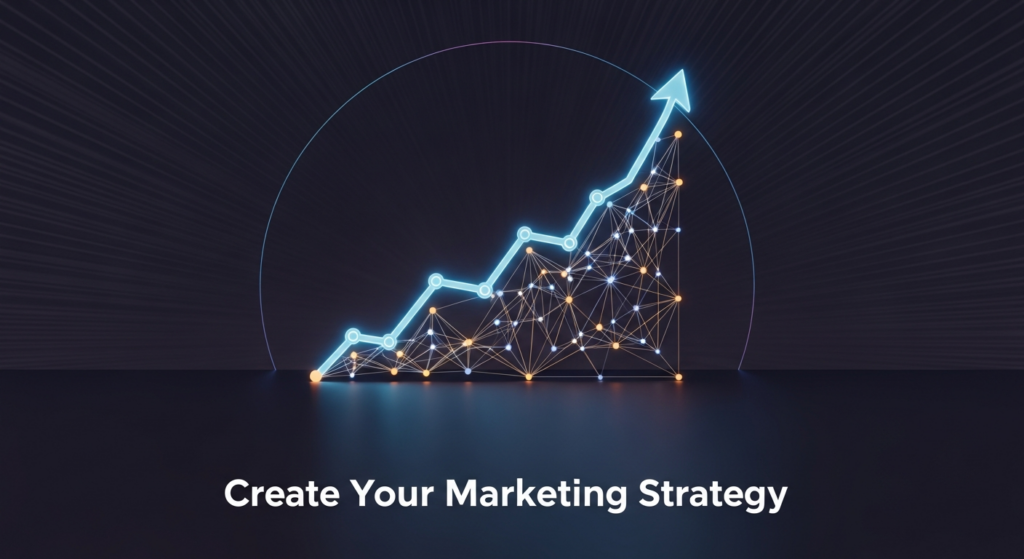
This comprehensive guide demystifies the process of creating a powerful marketing strategy from scratch. We will walk you through each critical phase, from initial research and goal setting to implementation and ongoing adaptation. Whether you are a startup founder laying the groundwork for your brand or an established marketer looking to refine your approach, this guide provides the actionable insights needed to build a strategy that drives tangible business results.

At its core, a marketing strategy is a long-term, forward-looking approach that outlines how a business will reach its target audience and convert them into customers. It is the foundational ‘why’ behind all marketing activities, answering fundamental questions such as: Who are our ideal customers? What unique value do we offer? How will we position ourselves against competitors? What primary business objectives must our marketing support?
A marketing strategy is not simply a list of tasks or a campaign calendar. It is the overarching framework that connects business goals to marketing efforts. This involves understanding the market landscape, identifying opportunities, defining your brand’s position, and allocating resources effectively to achieve a sustainable competitive advantage. It’s about making deliberate choices about where to compete and how to win.
Think of it like building a house. Your marketing strategy is the blueprint. It dictates the foundation, the structure, the number of rooms, and the overall design. Without this blueprint, you might start building walls and installing windows, but the final result would likely be unstable, incoherent, and unfit for its purpose. The strategy ensures that every component works together to create a strong, functional, and valuable whole.

Operating without a documented marketing strategy is like sailing a ship without a compass or a destination. You might be moving, but you have no way of knowing if you are heading in the right direction. A written strategy provides the clarity, alignment, and accountability needed to navigate the complexities of the market and drive intentional growth.
A documented strategy ensures alignment across the entire organization. When everyone—from the C-suite to the marketing intern—understands the core objectives, target audience, and value proposition, decisions become more consistent and effective. This clarity eliminates guesswork and ensures that sales, product development, and marketing teams are all working toward the same goals. Such alignment prevents wasted effort and internal friction, fostering a more efficient and cohesive organization.
Furthermore, a formal strategy provides a basis for measurement and optimization. By defining goals and Key Performance Indicators (KPIs) upfront, you establish benchmarks to measure campaign success. This data-driven approach allows you to identify what works and what does not, enabling you to adjust tactics, reallocate your budget, and continuously improve your ROI. It helps shift the perception of marketing from a cost center to a predictable driver of revenue. A documented plan is also a vital tool for securing budgets and resources, as it clearly articulates the expected outcomes and strategic thinking behind the investment.

The terms ‘marketing strategy’ and ‘marketing plan’ are often used interchangeably, but they represent two distinct yet sequential concepts. Understanding this difference is critical for effective execution. The strategy defines the ‘why’ and the ‘what,’ while the plan details the ‘how’ and the ‘when.’ The strategy provides the direction, and the plan outlines the steps to get there.
Your marketing strategy is the high-level blueprint. It outlines your long-term goals, defines your target audience, and establishes your brand positioning and unique value proposition. It’s concerned with the big picture and the competitive landscape. For example, a strategy might be to position your brand as the most sustainable option in the luxury goods market, targeting environmentally conscious, high-income earners.
The marketing plan, on the other hand, is the tactical roadmap that brings the strategy to life. It breaks down the strategy into specific actions, campaigns, and timelines. It details the channels you will use (e.g., content marketing, social media, PPC), the budget allocated to each, the content to be created, and the metrics to be tracked. Following the example above, the marketing plan would include details like launching a Q2 content marketing campaign focused on sustainable sourcing, running targeted Instagram ads showcasing eco-friendly materials, and partnering with environmental influencers. The strategy is the destination; the plan is the turn-by-turn navigation to get there.
| Feature | Marketing Strategy | Marketing Plan |
|---|---|---|
| Purpose | The ‘why.’ It defines the long-term goals and the approach to achieve a competitive advantage. | The ‘how.’ It details the specific actions, campaigns, and tactics to execute the strategy. |
| Scope | Broad and comprehensive, covering market position, target audience, and value proposition. | Narrow and specific, focused on individual campaigns, channels, and activities. |
| Timeframe | Long-term (typically 1-5 years), though it should be reviewed regularly. | Short-term (monthly, quarterly, or annually). |
| Focus | Achieving overarching business and marketing objectives. | Executing specific tasks and hitting campaign-level targets. |
| Example | “Become the leading provider of project management software for small creative agencies by focusing on superior user experience and integration capabilities.” | “Launch a 3-month LinkedIn ad campaign targeting agency owners, create 10 blog posts on productivity for creatives, and host a webinar on agency workflow optimization.” |

A robust marketing strategy is built on several key pillars that work in concert to guide your decisions. These foundational components ensure that your approach is customer-centric, competitive, and aligned with your business’s core strengths. Without them, your strategy lacks the structure to be effective.
The STP model is a cornerstone of modern marketing. It is a three-step process that ensures you communicate the right message to the right people.
The marketing mix is the set of controllable, tactical marketing tools a company uses to produce the desired response from its target market. The traditional model consists of the 4 Ps:
For service-based businesses, the model is often expanded to the 7 Ps, adding:
Your Unique Value Proposition (UVP), also known as a Unique Selling Proposition (USP), is a clear statement describing the benefit you offer, how you solve your customer’s needs, and what distinguishes you from the competition. It is the core reason a customer should buy from you instead of a competitor. A strong UVP is specific, concise, and focused on a benefit your target audience genuinely cares about. It should be front and center in your brand messaging and influence all your marketing communications.

The first phase of developing your marketing strategy is about discovery and definition. You cannot create an effective roadmap without first understanding the terrain and deciding on your destination. This foundational phase involves deep research into your market, your customers, and your own business, culminating in clear, measurable goals.
Before you can win in the market, you must understand it. Start with a comprehensive competitor analysis to identify your direct and indirect competitors. Analyze their products, pricing, marketing channels, and messaging. What are their strengths and weaknesses? Where are the gaps in the market that you can fill? Tools like Ahrefs or SEMrush can help you analyze their online presence and content strategy.
Simultaneously, perform a SWOT analysis of your own business. This framework helps you identify key internal and external factors:
This combined analysis will provide a realistic picture of your position in the market and highlight the most promising strategic directions.
You cannot effectively market to everyone. Attempting to do so results in generic messaging that resonates with no one. The key is to deeply understand your ideal customer. Go beyond basic demographics to explore their psychographics: What are their goals, challenges, and pain points? What motivates their purchasing decisions? Where do they spend their time online? What kind of content do they consume?
Consolidate this research into detailed buyer personas—semi-fictional representations of your ideal customer based on market research and real data. Give each persona a name, a job title, goals, and challenges. For example, you might create ‘Marketing Mary,’ a 35-year-old marketing manager at a mid-sized tech company who struggles with measuring ROI. This persona becomes a touchstone for all your marketing decisions, ensuring you create content and campaigns that speak directly to the needs of your target audience.
With a clear understanding of the market and your audience, you can set your goals. Vague objectives like ‘increase sales’ or ‘improve brand awareness’ are not actionable. To be effective, your goals must be SMART:
Setting SMART goals provides clarity, focus, and a clear benchmark for evaluating your performance.

Once you’ve established your strategic foundation with research and clear goals, it’s time to move into the more tactical aspects of your strategy. This phase is about deciding how you will reach your audience, what resources you will allocate, and what you will say to them. This is where your high-level strategy begins to take tangible shape.
A vast array of marketing channels is available, from digital staples like SEO and email to traditional methods like print and events. The key is not to be everywhere, but to be where your target audience is most active. Your buyer persona research is invaluable here. If ‘Marketing Mary’ spends her time on LinkedIn and reads industry blogs, then content marketing and LinkedIn advertising should be core tactics.
Consider a mix of channels that align with different stages of the customer journey. For example:
Select a handful of channels where you can make a significant impact rather than spreading yourself too thin across dozens.
Your marketing budget determines the scale and scope of your activities. There are several methods for setting a budget, such as a percentage of revenue (typically 5-15%) or objective-based budgeting, where you calculate the costs required to achieve your specific SMART goals. For a new business, it’s often a combination of what is affordable and what is necessary to gain initial traction.
Break down your total budget by channel and tactic. For example, 40% might go to content creation and SEO, 30% to paid advertising, 20% to marketing technology, and 10% to events. Be sure to include costs for personnel, software, and creative production. A clear budget prevents overspending and forces you to make strategic decisions about where to invest your resources for the highest potential return.
Your brand messaging is the expression of your unique value proposition. It is the consistent language and tone you use across all marketing channels to communicate who you are, what you do, and why it matters to your target audience. It should be clear, compelling, and consistent.
Develop a messaging framework that includes:
This framework ensures that every piece of communication, from a website headline to a social media post, reinforces your strategic positioning and resonates with your buyer personas.

The final phase is where strategy turns into action and results. A brilliant strategy is worthless if it is not executed effectively and its performance is not tracked. This phase focuses on creating a concrete plan of action and establishing the systems needed to measure success, learn from your efforts, and optimize over time.
This is where your marketing plan comes into full view. Translate your chosen tactics and channels into a specific, time-bound action plan. A content calendar, a campaign schedule, or a project management board can be used to organize this.
For each major initiative, define:
A detailed timeline, often visualized as a Gantt chart, helps you manage resources, identify dependencies, and ensure all moving parts of your plan are coordinated. This level of detail transforms your strategy from an abstract document into a day-to-day operational guide.
To know if your strategy is working, you must measure it. Key Performance Indicators (KPIs) are the specific, quantifiable metrics you will use to evaluate your progress against your SMART goals. Your KPIs should be directly tied to your objectives.
Here are some examples of goals and their corresponding KPIs:
Set up dashboards using tools like Google Analytics, HubSpot, or a dedicated BI tool to monitor these KPIs. Regularly review this data to understand what is performing well and where adjustments are needed.

Studying successful companies can provide powerful inspiration for your own strategy. These brands have mastered the art of understanding their audience and delivering a unique value proposition consistently.
Nike: Nike’s strategy is built on brand positioning and emotional storytelling. Their target audience is not just athletes; it’s anyone who has a body. Their core message, ‘Just Do It,’ is about aspiration, determination, and overcoming personal barriers. Their marketing strategy focuses less on product features and more on creating an emotional connection with consumers through high-profile athlete endorsements, inspiring ad campaigns, and community-building via apps like the Nike Run Club. The strategy is to sell an idea, not just a product.
Spotify: Spotify’s strategy revolves around personalization and user experience. They leveraged a ‘freemium’ model to achieve massive user acquisition, allowing people to experience the core product for free. Their key differentiator is a powerful, data-driven personalization engine. Features like ‘Discover Weekly’ and ‘Spotify Wrapped’ make users feel understood and create a product with high user retention. Their marketing highlights this personalization, positioning Spotify as a companion that curates the soundtrack to your life.
Airbnb: Airbnb’s strategy disrupted the hospitality industry by focusing on a unique value proposition: ‘Belong Anywhere.’ They did not sell rooms; they sold unique experiences and a sense of community. Its early growth strategy relied heavily on user-generated content, such as reviews and high-quality photos, alongside clever guerrilla marketing tactics. Airbnb’s marketing continuously emphasizes authentic travel experiences over sterile hotel stays, targeting travelers who seek connection and local culture. This customer-centric, community-focused strategy built immense trust and a powerful global brand.

Creating a marketing strategy does not have to be done in a vacuum. A wide range of tools can help you conduct research, organize your plans, and measure your results more effectively.

Developing a marketing strategy is a complex process, and it’s easy to make mistakes, especially when you’re just starting out. Being aware of these common pitfalls can help you create a more effective and resilient strategy.

A marketing strategy is not a static document to be created once and filed away. It is a living guide that must evolve with your business, customers, and the market. The most successful companies are agile and responsive, continuously learning from data and optimizing their approach.
Schedule regular reviews of your strategy—a quarterly review is a good cadence for most businesses. During these sessions, analyze your KPI dashboards to assess progress toward your SMART goals. Identify which channels are performing best and which campaigns have fallen short. Based on this analysis, be prepared to reallocate your budget from underperforming tactics to those delivering a higher ROI.
Stay curious and keep listening. Pay attention to changes in consumer behavior, new technologies, and shifts in the competitive landscape. Solicit feedback from your customers through surveys and interviews. Monitor social media conversations and industry news. When you discover new insights or face new challenges, be prepared to adjust your strategy accordingly. This could mean targeting a new audience segment, experimenting with a new marketing channel, or refining your brand messaging. The goal is not to abandon your core strategy but to fine-tune it, ensuring it remains relevant, effective, and aligned with your long-term vision for growth.