






In today’s hyper-competitive digital landscape, data is the lifeblood of marketing. Customers interact with brands across a vast array of channels—websites, mobile apps, social media, email, and physical stores. Each interaction generates a valuable piece of data, but the challenge and immense opportunity lie in unifying these disparate pieces. Without a coherent strategy, this data remains fragmented in isolated systems, leading to a disjointed customer experience and hampering marketing effectiveness. A robust marketing data integration strategy is therefore essential.
This guide provides a comprehensive walkthrough for building a unified data strategy. We will explore why it is no longer optional, break down the core components of a data ecosystem, and provide a step-by-step framework for auditing, planning, executing, and activating your integrated data. By unifying customer data across all platforms, you can unlock the insights needed to deliver truly personalized experiences, optimize marketing spend, and build lasting customer relationships.

The shift from multichannel marketing to omnichannel customer engagement has made data integration a fundamental requirement for success. Modern consumers do not see channels; they see a single brand. They expect a seamless, consistent, and personalized experience, whether they are browsing on their phone, asking a question on social media, or receiving an email. A fragmented data landscape makes meeting these expectations impossible. Investing in a unified strategy is not merely a technical upgrade; it is a strategic imperative for growth and relevance.
Data silos are the natural enemy of effective marketing. These isolated repositories of data prevent information from being shared between departments. For example, your email marketing platform knows a customer’s click history, your CRM has their purchase history, and your website analytics tool tracks their browsing behavior. When these systems fail to communicate, the consequences are severe:
The cost of these silos is not just financial; it’s a significant drain on customer trust and competitive advantage. Dismantling them is the first and most critical step toward a modern marketing approach.
The traditional, linear marketing funnel is a relic of the past. Today’s customer journey is a complex, non-linear web of interactions across multiple devices and platforms. A potential customer might discover your brand through a social media ad, visit your website to research products, sign up for your newsletter, add an item to their cart on a mobile app, and finally complete the purchase in a physical store. Each of these touchpoints is a critical piece of their story.
A unified data strategy allows you to connect these dots. By integrating data from all touchpoints, you can perform sophisticated customer journey mapping. This enables you to understand which channels are most effective at each stage, where friction points exist, and how different interactions influence the final purchase decision. Without this integrated view, you are marketing in the dark, unable to see the full picture of how customers engage with your brand.
The ultimate objective of a marketing data integration strategy is to create a Single Customer View (SCV). An SCV is a persistent, unified profile of each customer that consolidates every piece of data you have about them from every available source. This includes:
The SCV serves as the single source of truth for all marketing, sales, and service activities. It powers personalization, enables precise segmentation, and provides the foundation for accurate analytics and attribution. Achieving a true SCV transforms marketing from a series of disconnected campaigns into a cohesive, intelligent conversation with each customer.
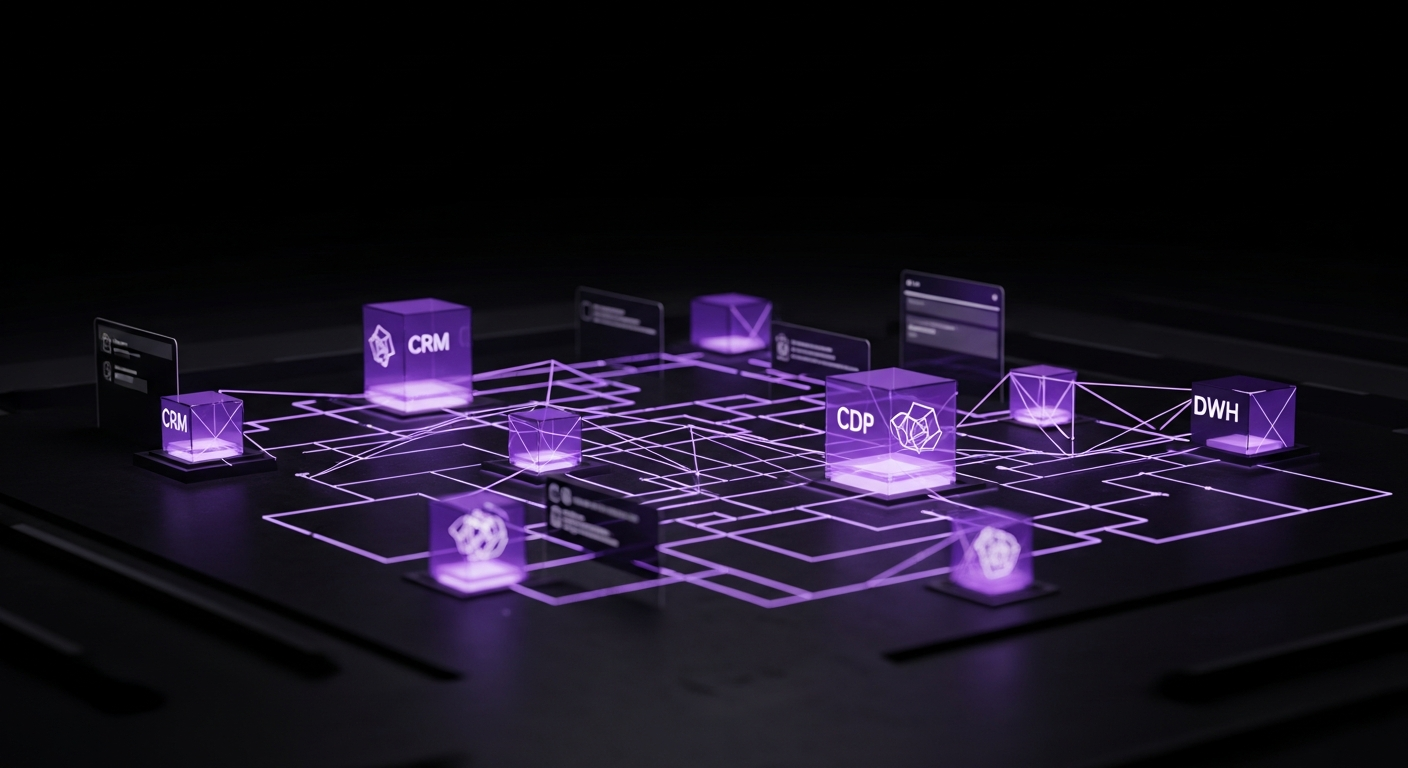
Building a unified data strategy requires understanding the key technologies that collect, store, and manage customer data. Each platform serves a distinct purpose, and they work best when integrated into a cohesive ecosystem. These are the core components you will encounter.
A Customer Relationship Management (CRM) system is a tool for managing direct interactions with customers and prospects. As the central hub for sales and service teams, a CRM stores contact information, tracks sales pipelines, and logs customer service communications. While CRMs contain a wealth of valuable first-party data, they typically focus on information gathered through direct channels and often lack a complete view of a customer’s digital browsing behavior or marketing engagement.
A Customer Data Platform (CDP) is the heart of a modern marketing data integration strategy. Its primary function is to collect first-party customer data from numerous online and offline sources, unify that data through identity resolution, and create the Single Customer View (SCV). A CDP then makes these unified profiles available to other systems in your marketing stack, such as email platforms and advertising networks. Unlike a CRM, a CDP is built to handle vast amounts of behavioral and anonymous data and stitch it to known customer profiles, providing a comprehensive view of the entire customer journey.
A Data Management Platform (DMP) is used primarily for advertising. Its main purpose is to collect, organize, and activate large sets of anonymous, third-party data like cookies and device IDs. Marketers use DMPs to create audience segments for programmatic ad campaigns and to find new lookalike audiences. While DMPs are powerful for top-of-funnel acquisition, they are less effective for managing relationships with known customers because their data is anonymous and has a short lifespan. The increasing restrictions on third-party cookies are also impacting the traditional role of DMPs.
Data Warehouses and Data Lakes are large-scale storage systems designed for business intelligence (BI) and advanced analytics. A Data Warehouse stores structured, processed data in a predefined schema, ideal for generating standardized reports. A Data Lake stores vast amounts of raw data in its native format, both structured and unstructured. Data scientists use data lakes for deep exploration and to build complex predictive models. While powerful for historical analysis, these systems are not designed to activate data in real-time for marketing campaigns, which is a key function of a CDP.
| Feature | Customer Data Platform (CDP) | Customer Relationship Management (CRM) | Data Management Platform (DMP) |
|---|---|---|---|
| Primary Data Source | First-party data (behavioral, transactional, demographic) from all sources | First-party data (transactional, interactional) from sales and service | Third-party anonymous data (cookies, device IDs) |
| Primary User | Marketing Teams | Sales and Customer Service Teams | Advertisers and Media Buyers |
| Key Function | Unify customer data into a Single Customer View (SCV) and activate it | Manage customer relationships and sales pipeline | Create anonymous audience segments for digital advertising |
| Data Identifier | Persistent, known individuals (email, phone, user ID) | Known customers and leads (email, account number) | Anonymous identifiers (cookies, mobile ad IDs) |
| Data Persistence | Long-term, historical data | Long-term, relationship history | Short-term, typically 90-day cookie lifespan |

Before building a unified data strategy, you must first understand your current landscape. A thorough audit is the essential first step to identify what data you have, where it lives, and how it moves—or fails to move—throughout your organization. This process provides the blueprint for your entire integration project.
The goal is to create a comprehensive inventory of every place a customer or prospect can interact with your brand. Collaborate with different departments (marketing, sales, support, product) to ensure nothing is missed. Your list often includes:
For each touchpoint, document the type of data it generates (e.g., a website generates page views and form fills; a POS system generates transaction data).
Once you have a list of sources, visualize how data currently moves between them. This map will often reveal a tangled web of point-to-point connections and, more importantly, a significant number of dead ends where data is completely siloed. Create a diagram showing each system as a node and draw lines to represent existing connections. Ask critical questions:
This mapping exercise will highlight the precise location and severity of your data silos, clarifying where integration efforts are most needed.
Not all technologies are equal when it comes to data integration. For each platform in your stack, assess its ability to share data. Look for key features like a well-documented API (Application Programming Interface), which allows other systems to access its data programmatically. Investigate its export capabilities and whether it has pre-built connectors with other common platforms. This evaluation will help you determine if your existing tools can be part of the solution or if they are part of the problem and need to be replaced.

A data integration project without clear goals is destined to fail. It is not enough to simply want “unified data.” You must define precisely what you want to achieve with that data and how you will measure success. This step ensures your technical efforts are directly tied to tangible business outcomes.
Your data strategy should directly reflect your company’s overarching business goals. Start by identifying key objectives for the next year. Are you focused on increasing customer retention, improving lead conversion rates, or growing average order value? Once these are defined, you can formulate data goals that support them. For example:
This alignment ensures you get buy-in from leadership and that your project delivers demonstrable value to the organization.
To make your goals actionable, they should follow the SMART framework: Specific, Measurable, Achievable, Relevant, and Time-bound. Vague goals like “improve personalization” are not helpful. A SMART goal provides clarity and a clear target.
A well-defined SMART goal could be: “To create a Single Customer View by integrating our Shopify, Salesforce, and Mailchimp data within nine months, enabling us to launch three behavior-based automated marketing campaigns by the end of Q4.”
Key Performance Indicators (KPIs) are the specific metrics you will track to monitor progress and measure the ultimate success of your integration strategy. These should be a mix of project-level and business-impact metrics.
Regularly tracking these KPIs will demonstrate the value of your project and help you identify areas for improvement along the way.

With your goals defined, the next step is to decide on the architectural approach for connecting your systems. The model you choose will impact the scalability, flexibility, and maintenance cost of your data ecosystem. It is crucial to select a model that not only solves immediate problems but can also grow with your business.
There are two primary models for connecting applications:
| Aspect | Point-to-Point Integration | Hub-and-Spoke Model |
|---|---|---|
| Scalability | Poor. Becomes exponentially complex with each new system. | Excellent. Easily add new systems by connecting them to the hub. |
| Maintenance | High. A change in one system may require updating multiple connections. | Low. Changes are managed centrally at the hub. |
| Data Consistency | Low. Risk of data discrepancies with no central source of truth. | High. The hub acts as the central repository and ensures data consistency. |
| Best For | Organizations with only 2-3 systems to connect. | Most businesses, especially those planning to grow their tech stack. |
ETL and ELT are two common processes for moving data from a source system to a destination like a data warehouse.
The choice between ETL and ELT depends on your tools, data volume, and analytical needs.
An Application Programming Interface (API) is a set of rules that allows different software applications to communicate. In data integration, APIs are the digital messengers that enable real-time data exchange. For example, when a customer makes a purchase, an API can instantly send that transaction data from your e-commerce platform to your CDP and CRM. Modern integration relies heavily on APIs for speed and efficiency, enabling the real-time personalization and marketing automation that customers now expect. A robust and well-documented API is a critical feature when evaluating any new tool.

Choosing the right technology is a critical decision that will shape the success of your data integration efforts. The market is filled with a wide array of tools, from comprehensive platforms to specialized solutions. Your choice should be guided by your specific goals, technical resources, and budget.
You have two strategic options when building your technology stack:
For most marketers focused on data unification, a best-of-breed approach with a strong CDP at its core provides the most power and flexibility.
When evaluating a Customer Data Platform or a similar integration hub, consider several critical features:
Implementing a data integration strategy is a significant investment that goes beyond software license fees. Your budget should account for several key areas:

Integrating your data is powerful, but without proper governance, it can lead to a “garbage in, garbage out” scenario. A data governance framework is a set of rules, processes, and standards that ensures your data is accurate, consistent, secure, and used responsibly. This is not an optional add-on; it is a foundational element of a successful and sustainable data strategy.
Data quality is paramount. Your unified profiles are only as good as the data they contain. Establish and enforce data standards across the organization by creating a data dictionary that defines key metrics and attributes. For example, how is an “active customer” defined? What format should be used for phone numbers? Implementing standardization rules during data ingestion helps prevent inconsistencies and ensures the integrated data is clean and reliable from the start.
A key part of data governance is clarifying roles and responsibilities. Assign clear ownership for different data domains. For example, the marketing team might “own” campaign engagement data, while the sales team owns CRM data. The data owner is responsible for the accuracy and proper use of their data set. Furthermore, you must establish clear, role-based access controls to ensure that employees can only view or modify data relevant to their job function. This protects data integrity and enhances security.
In the modern era, data compliance is non-negotiable. Global privacy regulations like the General Data Protection Regulation (GDPR) and the California Consumer Privacy Act (CCPA) grant consumers significant rights over their personal data. A unified data system can make compliance easier by providing a central place to manage customer data and consent preferences. Your governance framework must include clear processes for handling data requests, managing consent flags, and ensuring all data processing has a legal basis. Failure to comply can result in hefty fines and significant damage to your brand’s reputation.

With a solid plan, the right tools, and a governance framework in place, it is time to begin the technical implementation. A methodical, phased approach is crucial to minimize disruption and ensure a successful outcome. This is where your strategic planning transforms into a tangible, unified data asset.
Trying to integrate all your data sources at once is a recipe for disaster. Instead, adopt a phased approach that prioritizes based on impact and feasibility. Start small to score an early win and build momentum.
This iterative process allows your team to learn and adapt, reduces project risk, and begins delivering value much sooner.
This is the critical data hygiene step that occurs during integration. Raw data from source systems is often messy, inconsistent, and full of duplicates.
These processes are essential for creating the accurate and reliable Single Customer View that your marketing efforts will depend on.
Before you activate your newly unified data, you must rigorously test and validate it. Trust in the data is paramount, and teams will not use a system they believe is inaccurate. Create a validation plan that involves:
Only after thorough validation should you proceed to activate the data in your live marketing campaigns.

The true value of a data integration strategy is realized when you put your unified data to work. A Single Customer View is not just a database; it is a strategic asset that can revolutionize your marketing, transforming it from generic broadcasts into personalized, relevant conversations that drive real business results.
With a complete view of each customer’s history, preferences, and behaviors, you can move beyond simple personalization like using a first name in an email. Hyper-personalization involves tailoring every aspect of the customer experience in real-time. Examples include:
Unified data allows you to graduate from basic demographic segmentation to far more powerful methods. You can build rich, dynamic audience segments that drive more effective campaigns:
One of the biggest challenges in marketing is understanding which efforts actually drive results. Data silos make true multi-touch attribution nearly impossible. With an integrated data set that captures touchpoints across the entire customer journey, you can finally connect the dots between your marketing spend and revenue.
By unifying data from your ad platforms, website analytics, and CRM, you can analyze the full sequence of interactions that led to a conversion. This allows you to move beyond simplistic “last-touch” attribution and implement more sophisticated models (like linear or time-decay) that assign proper credit to each touchpoint. This leads to a clearer understanding of marketing ROI and enables you to make smarter decisions about budget allocation.

Embarking on a data integration project is a complex undertaking, and several common traps can derail even the best-laid plans. Being aware of these pitfalls from the outset can help you navigate the process more effectively.

The field of marketing data integration is continuously evolving, driven by advancements in technology and rising customer expectations. As we look to the future, three key trends are set to further transform how businesses leverage unified customer data: Artificial Intelligence (AI), real-time processing, and predictive analytics.
Artificial intelligence and machine learning are becoming accessible features within marketing platforms like CDPs. AI will automate complex tasks like identifying micro-segments or predicting the next best action for each individual. This allows marketers to move beyond rule-based campaigns to AI-driven personalization, where the system itself determines the optimal content, timing, and channel for each customer interaction, delivering personalization that is impossible to achieve manually at scale.
The demand for “in-the-moment” marketing is also pushing the industry toward true real-time data processing. While traditional systems operated on batch updates, modern infrastructure is being built to ingest, unify, and activate data in milliseconds. This means a customer’s action on a mobile app can instantly trigger a personalized experience on the website they visit seconds later. This real-time capability allows brands to be incredibly responsive and relevant, capitalizing on customer intent at the exact moment it occurs.
Finally, the culmination of unified data and AI is the rise of predictive analytics. With a rich, historical dataset, businesses can build sophisticated models to forecast future outcomes. This includes predicting customer lifetime value, identifying customers with a high propensity to churn, and forecasting which products are likely to be popular next quarter. These predictive insights enable marketers to shift from a reactive to a proactive stance, making strategic decisions that anticipate customer needs and market trends.

These platforms manage customer data but for distinct purposes. A CRM (Customer Relationship Management) is for managing direct customer interactions, primarily for sales and service. A DMP (Data Management Platform) is for advertisers and uses anonymous, third-party data for ad targeting. A CDP (Customer Data Platform) is a marketing system that ingests first-party data from all sources to create a unified profile (a Single Customer View) for each customer, which is then used to orchestrate personalized marketing across all channels.
The ROI is measured by tracking improvements in key business metrics impacted by unified data. This includes increases in Customer Lifetime Value (LTV) from better retention, reductions in Customer Acquisition Cost (CAC) from more efficient targeting, improved conversion rates on personalized campaigns, and a decrease in customer churn. By establishing a baseline for these metrics before implementation, you can quantify the financial impact.
The top challenges are typically poor data quality (inconsistent or inaccurate data), the technical complexity of integrating legacy systems that lack modern APIs, and achieving accurate identity resolution (correctly matching data from different sources to the right individual). Organizational challenges, such as a lack of cross-departmental collaboration and the absence of a strong data governance framework, are also significant hurdles.
A small business can start with a phased, focused approach. Begin by identifying your two or three most important data sources, such as your website analytics, email list, and e-commerce platform. Use a modern Customer Data Platform (CDP) that offers pre-built connectors for these tools to simplify the technical work. The goal should be to achieve an initial Single Customer View and use it for a specific, high-impact use case, like a cart abandonment campaign, to prove value quickly before expanding.
A Single Customer View (SCV) is a complete, persistent, and centralized profile of an individual customer that consolidates all the data you have about them from every touchpoint (e.g., website visits, purchases, support tickets). It is important because it serves as the single source of truth for all marketing and sales activities. The SCV eliminates data silos, enabling true personalization, accurate segmentation, and a seamless customer experience across all channels.
A successful data integration strategy requires cross-functional collaboration. Key departments to involve include Marketing (as the primary driver), IT (for technical expertise on systems and security), Sales and Customer Service (as key sources and users of customer data), and the Analytics or Business Intelligence team (for expertise in data analysis). Involving legal and compliance teams early on is also crucial to ensure the strategy adheres to data privacy regulations.