





For decades, the marketing funnel was the dominant growth framework. It offered a clear, linear path illustrating how a stranger becomes a customer. Businesses built strategies on its principles, with marketing teams focused on filling the top of the funnel and optimizing conversions at each stage. However, in today’s customer-centric landscape, the limitations of this model are clear. The customer journey is not a straight line, and treating a customer’s value as complete at the point of purchase is a significant oversight.
Enter the Flywheel, a modern, cyclical model that places the customer at the center of the business. Popularized by HubSpot, the Flywheel reimagines growth not as a finite process but as a continuous, self-reinforcing loop. Its core principle is that satisfied customers are the most powerful driver of growth. This paradigm shift challenges organizations to rethink everything from departmental structure to how they define success.
This guide deconstructs both the traditional marketing funnel and the customer-centric Flywheel model. We will compare them directly, explore their respective strengths and weaknesses, and provide a clear roadmap for businesses considering a new approach. Is the funnel truly obsolete, or does it still have a place in a Flywheel-driven world? Let’s examine the evidence.

To appreciate the shift to the Flywheel, we must first understand the framework that dominated business strategy for generations. The marketing and sales funnel visualizes the customer journey as a series of narrowing stages. Its logic is straightforward: cast a wide net to attract a large audience and then guide as many prospects as possible to the bottom, where they emerge as customers.
A traditional funnel is typically divided into key stages, often known by acronyms like AIDA (Awareness, Interest, Desire, Action) or by their position: Top of Funnel (ToFu), Middle of Funnel (MoFu), and Bottom of Funnel (BoFu).
The movement through the funnel is unidirectional. A prospect enters at the top and, if successfully converted, exits at the bottom. The process then begins again with new prospects.
The funnel’s longevity is no accident; it became a staple for several compelling reasons. Its primary strength is its simplicity. It provides a clear, easily understood model for a complex journey, allowing teams to visualize progress and establish a common language between marketing and sales.
Furthermore, the funnel is highly measurable. Marketers can track conversion rates between each stage to identify bottlenecks and opportunities for improvement. The model provides direct answers to questions like, “What percentage of our website visitors become leads?” or “What is our lead-to-customer conversion rate?” This data-driven approach enables predictable forecasting and resource allocation. In an era dominated by outbound marketing, where companies controlled the flow of information, this linear process was highly effective.
Despite its historical success, the funnel model is ill-suited to modern business because it treats customers as an output, not an asset. The entire model culminates in a sale. Once the transaction is complete, the customer exits the funnel, and their potential energy is lost. The process ends precisely where the greatest opportunity for sustainable growth—customer advocacy—begins.
This approach ignores the immense power of happy customers. It fails to account for word-of-mouth marketing, repeat business, and brand loyalty. With studies showing that a vast majority of consumers trust peer recommendations over brand advertising, treating existing customers as an afterthought is a critical error. Additionally, the modern customer journey is rarely linear. A buyer might discover a brand on social media (Awareness), read third-party reviews (Consideration), visit a pricing page (Decision), and then return to read a blog post (Awareness) before requesting a demo. The funnel’s rigid structure fails to reflect this complex, buyer-driven reality, often leading to departmental silos. Marketing generates leads and passes them to sales, while customer service is often viewed as a separate cost center rather than a part of the core growth engine.
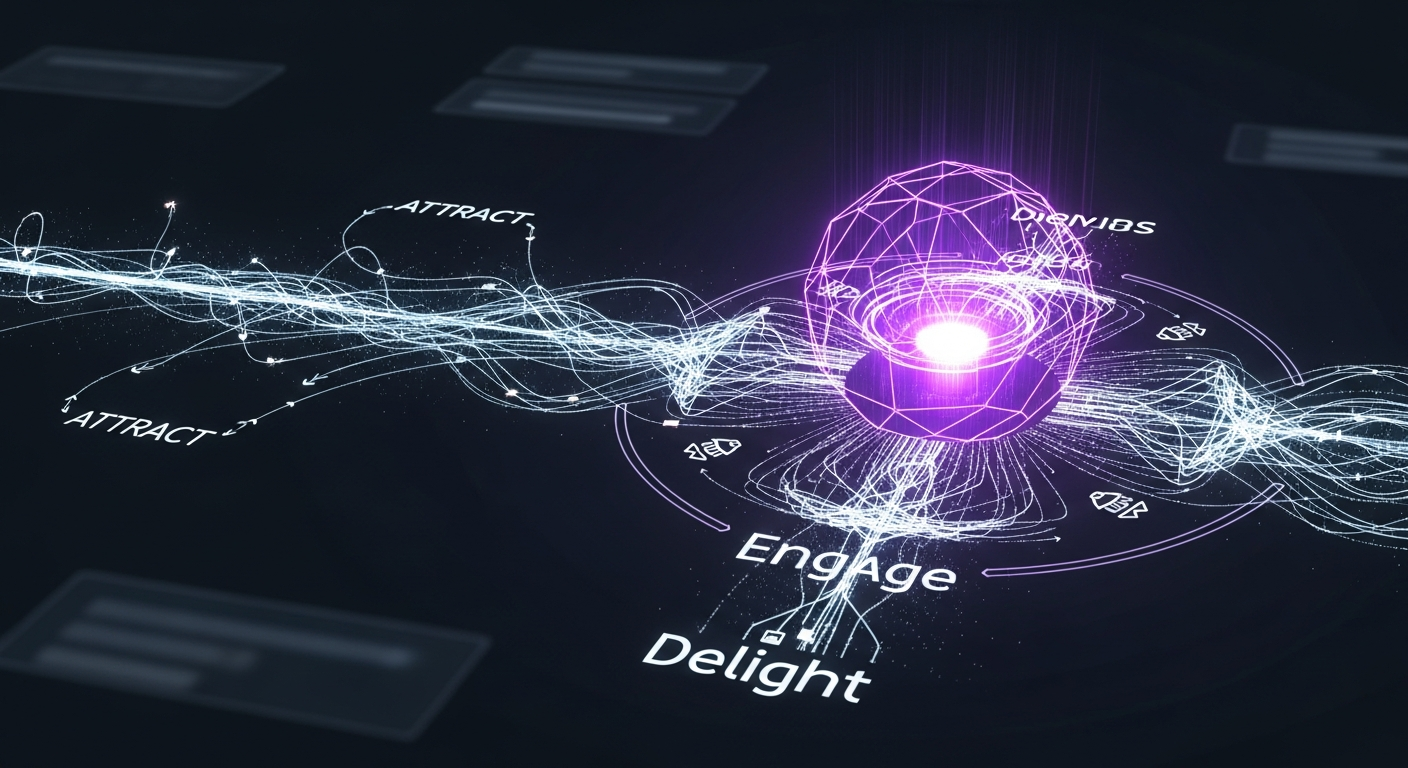
As the funnel’s shortcomings became more pronounced, a new model emerged that better represents modern growth dynamics. The Flywheel reframes the customer journey not as a linear process but as a circular, self-sustaining loop. It is a business philosophy built on a simple yet powerful premise: happy customers are the most effective fuel for growth.
Instead of a narrowing funnel, the Flywheel is a continuous cycle with the customer at its core. Growth is achieved by applying force to three key stages, which makes the wheel spin faster and with less friction over time.
The model’s power lies in the connection between these stages. Delighted customers become promoters who share positive experiences, write reviews, and refer new business. This advocacy feeds directly back into the Attract stage, creating a self-reinforcing growth loop.
The Flywheel analogy is rooted in physics, which helps explain how it drives growth. Three factors determine its effectiveness:
In the funnel model, the energy for customer acquisition comes exclusively from a company’s sales and marketing budget—a constant, resource-intensive effort. In the Flywheel model, a significant portion of that energy comes from the existing customer base. When customers are delighted, they effectively become part of your marketing team.
Each satisfied customer adds momentum. Their positive reviews, social media mentions, and direct referrals apply force to the flywheel, attracting new prospects. This advocacy is often the most credible and effective marketing channel, creating compounding growth. Every new happy customer not only represents revenue but also adds energy to the system, making it easier and more cost-effective to acquire the next one.
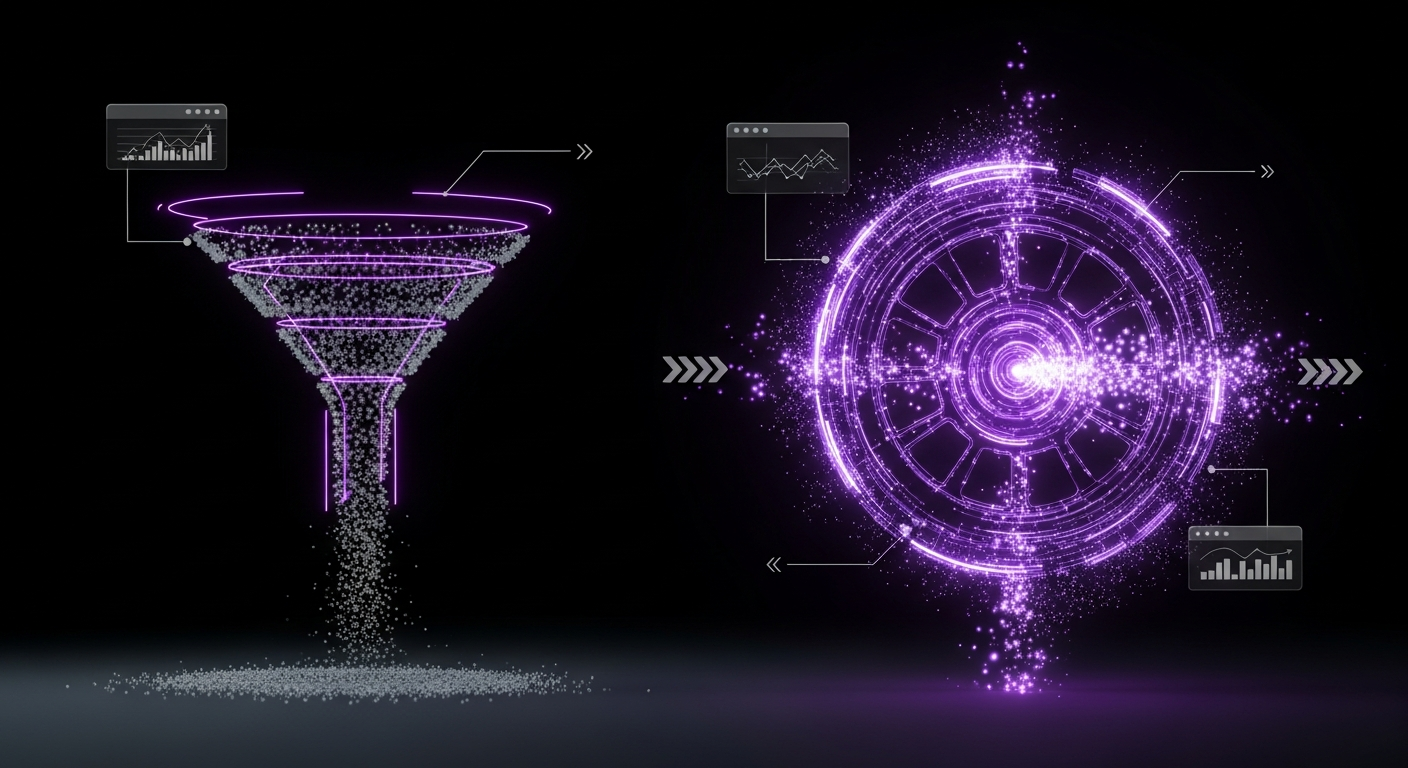
Comparing these two models directly across key dimensions highlights the fundamental shift in strategy they represent for growth, customer relationships, and internal organization.
| Dimension | Marketing Funnel | Flywheel Model |
|---|---|---|
| Customer Role | An output; the end-point of the process. | The core; the central driving force of growth. |
| Business Growth | Linear and resource-intensive. Growth requires constantly adding more leads to the top. | Compounding and sustainable. Happy customers add momentum, making future growth more efficient. |
| Departmental Structure | Encourages silos. Marketing, Sales, and Service often operate independently with distinct goals. | Requires alignment. Marketing, Sales, and Service must work together with shared goals to reduce friction. |
| Primary Focus | Customer acquisition. Success is measured by the number of new deals closed. | Customer experience and retention. Success is measured by customer satisfaction, retention, and advocacy. |
| Source of Energy | Company-driven. Relies entirely on sales and marketing efforts and budget. | Customer-driven. Leverages the energy of happy customers (word-of-mouth, referrals) to fuel growth. |
| View of Customers | A resource to be converted. | An asset to be invested in. |
The most significant difference is how each model perceives the customer. The funnel views the customer as the final destination of a linear process. In contrast, the Flywheel places the customer at the center, recognizing that the relationship truly begins at the point of sale. A customer’s success and satisfaction are the fuel that powers future business growth.
Growth in a funnel-based business is linear. To double your revenue, you generally need to double your inputs at the top of the funnel, which often means doubling your marketing spend. It’s a model of addition. The Flywheel enables compounding growth. By delighting customers, you create advocates who bring in new customers, who in turn can become advocates. This creates a virtuous cycle where growth begets more growth, reducing dependency on paid acquisition over time.
Funnels naturally create divisions. Marketing owns the top, Sales owns the bottom, and Service handles post-sale issues. This leads to friction at handoff points and a disjointed customer experience. The Flywheel demands the opposite. To reduce friction and keep the wheel spinning smoothly, Marketing, Sales, and Customer Service must be deeply integrated. They need shared data, shared goals (like Net Promoter Score or Customer Lifetime Value), and a collective responsibility for the entire customer journey.
The primary KPI for a funnel is often the number of new customers acquired and the cost of that acquisition (CAC). While important, this narrow focus can lead businesses to neglect existing customers. The Flywheel promotes a more balanced approach. It elevates metrics related to customer health and happiness—like retention rate, churn, and CLV—to the same level of importance as acquisition metrics. It recognizes that retaining and delighting an existing customer is often more profitable than acquiring a new one.

While the Flywheel is a more modern strategic approach, dismissing the funnel entirely would be a mistake. The framework has inherent strengths that provide tactical value, but its strategic weaknesses in today’s market are significant.

Adopting a Flywheel mindset offers profound strategic advantages that help build a more resilient and sustainable business. The transition represents a fundamental shift in operational philosophy, not just a change in diagrams.

Shifting from a linear funnel to a cyclical flywheel requires a strategic, cultural, and operational transformation. It involves reorienting the entire company around the customer. These four steps can guide the transition.
The first step is to understand where your flywheel is losing momentum. Map out every single touchpoint a customer has with your company, from their first visit to your website to their 10th interaction with your support team. At each point, ask critical questions: Where are handoffs between teams clunky? Which internal policies are company-centric instead of customer-centric? Why do customers churn? Involve members from marketing, sales, and service in this process to get a complete picture. Use customer surveys, support tickets, and interviews to identify the biggest sources of friction.
Silos are the enemy of the Flywheel. You must restructure your teams to foster collaboration around the customer. This starts with shared goals. Instead of Marketing being measured on MQLs and Sales on closed deals, introduce shared KPIs like customer satisfaction (NPS) or overall revenue growth. Implement a unified CRM that provides a single source of truth for all customer interactions. Schedule regular cross-functional meetings where teams can discuss friction points and collaborate on solutions to improve the customer experience at every stage.
Your metrics dictate your focus. To truly adopt a Flywheel model, you must elevate customer-centric KPIs to the same level of importance as acquisition metrics. While you’ll still track things like conversion rates, your primary dashboard should feature metrics that measure the health and momentum of your flywheel. These include Net Promoter Score (NPS), Customer Lifetime Value (CLV), Churn Rate, and Referral Rate. When the entire company is focused on improving these numbers, the culture naturally shifts toward delighting the customer.
The final step is to actively invest in turning your happy customers into a growth engine. This goes beyond simply providing good service. It means creating systems to amplify their voices. Proactively ask for feedback and reviews on relevant platforms. Build a formal customer referral program that rewards them for sending new business your way. Create case studies and testimonials that showcase their success. Invest in a world-class customer success team whose primary job is to ensure your customers achieve their desired outcomes with your product or service. By helping them win, you ensure your own flywheel spins faster.
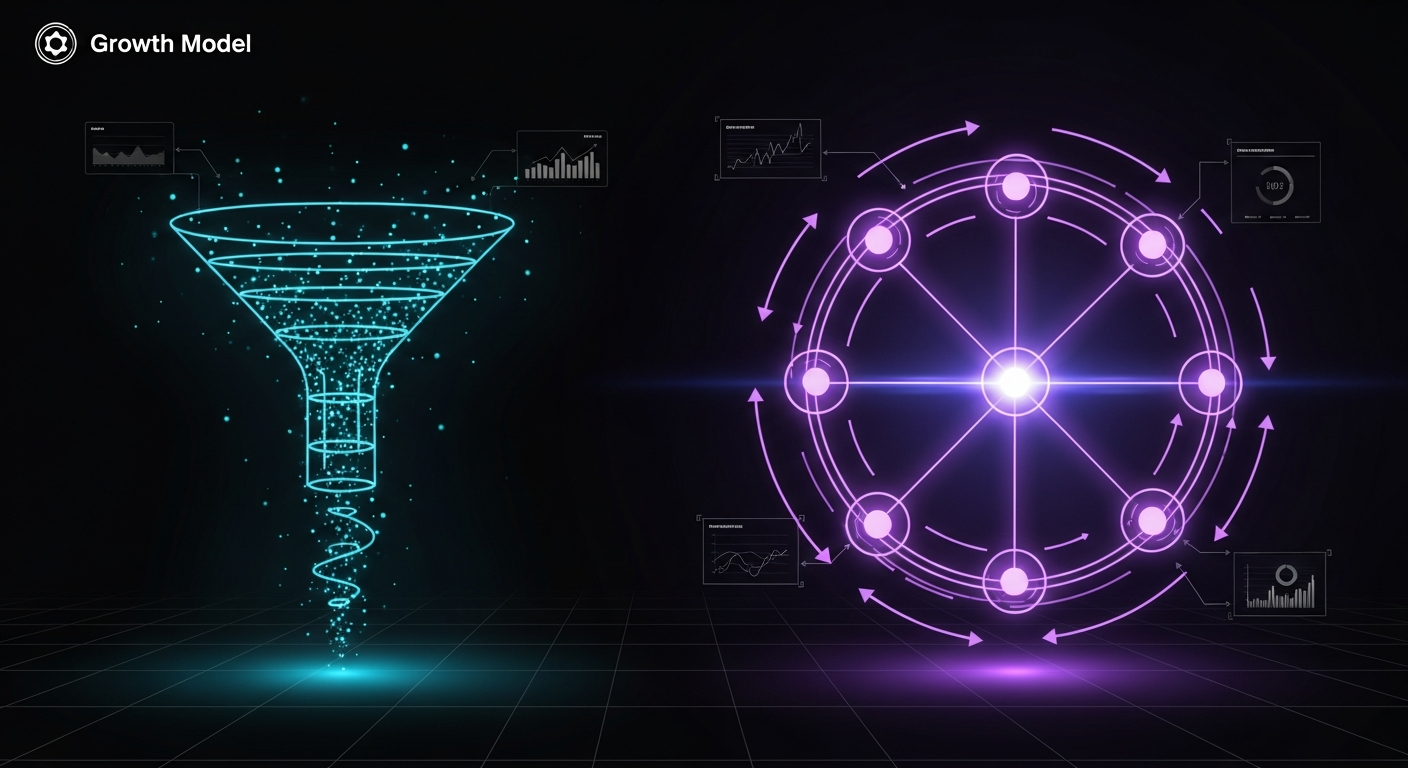
The metrics a company prioritizes reveal which model it truly operates under. While some KPIs overlap, the core metrics for the funnel and the flywheel highlight their distinct philosophies.
Funnel-centric businesses live and die by their conversion metrics. Their focus is on the efficiency of acquisition.
Flywheel-centric businesses focus on metrics that reflect customer health, loyalty, and advocacy. Their focus is on sustainable, long-term value.
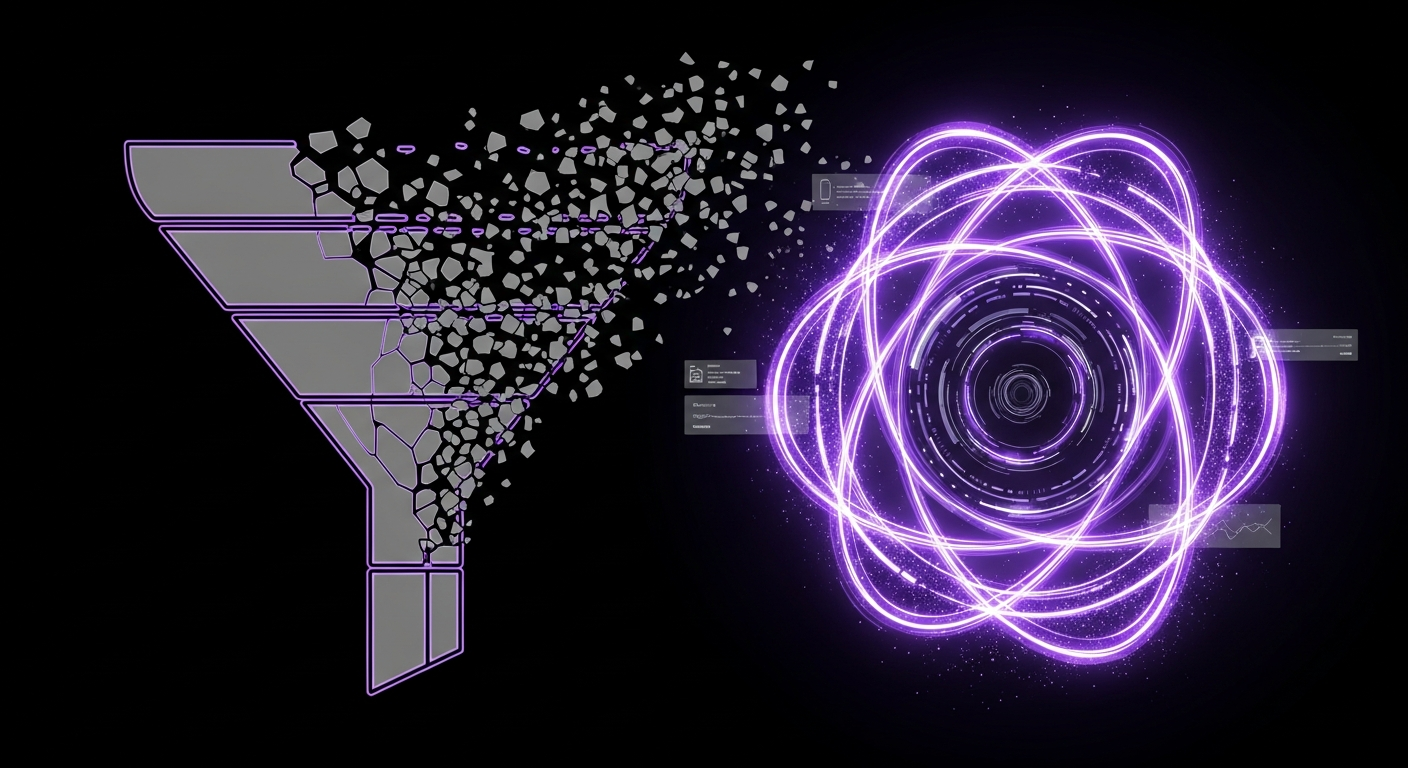
Despite the compelling case for the Flywheel, the funnel is not obsolete. Its value has shifted from an overarching business strategy to a tactical tool for optimizing specific processes *within* the Flywheel. Funnels can be viewed as diagnostic instruments applied to parts of the larger, cyclical journey.
For example, you can use a mini-funnel to analyze and improve the conversion path on a specific landing page. How many people who see the page fill out the form? You can apply a funnel to your sales process to understand the conversion rates from the first call to a closed deal. In these contexts, the funnel’s ability to measure stage-by-stage drop-off is incredibly valuable for identifying and fixing friction.
Furthermore, for businesses with highly transactional, low-consideration products where the post-purchase relationship is minimal, a simple funnel model might still be sufficient. However, even these businesses can benefit from thinking about how to generate positive reviews and repeat purchases, which are core tenets of the Flywheel.
The Flywheel model is not just theoretical; it is the engine behind some of the world’s most successful companies.
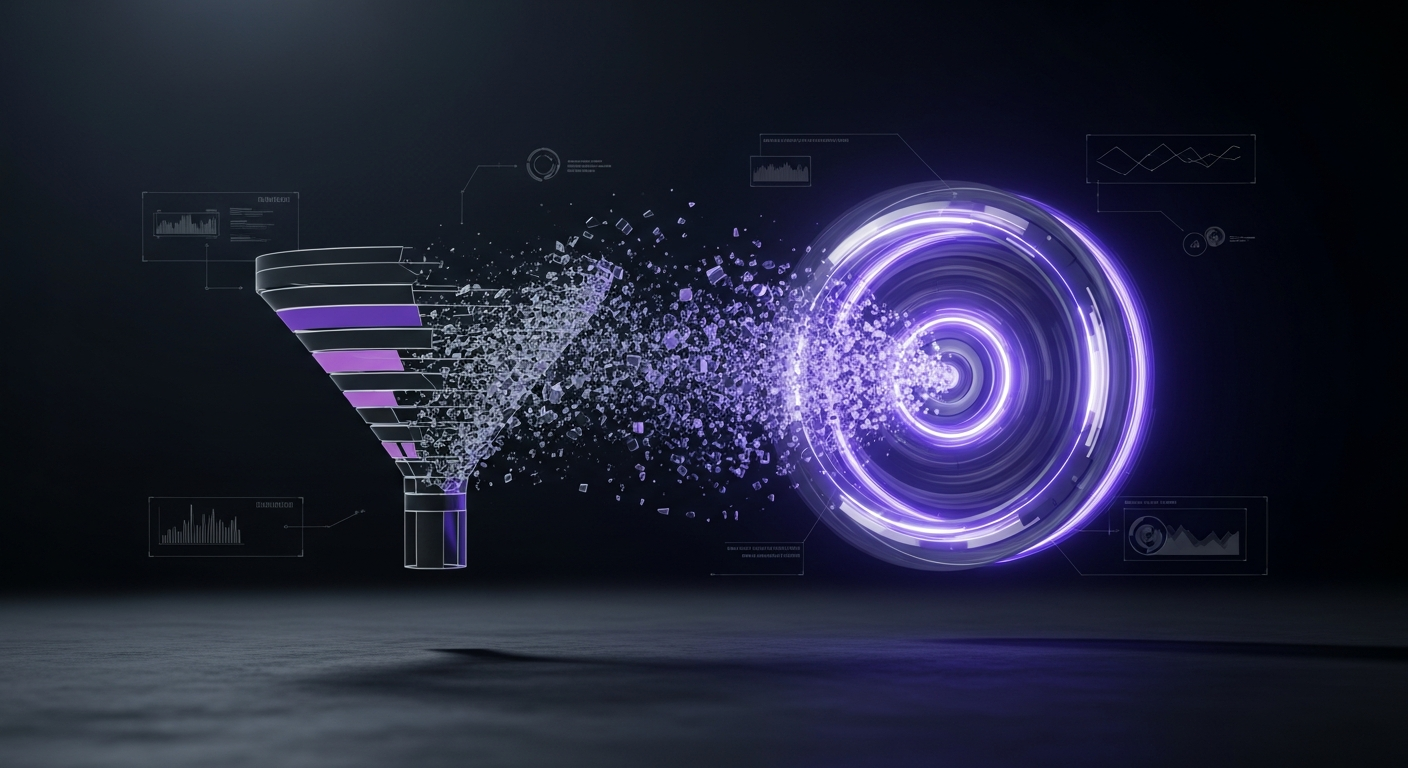
The debate between the Flywheel and the Funnel is not about declaring a winner but about recognizing an evolution in business strategy and customer expectations. The traditional marketing funnel, with its singular focus on acquisition and its linear view of the customer, is no longer sufficient as a comprehensive growth strategy.
The Flywheel provides a more accurate and sustainable framework for today’s market. By placing the customer at the center, it builds a system of compounding momentum based on the principle that customer success drives business success. This model encourages businesses to break down internal silos, focus on a remarkable end-to-end experience, and leverage their happiest customers as their most effective marketing channel.
So, is the funnel obsolete? As a primary business strategy, yes. However, as a tactical tool for diagnosing and optimizing specific processes within the Flywheel, it remains valuable. The future of growth lies not in abandoning the funnel’s lessons but in integrating them into the broader, customer-centric philosophy of the Flywheel. Ultimately, the companies that thrive will be those that see customers not as the end of a process, but as the very heart of it.
The core difference is their structure and treatment of the customer. The funnel is linear and treats customers as an output; after a purchase, they exit the model. The flywheel is cyclical, placing the customer at the center and using the energy from satisfied customers (referrals, repeat business) to fuel new growth. A funnel loses momentum at the end, whereas a flywheel reinvests it.
Yes, but its role has changed. While it is no longer effective as an overarching business growth strategy, the funnel is still a relevant and useful tool for tactical analysis. It can be used to measure and optimize specific linear processes, such as the conversion rate on a landing page or the stages of a sales pipeline, which are parts of the larger flywheel.
Success is measured with customer-centric metrics that reflect the flywheel’s health and momentum. Key performance indicators (KPIs) include Net Promoter Score (NPS) to gauge customer satisfaction, Customer Lifetime Value (CLV) to measure long-term profitability, customer churn rate to track retention, and referral rate to quantify how effectively your delighted customers are driving new business.
Absolutely. The most effective approach is to use the flywheel as the primary strategic framework for the entire business, ensuring all departments are aligned around the customer experience. Then, use funnels as diagnostic tools within the flywheel’s stages. For example, you can apply a funnel to your ‘Attract’ stage to optimize your content-to-lead conversion rate.
The three stages of the marketing flywheel, as defined by HubSpot, are: Attract, Engage, and Delight. ‘Attract’ focuses on drawing in prospects with valuable content. ‘Engage’ is about building relationships and making it easy to buy. ‘Delight’ centers on providing an outstanding post-purchase experience to create advocates and promoters.
While the concept of a flywheel as a business metaphor was famously discussed by Jim Collins in his book “Good to Great,” it was Brian Halligan, the co-founder of HubSpot, who adapted and popularized it as a modern replacement for the traditional marketing funnel. He introduced it as a way to illustrate how customer-centricity and inbound principles create a self-sustaining growth loop.