








In digital marketing, a customer’s path from awareness to purchase is rarely a straight line. They might see a social media ad, read a blog post, click a search result, and open an email newsletter before making a decision. This complexity raises a critical question for marketers: which of these touchpoints drove the sale? Marketing attribution answers this question. It is the analytical process of assigning credit to the various marketing interactions a customer has on their journey to conversion.
Implementing an attribution model provides a framework for evaluating how each channel and campaign contributes to business goals. It moves analysis beyond simple metrics like clicks and impressions to reveal the true Return on Investment (ROI) of your marketing activities. In essence, attribution tells the story of how different initiatives work together to influence customer behavior and generate revenue.
At its core, marketing attribution is the process of identifying the user actions, or touchpoints, that contribute to a desired outcome and then assigning a value to each one. This “desired outcome” is typically a conversion, such as a completed sale, a form submission, or a demo request. “Touchpoints” are any interactions a prospect has with your brand, including engaging with a social post, clicking a paid ad, visiting your site via organic search, or opening an email.
Think of it like a sports team. While the goal scorer receives the most obvious credit, the victory was also made possible by the defenders who won the ball, the midfielders who passed it up the field, and the player who made the final assist. Marketing attribution aims to give appropriate credit to every player on the team, not just the one who scored.
Operating without an attribution strategy is like navigating without a compass. You might be active, but you have no idea if you’re heading in the right direction. This often leads to wasted marketing spend. Without understanding which channels effectively convert customers, you risk over-investing in underperforming activities and under-investing in those that drive significant value.
This lack of insight prevents effective campaign optimization—you can’t improve what you don’t measure. It also makes it difficult to demonstrate marketing’s value to leadership. When you can’t draw a clear line from marketing spend to revenue, your department may be viewed as a cost center rather than a revenue driver, making it harder to secure budget and prove strategic importance.
The ultimate purpose of marketing attribution is to connect marketing activities to financial outcomes. It transforms marketing from an art into a data-backed science, directly linking campaigns to revenue. When you can confidently state, “Our content marketing influenced $500,000 in sales last quarter,” you change the conversation with stakeholders.
This connection enables smarter budget allocation, allowing you to shift resources to channels with the highest proven ROI. It also provides deep insights into customer behavior, revealing the most effective conversion paths. By understanding how customers interact with your brand, you can create more personalized and effective campaigns, ultimately increasing conversion rates and maximizing Customer Lifetime Value (CLV).

For many years, the default method for measuring digital marketing success was last-click attribution. This model gives 100% of the credit for a conversion to the final touchpoint a customer interacted with before buying. For example, if a user clicked a Google Ad and then made a purchase, the ad received all the credit. While simple, this approach is a relic of a simpler digital era. As the marketing landscape has grown more complex, so has the need for more sophisticated measurement.
The reality of modern marketing is that no single channel works in a vacuum. Success is the result of a coordinated effort across multiple platforms. Relying on outdated, simplistic models means missing the bigger picture and making strategic decisions based on incomplete and often misleading information. The evolution toward multi-touch attribution is a direct response to this new reality.
The modern customer journey is no longer a linear funnel; it is a complex, fragmented web of interactions spanning multiple devices and platforms. Consider a typical path for a B2B software purchase: an engineer sees a relevant LinkedIn post from your company on their phone. A week later, they use their work laptop to search for solutions and read one of your blog posts. They are then retargeted with a display ad. Days later, they sign up for a webinar after receiving an email. Finally, after a compelling demo, their manager approves the purchase.
In this scenario, which touchpoint deserves the credit? The LinkedIn post that created awareness? The blog post that provided a solution? The email that prompted the webinar signup? The last-click model would ignore all crucial early and mid-stage interactions, giving full credit only to the final touchpoint. The modern journey demands a model that acknowledges and values this complexity.
The primary flaw of single-touch models (both first- and last-click) is that they create a distorted view of marketing performance. Last-click attribution overvalues bottom-of-the-funnel channels like branded search and direct traffic, as these are often the final steps a user takes. Conversely, it undervalues top-of-the-funnel activities like social media and content marketing, which are essential for building awareness but rarely receive the final click.
This can lead to poor budget decisions. A marketer looking at a last-click report might conclude that their blog and social media efforts are ineffective and cut their budgets, only to find their branded search traffic and conversions plummet a few months later. They have inadvertently cut off the source that was feeding the rest of the funnel. Single-touch models fail to recognize the synergistic relationship between different channels.
Accurate measurement is not just about assigning a number; it’s about understanding the context behind it. Attribution provides the critical context of the customer journey. It helps you answer questions like: Which channels are best at introducing new customers to our brand? Which are most effective at nurturing leads? How long is our average sales cycle, and what are the key milestones along the way?
Without this context, you’re left with isolated data points that don’t tell a complete story. By adopting a more holistic attribution model, you gain a panoramic view of your marketing ecosystem. This allows you to see how different channels play different roles—some are openers, some are influencers, and some are closers. Understanding this context is the key to building a truly integrated and effective marketing strategy.
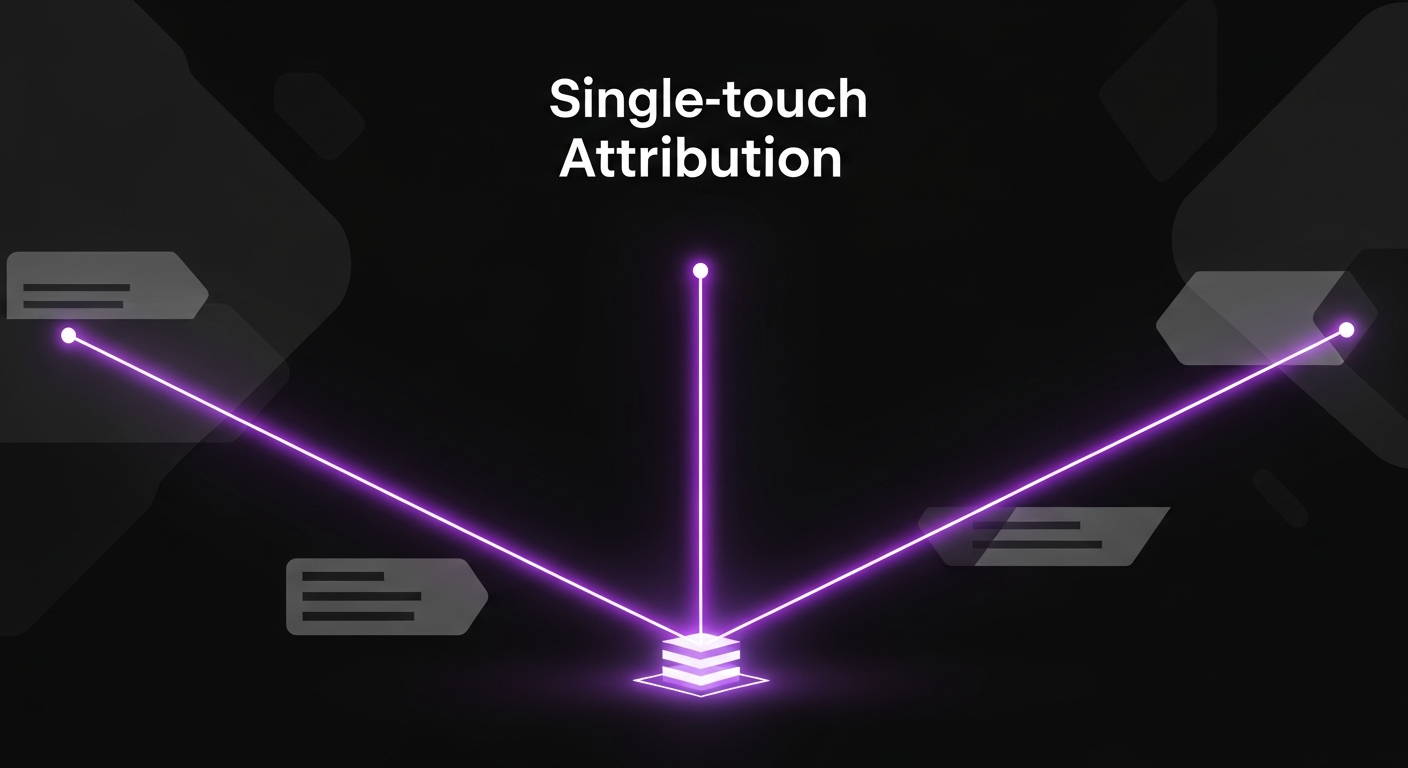
Before exploring complex methodologies, it’s essential to understand foundational single-touch models. These models assign 100% of conversion credit to a single touchpoint in the customer journey. While criticized for their simplicity, they can offer value in specific contexts and serve as a starting point for businesses new to attribution. Their main advantage is ease of implementation and interpretation, as they are often the default in platforms like Google Ads and Google Analytics.
There are two primary types of single-touch models: First-Touch and Last-Touch. Each provides a different, albeit narrow, perspective on what drives conversions. Understanding their mechanics, strengths, and weaknesses is crucial for appreciating why more advanced models are often necessary.
The First-Touch attribution model gives 100% of the credit for a conversion to the very first marketing touchpoint a customer had with your brand. For example, if a user first discovered your company through an organic search result and later converted after clicking a retargeting ad, the organic search channel would receive all the credit. This model is focused entirely on top-of-funnel demand generation.
Its main benefit is highlighting which channels are most effective at introducing new prospects into your ecosystem. It helps you understand where your customers originate. However, its significant drawback is that it completely ignores all subsequent interactions that may have been instrumental in nurturing the lead and closing the sale. It tells you how the conversation started but nothing about how it progressed.
Last-Touch attribution is the opposite of First-Touch. It assigns 100% of the credit to the final touchpoint a customer interacted with before converting. In the previous example, the retargeting ad would receive all the credit. This has long been the most common attribution model because it’s simple to track and directly links a conversion to a recent action.
The strength of this model is its focus on what ultimately triggers a conversion, making it useful for understanding which channels are effective “closers.” However, its weakness is profound: it gives no value to any of the earlier marketing efforts that built awareness, trust, and consideration. This can lead to a severe undervaluation of top- and mid-funnel activities, creating a skewed perception of what truly drives growth.
Despite their limitations, single-touch models are not entirely without merit. They can be appropriate in specific business contexts. For businesses with a very short sales cycle, the journey from first touch to conversion might happen in a single session. In such cases, a last-touch model can be a reasonably accurate reflection of reality, such as an impulse purchase driven by a limited-time social media ad.
Similarly, if a campaign’s primary goal is purely brand awareness, a first-touch model can be a useful Key Performance Indicator (KPI) to measure its success in bringing new people into the funnel. The key is to recognize their limitations and use them only when they align with a specific, narrow business objective, rather than as a comprehensive measure of overall marketing performance.

Recognizing the limitations of single-touch models, most marketers turn to multi-touch attribution for a more balanced and realistic view of their performance. Multi-touch attribution models distribute conversion credit across multiple touchpoints in the customer journey. This approach acknowledges that a conversion is typically the result of a series of interactions, not a single event. By assigning partial credit to each contributing channel, these models provide a more nuanced understanding of how your marketing ecosystem works as a whole.
There are several common rule-based multi-touch models, each distributing credit according to a different set of predefined rules. While none are perfect, they each offer a unique lens through which to analyze your conversion paths and can be chosen based on your specific business model and marketing strategy.
The Linear attribution model is the most straightforward multi-touch approach. It gives equal credit to every touchpoint along the customer’s journey. If a customer interacted with a blog post, a Facebook ad, a Google search ad, and an email before converting, each of these four touchpoints would receive 25% of the credit.
The primary advantage of the Linear model is its democratic approach—it values every interaction. This can be useful for businesses that want to maintain a consistent presence across the entire customer lifecycle. However, its main drawback is that it assumes all touchpoints are equally influential, which is rarely the case. A brief social media impression might be treated the same as an in-depth webinar, which may not accurately reflect their respective impacts.
The Time-Decay model gives more credit to the touchpoints that occurred closer in time to the conversion. The credit assigned to each touchpoint decays the further back in the journey it occurred. Therefore, the final click gets the most credit, the second-to-last gets less, and the very first touchpoint gets the least.
This model is based on the premise that interactions immediately preceding a purchase are often the most influential. It can be particularly useful for businesses with longer consideration phases but relatively short sales cycles, such as high-value B2C purchases. The downside is that it can still devalue the crucial top-of-funnel activities that initiated the journey, even if it doesn’t ignore them completely like the last-touch model does.
The U-Shaped, or Position-Based, model attempts to combine the insights of first-touch and last-touch models. It assigns a high percentage of credit to both the first touchpoint (the interaction that introduced the customer) and the last touchpoint (the interaction that led to conversion), distributing the remainder evenly among the touchpoints in the middle. A common configuration gives 40% of the credit to the first touch, 40% to the last touch, and the remaining 20% to all interactions in between.
This model is popular because it values both the channel that generated the lead and the channel that closed it, making it a great choice for businesses that prioritize both lead generation and conversion optimization. Its potential weakness is that it can undervalue the mid-funnel nurturing activities that are often critical for moving a lead from initial interest to a final decision.
The W-Shaped model is an evolution of the U-Shaped model, designed for more complex customer journeys. It assigns high credit to three key touchpoints: the first touch (lead creation), a significant mid-funnel interaction (like a lead converting to an opportunity in a CRM), and the last touch (the final conversion). A typical split gives 30% credit to each of these three milestones, with the remaining 10% distributed among the other touchpoints.
This model is particularly well-suited for B2B companies with long sales cycles where tracking progression through the sales funnel is critical. It provides a more detailed view of what drives movement through the funnel, not just the beginning and end. The main challenge is that it requires more sophisticated tracking to accurately identify the key mid-funnel conversion point.
| Model | How It Works | Best For | Pros | Cons |
|---|---|---|---|---|
| Linear | Distributes credit equally across all touchpoints. | Businesses with a long sales cycle where all touchpoints are considered important for maintaining customer engagement. | Simple to understand; values every interaction. | Treats all touches as equally important, which is rarely true. |
| Time-Decay | Gives more credit to touchpoints closer to the conversion. | Short-term campaigns or businesses with shorter consideration phases. | Reflects the growing influence of touchpoints as a user nears conversion. | Can undervalue initial awareness-building touchpoints. |
| U-Shaped (Position-Based) | Assigns 40% credit to the first touch, 40% to the last, and 20% to the middle touches. | Businesses that highly value both lead generation and conversion-driving channels. | Highlights the two most critical stages of the journey: discovery and decision. | May undervalue the crucial mid-funnel nurturing stage. |
| W-Shaped | Assigns high credit (e.g., 30% each) to first touch, a key mid-funnel milestone, and last touch. | B2B companies with long, complex sales cycles and defined funnel stages (e.g., Lead, Opportunity). | Provides a nuanced view of what drives movement through the entire funnel. | More complex to set up; requires clear milestone tracking. |

While rule-based multi-touch models are a significant improvement over single-touch attribution, they still rely on assumptions about which touchpoints are most important. Models like Linear, U-Shaped, and Time-Decay are based on predefined rules, not actual performance data. The next frontier, algorithmic or Data-Driven Attribution (DDA), removes this guesswork by leveraging machine learning and statistical analysis.
These advanced models don’t follow a predefined rule; instead, they create a custom model based on your unique business data. By analyzing every conversion path and, just as importantly, every non-converting path, they determine the actual statistical impact of each marketing touchpoint, providing the most accurate and objective measurement of performance possible.
Data-Driven Attribution models build a baseline of expected conversions by analyzing all touchpoint data from your converting and non-converting users to understand patterns. They then compare the conversion rates of customers exposed to a specific marketing touchpoint against those who were not. Based on this comparison, the model calculates the probabilistic contribution of each touchpoint.
In essence, it creates a custom attribution model tailored specifically to your marketing activities and customer behavior. Instead of assigning a fixed percentage like 40% to the first touch, it might determine that for your business, the first touch is worth 18% of the credit, a mid-funnel whitepaper is worth 35%, and the final branded search click is worth 12%. This credit is dynamic and changes as the model learns from new data.
Machine learning is the engine that powers data-driven attribution. The sheer volume and complexity of data in a modern customer journey are too great for manual analysis. Machine learning algorithms can process millions of potential conversion paths, identifying subtle correlations and patterns that a human analyst would miss. They can account for the order of touchpoints, the time between them, and the type of creative used.
This allows the model to move beyond simple correlation to a more causal understanding of what drives conversions. By continuously processing new data, the model refines itself over time, providing marketers with a dynamic, living picture of their marketing effectiveness. This is a stark contrast to the static, one-size-fits-all approach of rule-based models.
The advantages of data-driven models are significant. They are the most accurate and objective form of attribution, as they remove human bias and assumptions. They provide a truly customized model that reflects your specific business dynamics and can lead to much smarter, more profitable optimization decisions. By understanding the true incremental lift of each channel, you can allocate your budget with maximum efficiency.
However, these models are not without their challenges. The biggest hurdle is the data requirement; they need a substantial volume of conversion data to function accurately, which can be a barrier for smaller businesses or those with few monthly conversions. They can also be a “black box,” meaning it’s not always easy to understand how the algorithm arrived at its conclusions. Finally, access to true data-driven models often requires investment in advanced analytics platforms or enterprise-level tools, which can be costly.

With an array of attribution models available, selecting the right one can feel daunting. There is no single “best” model for everyone; the optimal choice depends on your unique business context, goals, and resources. The key is to select a model that provides the most accurate and actionable insights for your specific situation.
Making this decision requires a thoughtful assessment of several key factors within your organization. By evaluating your sales cycle, channel mix, and business objectives, you can move from theoretical understanding to practical application and choose a model that empowers your marketing strategy.
Your sales cycle length is a critical factor in choosing an attribution model. This is the time it takes for a prospect to move from their first interaction with your brand to a final purchase.
The diversity of your marketing channels also plays a major role. A company that relies on one or two channels will have different attribution needs than one with an integrated, multi-channel strategy.
Finally, your attribution model should directly reflect your primary business objectives. The questions you are trying to answer should guide your choice of model.

Choosing an attribution model is a critical strategic decision, but it’s only the first step. The real value is unlocked through careful implementation. This process involves establishing a solid data foundation, selecting the right technology, and ensuring your data sources are clean and integrated. A well-executed implementation plan transforms attribution from a theoretical concept into a powerful tool for decision-making.
Without proper setup, even the most advanced model will produce flawed insights. Following a structured approach is key to building a reliable and trustworthy attribution system.
The foundation of any attribution strategy is comprehensive and consistent tracking. The “garbage in, garbage out” principle is paramount: you must collect clean, accurate data from every marketing touchpoint to get reliable insights.
Once your tracking is in place, you need a platform to collect, process, and model this data. The market for attribution tools ranges from free, built-in solutions to sophisticated, enterprise-grade software.
This is often the most challenging but critical step. Your customer data likely lives in multiple silos: ad platforms, website analytics, your CRM, and your email service provider. A successful attribution strategy requires bringing this data together into a single, unified view of the customer journey.
This may involve using a Customer Data Platform (CDP) or a data warehouse to consolidate information. The process includes “stitching” together user identities across different devices and cleaning the data to remove duplicates, correct inconsistencies, and fill in gaps. Investing time and resources in data hygiene is essential for building an attribution system that you and your stakeholders can trust.

While the promise of marketing attribution is immense, the path to achieving actionable insights is fraught with challenges. The digital landscape is fragmented, consumer privacy regulations are evolving, and the technologies we rely on have limitations. Acknowledging these hurdles is the first step toward overcoming them. Marketers who anticipate and proactively address these common problems are far more likely to build a successful and sustainable attribution practice.
From tracking users across multiple devices to bridging the online-offline divide, these challenges require a combination of smart technology, strategic thinking, and a realistic understanding of what is and isn’t possible.
A significant attribution challenge is the cross-device customer journey. A user might see an ad on their work laptop, research on their smartphone, and purchase on a tablet. Traditional cookie-based tracking registers these as three different users, breaking the conversion path and making accurate attribution impossible.
Solution: The solution is to shift from cookie-based tracking to people-based identification, which uses a persistent identifier to connect a user’s activity across devices. The most common method is leveraging authenticated user logins. When a user logs into your website or app, you can associate all their activity with a single user ID. Platforms like Google Signals and Facebook’s advanced matching use their own logged-in user data to help bridge this gap. For businesses without a login system, probabilistic matching can be a less accurate but still useful alternative.
For many businesses, the customer journey doesn’t happen entirely online. A user might see a digital ad that leads to a phone call, a visit to a physical store, or a conversation with a sales representative. Tying these offline conversions back to the digital marketing efforts that influenced them is a major challenge.
Solution: A multi-pronged approach is needed here. Dynamic call tracking can assign unique phone numbers to different digital campaigns, allowing you to trace calls back to their source. For in-store visits, you can use unique, trackable coupon codes in your digital ads or leverage geo-location data from ad platforms. The most robust solution is tight CRM integration. By ensuring that every offline interaction is logged in the CRM against a customer’s record, you can connect the dots between an online lead and an offline sale.
Major advertising platforms like Google, Meta (Facebook/Instagram), and Amazon operate as “walled gardens.” They have vast amounts of data about user interactions within their own ecosystems but are often reluctant to share granular, user-level data with outside platforms. This makes it difficult for a central attribution tool to get a complete, unbiased picture of the customer journey.
Solution: First, accept that no single attribution tool will ever have a perfect dataset. The strategy is to blend insights from multiple sources. Use the attribution reporting within each walled garden (e.g., Facebook Ads Manager) to understand performance on that platform. Then, use your central attribution tool (like Google Analytics) to understand how these channels work together. This approach requires a degree of triangulation, comparing data from different sources to build a more holistic view. The emergence of data clean rooms also offers a privacy-safe way to join your first-party data with data from walled gardens for more advanced analysis.
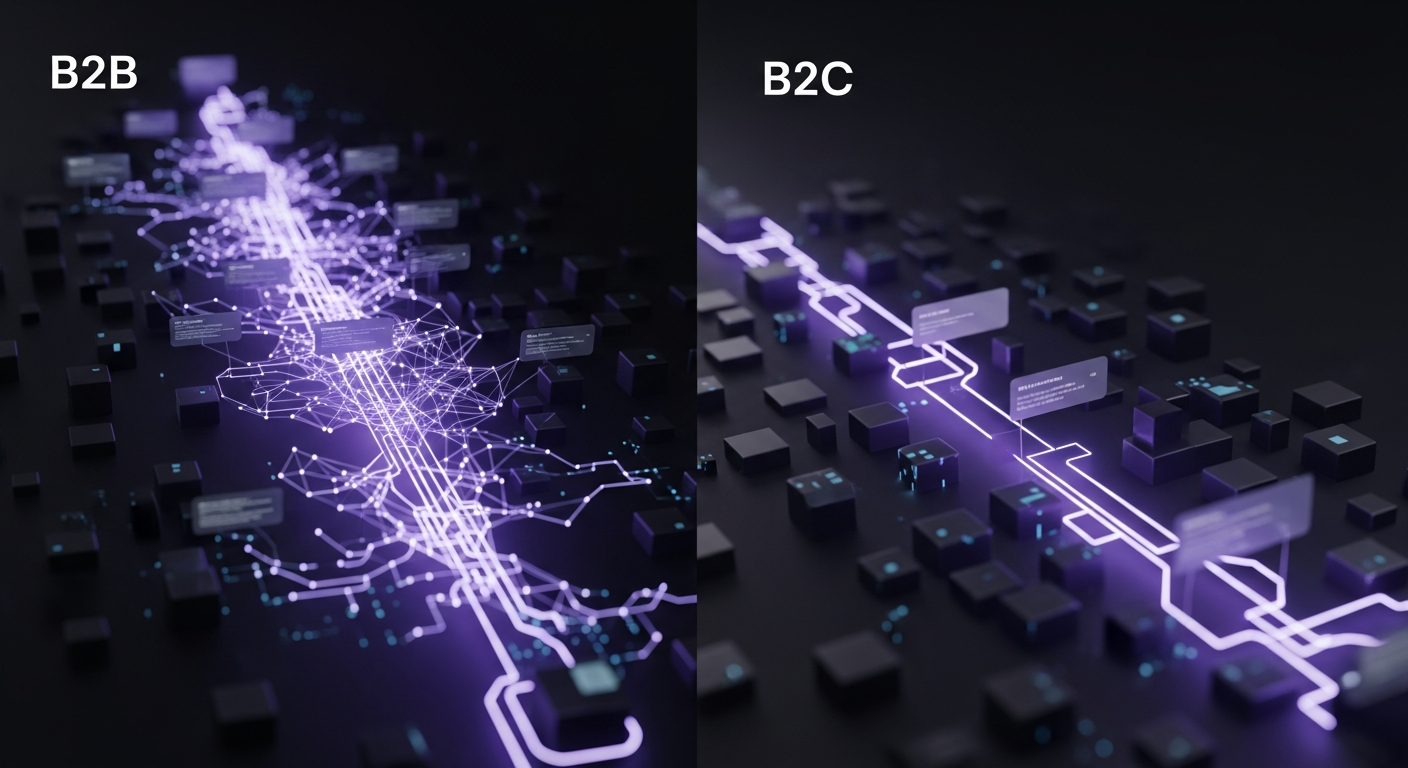
The principles of marketing attribution are universal, but their application varies dramatically between Business-to-Business (B2B) and Business-to-Consumer (B2C) contexts. The fundamental differences in their customer journeys, sales cycle lengths, and decision-making processes necessitate different approaches to measurement. Understanding these distinctions is key to implementing an attribution strategy that aligns with your specific market.
A model that works perfectly for a high-volume e-commerce store will likely fail to capture the complexity of an enterprise software deal. Tailoring your attribution approach to your audience is critical for generating meaningful insights.
The contrast between B2B and B2C journeys is stark. B2C journeys are often shorter, more emotional, and involve a single decision-maker. The path to purchase can be as simple as seeing an Instagram ad and making an impulse buy. While some B2C purchases are more considered (like buying a car), many are transactional and high-volume.
B2B journeys, on the other hand, are typically long, complex, and highly rational. They involve multiple stakeholders within a buying committee—from the end-user to IT, procurement, and the C-suite. The journey involves extensive research, multiple demos, and contract negotiations, often stretching over months or even years. The focus is less on a single user and more on an entire account.
Given the complexity and length of the B2B sales cycle, single-touch attribution models are almost entirely ineffective. They fail to capture the extensive nurturing process that is essential for closing a deal. B2B marketers need models that can value multiple touchpoints and key milestones over a long period.
For many B2C e-commerce businesses, the goal is to drive a high volume of transactions through a faster, more direct path to purchase. The attribution strategy should reflect this focus on speed and conversion efficiency.

The field of marketing attribution is in a constant state of evolution, driven by changes in technology, consumer behavior, and, most significantly, data privacy regulations. The methods that have served marketers for the past decade are being fundamentally challenged. The future of attribution will be defined by adaptation, new methodologies, and the increasingly sophisticated application of artificial intelligence.
Marketers who want to continue measuring ROI effectively must look beyond traditional models and embrace a more privacy-centric, predictive, and holistic approach to understanding performance. The coming years will require a shift in both mindset and toolset to navigate this new landscape.
The most significant disruption to digital attribution is the deprecation of third-party cookies in major web browsers. For years, these cookies were the primary mechanism for tracking users across websites, enabling ad retargeting and cross-site path analysis. Their removal fundamentally breaks many attribution models that rely on observing a user’s complete journey across the web.
The future will be heavily reliant on first-party data—the information you collect directly from your customers with their consent (e.g., email sign-ups, customer accounts). Marketers will need to build stronger direct relationships with their audiences to gather this data. Additionally, privacy-enhancing technologies and probabilistic modeling will become more mainstream to fill tracking gaps without relying on individual user identifiers.
As bottom-up, user-level attribution becomes more challenging due to privacy constraints, many businesses are rediscovering and modernizing a top-down approach: Marketing Mix Modeling (MMM). MMM is a statistical technique that uses aggregate data (like weekly channel spend and total weekly sales) to measure the impact of various marketing inputs. It can also incorporate non-marketing factors like seasonality and economic trends.
Instead of tracking individual users, MMM looks at the big picture, making it immune to cookie deprecation and privacy changes. The future of measurement will likely be a hybrid approach. Marketers will use MMM for high-level strategic budget allocation and use privacy-safe, first-party data attribution to optimize tactics within those channels.
Artificial intelligence is set to transform attribution from a backward-looking reporting tool into a forward-looking predictive engine. While current data-driven models use AI to assign credit for past conversions, future applications will focus on forecasting and optimization.
Predictive analytics will be used to forecast the ROI of planned campaigns before a single dollar is spent. AI algorithms will recommend optimal budget allocations across channels in real-time to maximize business outcomes. Furthermore, AI will enable predictive attribution, which analyzes a user’s early interactions to predict their likelihood to convert and identify the next best marketing action to increase that probability. This shifts the focus from merely measuring what worked to proactively making marketing more effective.

Marketing attribution is far more than an academic exercise in assigning credit. It is a foundational strategic tool that empowers marketers to navigate the complexities of the modern customer journey with confidence. By moving beyond simplistic models and embracing a more nuanced approach, you can transform your marketing department from a perceived cost center into a proven engine for revenue growth.
The journey begins with establishing a solid foundation of clean, integrated data and choosing a model that aligns with your sales cycle, channel mix, and business objectives. Whether you start with a rule-based multi-touch model like U-Shaped or advance to a sophisticated Data-Driven approach, the goal remains the same: to gain a deeper understanding of how your marketing efforts work together to create value.
Ultimately, the power of attribution lies not in the reports it generates, but in the actions it inspires. Insights should lead to smarter budget allocation, more effective campaign optimization, and a more personalized customer experience. In a world of increasing complexity and privacy constraints, the ability to measure, adapt, and prove ROI is what separates successful marketers from the rest.