






In the competitive landscape of modern business, creating a product or service is only the first step. The real challenge lies in creating something people want and are willing to pay for. This is where the Value Proposition Canvas comes in—a powerful strategic tool designed to ensure that products align with customer needs and desires. It acts as a visual map, helping teams systematically understand their customers and design offerings that resonate deeply.
At its heart, the Value Proposition Canvas is a framework for bridging the gap between a company’s value proposition and its customer profile. Think of it as a lock and key. The customer profile is the intricate lock, with its unique combination of needs, fears, and aspirations. Your value proposition is the key you are designing. If the key doesn’t fit the lock, the door to market success remains closed. The canvas provides a structured way to shape your key by meticulously examining every contour of the lock.
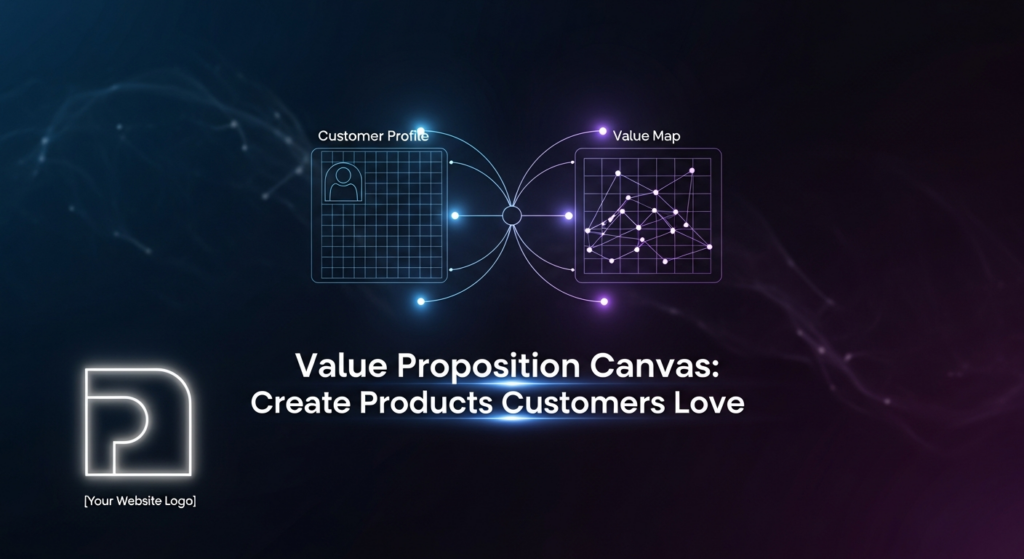
The framework achieves this by splitting the process into two distinct but interconnected parts. On one side, you analyze your customer segment—their jobs, pains, and gains. On the other, you map out how your product or service creates value through its features, pain relievers, and gain creators. The goal is to achieve a ‘fit’ between these two sides, ensuring that what you offer is a direct and compelling solution to a real-world customer problem.
The Value Proposition Canvas was created by Dr. Alexander Osterwalder, Yves Pigneur, and Alan Smith of Strategyzer. It did not emerge in a vacuum; rather, it serves as a powerful plug-in for their earlier, highly influential creation: the Business Model Canvas. The Business Model Canvas offers a holistic, one-page overview of an entire business model, broken down into nine essential building blocks, such as Key Partners, Cost Structure, and Revenue Streams.
While the Business Model Canvas provides a high-level view, its creators noticed that teams often struggled to articulate the two most critical blocks: ‘Customer Segments’ and ‘Value Propositions’. The Value Proposition Canvas was developed as a ‘zoom-in’ tool to specifically address this challenge. It allows teams to meticulously detail and validate the relationship between what they are building and who they are building it for before integrating that core hypothesis back into the broader business strategy outlined in the Business Model Canvas.
The beauty of the Value Proposition Canvas lies in its versatility. It is not a tool reserved for a specific department or type of organization. Its principles are universal, making it valuable for a wide range of professionals:

In an era of rapid change and intense competition, relying solely on intuition or internal assumptions can be a significant liability. The Value Proposition Canvas provides the structure and discipline needed to navigate uncertainty and build sustainable businesses. It’s more than just a helpful diagram; it’s a fundamental tool for strategic thinking and execution that delivers tangible benefits across an organization.
The graveyard of failed products is filled with well-built solutions to problems that didn’t exist. The primary reason new ventures and products fail is not a lack of technology or funding, but a lack of customers. The Value Proposition Canvas directly confronts this risk by forcing teams to shift their focus from the solution to the customer’s problem. It systematically challenges assumptions about what customers truly value.
By mapping out hypotheses about customer jobs, pains, and gains first, teams can identify their riskiest assumptions before a single line of code is written. This framework aligns perfectly with Lean Startup principles, providing a clear method for designing experiments—like customer interviews or landing page tests—to validate these assumptions. This iterative process of designing and testing value propositions significantly de-risks the product development lifecycle, saving invaluable time and resources.
True customer-centricity is more than a buzzword; it’s a cultural orientation that places the customer at the core of every decision. The Value Proposition Canvas is a practical tool for embedding this mindset within a team or an entire organization. The process begins not with a discussion of features or technology, but with a deep, empathetic dive into the customer’s world.
By dedicating half of the canvas to the customer profile, teams are compelled to step out of their own perspective and into their customers’ shoes. This exercise builds empathy and creates a shared understanding of the people they aim to serve. When every team member—from engineer to marketer—can clearly articulate the customer’s primary pains and desired gains, the entire organization begins to orient itself around a common purpose: creating genuine value for the customer.
Misalignment is a silent killer of productivity and innovation. When different departments operate with different assumptions about the customer and the value proposition, the result is often a disjointed product and a confusing go-to-market strategy. The visual and collaborative nature of the Value Proposition Canvas acts as a powerful alignment tool.
When a cross-functional team works together to complete a canvas, it creates a single, shared language and a unified point of reference. The resulting artifact serves as a ‘single source of truth’ that clarifies who the customer is, what problems are being solved, and how the company’s offering uniquely addresses those needs. This clarity ensures that product development, marketing, sales, and support are all working in concert, telling the same story, and pulling in the same strategic direction.

The right side of the Value Proposition Canvas—the circle—is dedicated entirely to understanding your customer. This is the starting point of the entire exercise. Without a deep and nuanced understanding of this profile, any value proposition you design will be built on a foundation of guesswork. The customer profile is broken down into three key areas: Jobs, Pains, and Gains.
Customer Jobs describe what your customers are trying to get done in their work or life. This concept, often associated with the ‘Jobs-to-be-Done’ (JTBD) framework, goes beyond simple tasks to encompass the progress a customer is trying to make in a given circumstance. These jobs can be categorized into three main types:
A comprehensive analysis requires identifying all three types of jobs, as customers are often trying to accomplish a mix of them simultaneously.
Pains describe anything that annoys your customers before, during, or after trying to get a job done. They are the negative emotions, undesired costs, situations, and risks that your customer experiences or could experience. A thorough exploration of pains is critical, as great value propositions are often built around solving significant pains. Pains can include:
Gains describe the outcomes and benefits your customers want to achieve. They are the positive experiences and desires that motivate them. Gains are not simply the opposite of pains; they can range from basic necessities to delightful surprises. It’s useful to think about gains in a hierarchy:

Once you have a clear picture of your customer, you shift your focus to the left side of the canvas—the square. This is the Value Map, where you explicitly detail how you intend to create value. This side forces you to be concrete about what you offer and how it directly addresses the customer profile you’ve just mapped out. It consists of three parts: Products & Services, Pain Relievers, and Gain Creators.
This is the most straightforward part of the Value Map. It’s a list of all the products and services your value proposition is built around. This is what your customer will ultimately see, purchase, and interact with. It’s important to list everything you offer that helps your customer get their functional, social, or emotional jobs done.
Your products and services can take many forms:
This list forms the foundation upon which you build your value proposition, but on its own, it is not the value proposition. The value comes from how these products and services alleviate pains and create gains.
Pain Relievers describe exactly how your products and services alleviate specific customer pains. This is where you make a direct connection between your solution and the problems, obstacles, and risks you identified in the customer profile. A great pain reliever focuses on the pains that matter most to customers and addresses them exceptionally well.
You should be able to draw a clear line from each pain you listed to a pain reliever you are providing. For example:
It’s crucial to be explicit. Don’t just list a feature; describe how that feature relieves a specific pain.
Gain Creators describe how your products and services create the outcomes and benefits your customers desire. They explicitly outline how you intend to produce the gains you identified in the customer profile. Similar to pain relievers, gain creators should directly address the required, expected, desired, or even unexpected gains of your customer.
A strong value proposition doesn’t just solve problems; it also creates positive outcomes. Your gain creators should show how you deliver on this promise:
The most powerful value propositions often excel at creating desired or unexpected gains, as this is where true delight and differentiation occur.

Filling out the two sides of the canvas is just the beginning. The ultimate goal is to achieve ‘fit,’ which occurs when your value map resonates deeply with your customer profile. This means your pain relievers address significant customer pains, and your gain creators produce meaningful customer gains. Fit is not a single event but a journey through three distinct stages.
Problem-Solution Fit is the first stage and happens ‘on paper.’ You achieve it when you have evidence that customers care about the jobs, pains, and gains you’ve identified, and that the value map you’ve designed on paper effectively addresses them. This is the phase of initial design and customer discovery.
At this point, you don’t have a product yet, or at least not a fully-fledged one. Your focus is on learning. You are testing your hypotheses by getting out of the building and talking to potential customers. The key question is: have we found a problem worth solving? You have achieved Problem-Solution Fit when you can clearly articulate the customer’s struggles and your proposed solution makes sense to them in conversation.
Product-Market Fit is the holy grail for startups and new products. It occurs ‘in the market’ when you have evidence that your value proposition is actually creating value for customers and is gaining traction. This is where your on-paper solution meets reality. You’ve built your Minimum Viable Product (MVP) and put it in the hands of customers.
The evidence for Product-Market Fit is quantitative and qualitative. It’s not just about customers saying they like your product; it’s about them using it, paying for it, and telling others about it. Key indicators include strong user growth, high retention rates, positive net promoter scores (NPS), and a sales cycle that begins to shorten. As venture capitalist Marc Andreessen famously put it, ‘The market pulls product out of the startup.’ When you have Product-Market Fit, you can feel it.
Business Model Fit is the final stage and occurs ‘in the bank.’ It’s about ensuring your value proposition, which customers want, is embedded in a business model that is both scalable and profitable. Having a great product that customers love is not enough if it costs you more to acquire and serve them than you earn in revenue.
This is where the Value Proposition Canvas plugs back into the broader Business Model Canvas. You need to validate that your Customer Acquisition Costs (CAC) are significantly lower than your Customer Lifetime Value (LTV). This involves finding scalable channels to reach customers and ensuring your cost structure is sustainable as you grow. Achieving this fit means you have found a way to create, deliver, and capture value in a repeatable and profitable way.

The Value Proposition Canvas is a hands-on tool. The real insights come from the process of completing it. Follow these steps to guide your team through a productive session.
Always start with the customer. If you serve multiple customer segments, pick one to focus on. You should create a separate canvas for each distinct segment, as their jobs, pains, and gains will differ. Gather a cross-functional team and begin brainstorming on the right side of the canvas (the circle). List as many jobs, pains, and gains as you can. Once you have a comprehensive list, prioritize them. Ask the team to vote on what they believe are the most critical jobs, the most severe pains, and the most essential gains from the customer’s perspective.
Now, move to the left side of the canvas (the square). First, list the core products and services that make up your offering for this specific customer segment. Then, for each prioritized pain and gain from the customer profile, brainstorm how your product either relieves that pain or creates that gain. Be honest and specific. If your product doesn’t address a critical pain, leave it blank. This is about mapping reality, not wishful thinking.
This is the moment of truth. Systematically go through your prioritized pains and gains on the right and see if you have a corresponding pain reliever or gain creator on the left. Check the connections. Are you addressing the pains that matter most? Are you creating the gains customers truly desire? Look for misalignments: features that don’t solve any real problem (potential bloat), major customer pains you are failing to address, or significant gains you are not creating. This analysis will reveal the strengths and weaknesses of your current value proposition.
Your completed canvas is not a final document; it’s a collection of hypotheses. Your next step is to identify the most critical assumptions that need to be true for your value proposition to succeed. Frame these assumptions as testable hypotheses (e.g., ‘We believe office managers will pay $20/month to automate their supply ordering process because it saves them 5 hours per month’). Then, design experiments to test these hypotheses in the real world. This could involve customer interviews, surveys, landing page A/B tests, or building a prototype. Use the feedback from these tests to refine and iterate on your canvas. The goal is to move from assumptions to validated facts.

Theory is best understood through practice. Let’s analyze how two highly successful companies created a powerful fit between their value proposition and their customers’ needs.
Before Netflix, renting a movie involved significant pains. Let’s analyze their initial DVD-by-mail service that disrupted Blockbuster.
| Canvas Component | Blockbuster Customer Profile | Netflix’s Value Map |
|---|---|---|
| Customer Jobs |
|
Products & Services
|
| Pains |
|
Pain Relievers
|
| Gains |
|
Gain Creators
|
Netflix achieved a near-perfect fit. They systematically eliminated every major pain of the traditional rental experience while creating desired gains like a massive selection and content discovery. This customer-centric approach was the key to their disruption of the entire industry.
Slack entered a crowded market for workplace communication but succeeded by focusing on the deep-seated pains of internal email and disorganized team collaboration.
Customer Profile (Knowledge Worker Teams):
Value Map (Slack Platform):
Slack’s value proposition resonated because it didn’t just offer another messaging tool; it offered a cure for the specific, acute pains of modern knowledge work, creating gains in efficiency, organization, and culture.

The Value Proposition Canvas is a powerful tool, but like any tool, its effectiveness depends on how it’s used. Avoid these common mistakes to get the most out of the framework.
One of the biggest mistakes is filling out the canvas alone or with a small, homogenous group locked in a conference room. The canvas is a tool for synthesizing diverse perspectives. It should be a collaborative exercise involving people from product, engineering, marketing, sales, and customer support. More importantly, the canvas must be validated with real customers. The insights from a single customer conversation are often more valuable than hours of internal brainstorming. Get out of the building and talk to users.
Every statement you write on the canvas is a hypothesis, not a fact. The goal is not to create a beautiful, perfectly filled-out document. The goal is to identify your most critical assumptions and then figure out the fastest, cheapest way to test them. Don’t fall in love with your initial ideas. View the canvas as a map of your assumptions and a guide for your experimentation and learning process. The value is in the testing, not the initial brainstorming.
The Value Proposition Canvas is not a one-and-done exercise that you complete and then file away. Markets change, competitors emerge, and customer needs evolve. Your value proposition must evolve with them. Revisit your canvas regularly—at least quarterly, or whenever you are planning a major new feature or strategic shift. Use it as a living document to guide ongoing decision-making and ensure you maintain a strong fit with your customers over time.

The insights generated from the Value Proposition Canvas should not exist in a vacuum. They are a strategic asset that should inform and influence key business activities, ensuring your entire organization is aligned around delivering customer value.
A well-researched canvas is the perfect blueprint for an effective MVP. By prioritizing the most critical customer jobs, severe pains, and desired gains, you can identify the core set of features needed to create value from day one. The canvas helps you focus your MVP on the essential pain relievers and gain creators, preventing you from building a bloated product full of unvalidated features. It ensures your first product release is a targeted experiment designed to test your core value proposition.
The canvas is a goldmine for your marketing and sales teams. The language customers use to describe their pains and gains is the exact language you should use in your ad copy, website headlines, and sales pitches. The value map provides a clear, benefit-oriented script for communicating your product’s value. Instead of leading with features (‘We have 256-bit encryption’), you can lead with the value proposition (‘We keep your data safe from breaches’). This customer-centric language is far more compelling and effective.
As your product matures, you will be inundated with feature requests and new ideas. The Value Proposition Canvas provides a strategic filter for your product roadmap. For any new feature under consideration, you can ask: ‘Which high-priority customer job, pain, or gain does this address?’ If you can’t clearly map a proposed feature back to a validated need on your canvas, it should be seriously questioned. This discipline ensures that your product evolves based on customer value, not internal whims or competitor mimicry.

To help you on your journey, several tools and resources can facilitate the Value Proposition Design process: