




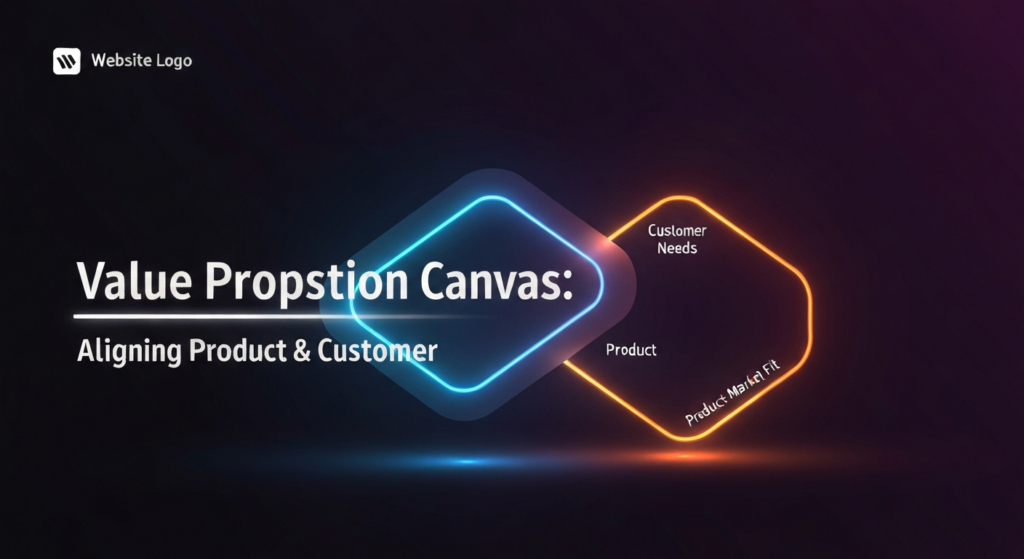

In the competitive landscape of modern business, the graveyard of failed products is vast. The primary reason for their demise is often shockingly simple: they were solutions in search of a problem. Companies invest millions in developing, marketing, and launching products that their target customers simply don’t need or want. This fundamental disconnect between a business offering and customer needs is one of the most significant risks to any venture. Fortunately, there is a powerful, visual framework designed to prevent this exact scenario: the Value Proposition Canvas.
This guide will provide a comprehensive exploration of the Value Proposition Canvas, a strategic tool that aligns your product with customer expectations to achieve an elusive but critical goal: Product-Market Fit. We will deconstruct its components, walk through its application step-by-step, and examine real-world examples to demonstrate its power. By the end, you will understand how to use this framework to build products and services that resonate deeply with your customers, reducing risk and paving the way for sustainable growth.
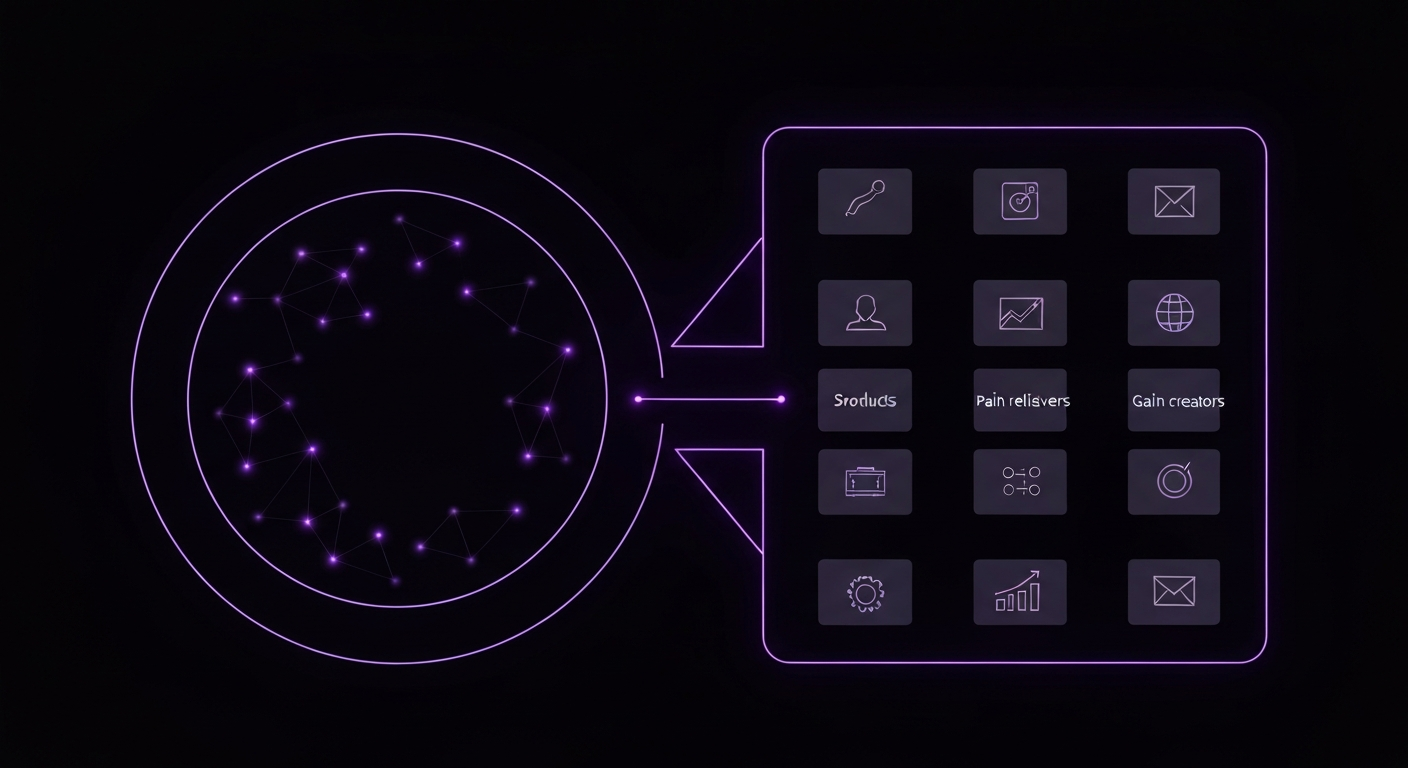
The Value Proposition Canvas is a visual business tool that helps you systematically understand your customer’s needs and design products and services that directly address them. It works by mapping your customer’s motivations, challenges, and desires against the features and benefits of your offering. At its core, it is a framework for ensuring that you are building something people actually care about before you invest significant resources. It’s about moving from guesswork to a structured, customer-centric approach to product development.
The canvas is split into two distinct parts that mirror each other: the Customer Profile (represented as a circle) and the Value Map (represented as a square). The Customer Profile focuses entirely on your customer, helping you sketch out a clear picture of their world. The Value Map details how your product or service intends to create value for that customer. The goal is to create a clear connection between the two sides, where the Value Map directly addresses the realities outlined in the Customer Profile.
The Value Proposition Canvas was created by Dr. Alexander Osterwalder, a leading business theorist, and the team at Strategyzer. It was introduced as a companion tool in their best-selling book, “Value Proposition Design: How to Create Products and Services Customers Want.” This wasn’t just a random invention; it emerged as a necessary plug-in to Osterwalder’s earlier and more famous creation, the Business Model Canvas. The creators realized that teams often struggled with the two most critical building blocks of the Business Model Canvas—the Value Proposition and the Customer Segments. The Value Proposition Canvas was designed to provide a more granular, focused framework to get these two pieces right.
The Business Model Canvas (BMC) provides a holistic, high-level view of your entire business on a single page. It outlines nine key building blocks, including revenue streams, key partners, and cost structure. It answers the question, “How will our business work?”
The Value Proposition Canvas (VPC), however, is a close-up lens on two of those nine blocks: Value Propositions and Customer Segments. It essentially “zooms in” on the relationship between what you offer and who you offer it to. You can think of the VPC as the engine that powers the core of your business model. If you don’t achieve a strong fit between your value proposition and your customer segment using the VPC, the rest of your Business Model Canvas, no matter how well-designed, is likely to fail.
| Aspect | Business Model Canvas (BMC) | Value Proposition Canvas (VPC) |
|---|---|---|
| Purpose | To describe, design, and challenge an entire business model. | To design, test, and build a specific value proposition for a customer segment. |
| Scope | Holistic (strategic view of the whole business). | Focused (deep dive into the customer-product relationship). |
| Key Components | 9 building blocks (Key Partners, Activities, Resources, Value Propositions, Customer Relationships, Channels, Customer Segments, Cost Structure, Revenue Streams). | 2 blocks (Customer Profile and Value Map), each with 3 sub-components. |
| Primary Question | How do we create, deliver, and capture value as a sustainable business? | Are we creating something that customers actually want and value? |
The ultimate objective of using the Value Proposition Canvas is to achieve Product-Market Fit. Coined by venture capitalist Marc Andreessen, Product-Market Fit means being in a good market with a product that can satisfy that market. It’s the point where you’ve built a solution that resonates so strongly with a target audience that it generates significant demand and value. The VPC is the strategic framework that guides you on the journey to finding this fit. It forces you to articulate and test your hypotheses about customer needs and how your product satisfies them, helping you iterate your way toward a proposition that the market eagerly embraces.

In a world of rapid innovation and fierce competition, building a successful business requires more than just a good idea. It demands a relentless focus on the customer. The Value Proposition Canvas is not just another piece of business jargon; it is a fundamental tool that instills this customer-centricity into an organization’s DNA. Its adoption can mean the difference between launching a product that thrives and one that fails.
The most significant benefit of the VPC is its power to de-risk new ventures and product launches. By starting with the customer’s world—their jobs, pains, and gains—you are forced to validate your assumptions early and often. Instead of building a full-featured product based on internal beliefs and then hoping it sells (the “build it and they will come” fallacy), the canvas promotes a more scientific approach aligned with the Lean Startup methodology. It helps you test the most critical hypotheses first: Do customers have the problem we think they have? Do they care enough to pay for a solution? Answering these questions before writing a single line of code can save immense amounts of time, money, and effort.
One of the biggest challenges within any organization is creating a unified vision of the customer. Marketing, sales, engineering, and product teams often have different, sometimes conflicting, perspectives. The Value Proposition Canvas acts as a common language and a single source of truth. When a cross-functional team collaborates to fill out a canvas, they are forced to debate, discuss, and align on a shared understanding of who their customer is and what they truly value. This shared context is invaluable, ensuring that all teams are aligned, from the features engineers build to the messaging marketers create.
Feature creep is a common pitfall in product development, where products become bloated with functionalities that few customers use. The VPC is a powerful antidote. The Value Map side of the canvas insists that every feature of your product must exist for a specific reason: either to be a “Pain Reliever” that solves a customer frustration or a “Gain Creator” that delivers a desired benefit. This direct link forces product teams to justify every feature in terms of the value it delivers to the customer. It shifts the conversation from “What can we build?” to “What should we build to help our customer?”
Exceptional marketing is about communicating value in a way that resonates with the customer’s worldview. The Value Proposition Canvas provides a blueprint for your marketing team. The Customer Profile section is a goldmine of marketing insights. The “Pains” section tells you the exact problems your customers are struggling with, which you can use in your ad copy and landing pages. The “Gains” section reveals their deepest aspirations, which you can use to craft a compelling brand story and vision. Instead of talking about your product’s features, you can speak directly to the customer’s jobs, pains, and gains, creating messaging that is far more persuasive and effective.

The first and most important step in using the Value Proposition Canvas is to step outside your own perspective and deeply empathize with your customer. The Customer Profile, the circle on the right side of the canvas, is your tool for achieving this. It provides a structured way to map the world of a specific customer segment. It is crucial to remember that this entire section should be filled with hypotheses that must later be validated through direct customer research.
Customer Jobs are the tasks your customers are trying to perform, the problems they are trying to solve, or the needs they are trying to satisfy in their work and life. It’s essential to think beyond the obvious functional tasks and consider the broader context. Customer jobs can be categorized into three main types:
By mapping out all three types of jobs, you gain a much richer understanding of your customer’s true motivations.
Customer Pains describe anything that annoys your customer before, during, or after trying to get a job done. They also include risks, which are potential bad outcomes. Pains represent the negative side of the customer experience. When brainstorming pains, consider:
Ranking these pains by severity is a critical step, as your value proposition should focus on solving the most intense ones.
Customer Gains describe the outcomes and benefits your customers want to achieve. These are the positive experiences and desires that motivate them. Gains are not simply the opposite of pains; they are the things that would delight a customer. Like jobs and pains, gains can be categorized to help you think more broadly:

Once you have a clear, detailed picture of your customer’s world, it’s time to turn your attention to your solution. The Value Map, the square on the left side of the canvas, is where you articulate how your offering will create value for that customer. It’s a structured way to outline the benefits of your offering and connect them directly to the customer’s needs. Each component of the Value Map should directly correspond to a component of the Customer Profile.
This is the most straightforward part of the Value Map. Here, you simply list all the products, services, and features that your value proposition is built around. This could be a physical product, a digital service, a subscription, or professional consulting. For example, if you are a financial planning company, your products and services might include retirement planning, investment management, and tax advisory services. It’s important to list them out, as they are the vehicles through which you will deliver pain relievers and gain creators.
Pain Relievers describe exactly how your products and services alleviate specific customer pains. They are not just features; they are explicit promises of how you will eliminate or reduce the frustrations, obstacles, and risks that your customers face. A great pain reliever directly addresses a significant pain identified in the Customer Profile.
For example, if a customer’s pain is “I waste too much time in meetings,” a pain reliever could be “Automated meeting summaries with action items sent to all attendees.” The key is to be precise: instead of just listing a feature like “AI summaries,” describe how it relieves a specific pain. This ensures you are building solutions to real problems, not just adding technology for its own sake.
Gain Creators describe how your products and services produce, increase, or maximize the outcomes and benefits that your customers desire. They are how you deliver on the gains identified in the Customer Profile. While pain relievers are about fixing negatives, gain creators are about enhancing positives and delivering delight.
A strong gain creator will address a required, expected, or desired gain, and the most innovative ones will deliver unexpected gains. For example, if a customer’s desired gain is “I want to feel more confident about my investment choices,” a gain creator could be “A personalized dashboard that visualizes your progress towards your financial goals and benchmarks your performance against market trends.” This goes beyond simply managing investments; it creates the feeling of confidence and control the customer is seeking. The goal is to explicitly outline how you will exceed customer expectations and provide them with surprising value.

The Value Proposition Canvas is a dynamic tool, not a static document. It’s meant to be used in an iterative process of brainstorming, mapping, and testing. Following a structured approach will help you get the most out of the framework and guide you toward a powerful value proposition.
Before you even put a sticky note on the canvas, you must decide which customer you are serving. A common mistake is to create a single, generic canvas for your entire market. Your business likely serves multiple customer segments, and each one has unique jobs, pains, and gains. For example, a software platform like Airbnb has at least two major segments: Guests and Hosts. Their needs are completely different. Therefore, you must create a separate Value Proposition Canvas for each distinct customer segment. Start with the segment you believe is most critical to your success.
Always start with the customer. Begin by filling out the circle on the right side of the canvas. Gather your team and brainstorm all the possible jobs, pains, and gains for your chosen segment. During this brainstorming phase, focus on quantity over quality. Encourage everyone to contribute ideas. Once you have a large number of items, take a step back and prioritize them. Ask yourselves: What are the most important jobs the customer is trying to get done? Which pains are the most extreme? Which gains are the most desired? Rank them on the canvas, perhaps by placing the most critical ones at the top. This initial map is a collection of your team’s best hypotheses.
Now, move to the square on the left. With a clear, prioritized view of your customer’s needs, begin to map your value proposition. First, list your products and services. Then, for each high-priority pain you identified, brainstorm a specific pain reliever your offering provides. Similarly, for each high-priority gain, define a corresponding gain creator. Be brutally honest. If your product doesn’t address a top customer pain, don’t force a connection. This is a moment of truth, not a sales pitch. The goal is to design a value proposition that is precisely focused on what your customer values most.
This is the critical final step where you assess the connection between your Value Map and your Customer Profile. Go through each pain reliever and gain creator on your Value Map and check if it clearly links to a job, pain, or gain on the customer side. The strength of your value proposition is determined by how well it addresses the customer’s most important jobs, most severe pains, and most desired gains. A strong fit occurs when your products and services relieve major pains and create essential gains that matter deeply to your customers. If you find gaps—important pains you don’t address or features that don’t connect to any customer need—you’ve identified areas for improvement and iteration.

The term ‘fit’ is the central concept of the Value Proposition Canvas. It represents the alignment between what you offer and what customers want. Achieving fit is not a single event but a journey through three distinct stages. The canvas is your guide through the first stage and sets the foundation for the subsequent two.
Problem-Solution Fit is achieved when you have evidence that customers care about certain jobs, pains, and gains, and you have designed a value proposition that addresses them on paper. This is the stage where the Value Proposition Canvas lives. You achieve this fit when your team has:
At this stage, you have a well-defined hypothesis. You’ve done your homework and created a potential solution to a real problem. However, Problem-Solution Fit exists only in theory, on your whiteboard or in your slide deck. The next step is to prove it in the real world.
Product-Market Fit occurs after you have taken your value proposition to market and found a set of customers who are actively buying and using your product. This is where your hypotheses from the canvas meet reality. You achieve this fit when your value proposition is generating real traction, demonstrated by:
Achieving Product-Market Fit is the holy grail for startups and new product initiatives. It’s the point where the market starts pulling your product out of your hands, rather than you having to push it onto the market. The VPC helps you iterate your offering based on customer feedback until you reach this critical milestone.
The final stage of fit connects your successful value proposition back to the broader business context. Business Model Fit is achieved when you have found a scalable and profitable business model to deliver your value proposition. This means your Customer Acquisition Cost (CAC) is significantly lower than your Customer Lifetime Value (LTV). You have not only found a product customers love (Product-Market Fit), but you have also figured out how to make money from it sustainably. This is where the Value Proposition Canvas and the Business Model Canvas work in perfect harmony. A validated VPC provides the foundation for a strong, profitable business model outlined in the BMC.

The Value Proposition Canvas is a simple tool, but its simplicity can be deceptive. There are several common pitfalls that can undermine its effectiveness. Being aware of these mistakes can help you use the framework correctly and derive maximum value from the exercise.
The single biggest mistake is treating the canvas as an internal brainstorming exercise and nothing more. The initial canvas you create is a collection of unproven hypotheses. Every item you place in the Customer Profile is an assumption that needs to be validated. The only way to do this is to “get out of the building” and talk to actual customers. Conduct interviews, run surveys, and observe their behavior. Without real-world feedback, your canvas remains a work of fiction.
On the Value Map side, teams often fall into the trap of listing their product’s features under Pain Relievers and Gain Creators. For example, listing “128-bit encryption” is a feature. The pain reliever is “Secures your personal data from being stolen.” The gain creator is “Gives you peace of mind that your information is safe.” Always articulate how your features translate into tangible benefits for the customer. The canvas is designed to force this crucial shift in perspective from what your product is to what it does for the customer.
The market is not static, and neither are your customers. Their needs, pains, and desired gains evolve over time as technology changes and new solutions emerge. Your Value Proposition Canvas should be a living document, not a one-and-done artifact that gathers dust. Revisit and update your canvas regularly, especially when you receive new customer feedback, when a competitor makes a move, or when you are planning your next product iteration. It should be a central, dynamic tool in your strategic planning process.
A common outcome of the initial brainstorming session is a canvas cluttered with dozens of sticky notes. While this is a good start, the process is incomplete without ruthless prioritization. Not all customer jobs, pains, and gains are created equal. Some pains are mild annoyances, while others are critical blockers. Your value proposition cannot and should not try to solve everything. Focus on addressing the top 2-3 most critical jobs, the most severe pains, and the most desired gains. A focused value proposition that excels at a few important things will always be more successful than one that tries to be everything to everyone.

To truly understand the power of the Value Proposition Canvas, let’s analyze how successful companies have implicitly or explicitly achieved a strong fit between their offering and their customers’ needs.
Tesla entered a market dominated by established giants. They succeeded by creating a value proposition that addressed the jobs, pains, and gains of a specific early-adopter segment in a way no one else had.
Tesla’s success came from not just making an electric car, but from creating a superior car that was also electric. They addressed the core pains of early EVs while delivering on the performance and technology gains that their target customers craved.
Airbnb is a two-sided platform, meaning it needs to create value for two distinct customer segments simultaneously: people looking for a place to stay (Guests) and people with space to rent (Hosts). This requires two separate Value Proposition Canvases.
For Guests:
For Hosts:

Getting started with the Value Proposition Canvas is easy. While you can simply draw it on a whiteboard, several digital tools and templates can streamline the process, especially for remote teams.
Platforms like Miro and Mural are perfect for collaborative VPC sessions. They offer infinite canvas space, pre-built templates for the Value Proposition Canvas, and digital sticky notes that make brainstorming and organizing ideas simple. These tools are ideal for workshops and for keeping your canvas as a living document that the whole team can access and update.
For those who want to go straight to the source, Strategyzer offers its own suite of web-based software and tools. Their app provides a structured environment for creating and managing both the Value Proposition Canvas and the Business Model Canvas. They also offer a wealth of free resources, including articles, case studies, and video tutorials on their website.
If you’re looking for a low-tech, simple solution, a quick search online will yield hundreds of free, downloadable templates in various formats like PDF, PowerPoint, or Google Slides. These are great for printing out for in-person workshops or for quickly sketching out ideas. While they lack the collaborative features of digital tools, they are a perfectly viable way to begin applying the framework immediately.

The Value Proposition Canvas is not an isolated exercise. Its true power is realized when its insights are deeply integrated into the core functions of your business. A well-researched and validated VPC should serve as a strategic compass, guiding decisions across product development, marketing, sales, and overall business modeling.
The most direct application is in shaping your product roadmap. The prioritized pains and gains on your canvas give you a clear, customer-validated rationale for which features to build next. Instead of relying on intuition or internal politics, you can prioritize initiatives that deliver the most value to your customers. Features that are strong pain relievers or essential gain creators should move to the top of the backlog.
Furthermore, the VPC is a critical input for your marketing and sales teams. The language your customers use to describe their jobs, pains, and gains is the exact language you should use in your ad copy, website content, and sales pitches. This ensures your messaging resonates on an emotional level and speaks directly to the motivations of your audience. Finally, a strong VPC solidifies the heart of your Business Model Canvas. With a clear understanding of the value you create and the customer you create it for, you are in a much stronger position to design the channels, relationships, and revenue streams that will build a sustainable and profitable business. By making the Value Proposition Canvas a central, living document in your strategic toolkit, you embed a customer-centric mindset into your organization’s culture, creating a powerful and enduring competitive advantage.