





In a crowded marketplace, clarity is a significant competitive advantage. Customers face a constant barrage of marketing messages, forcing them to make quick judgments about which brands warrant their attention. At the heart of this decision is a critical question: “What’s in it for me?” A powerful Unique Value Proposition (UVP) provides the definitive answer. It serves as the North Star for your entire business strategy, guiding everything from product development to your go-to-market plan.
For marketers, the UVP is more than a snappy headline; it is the core of all messaging. It articulates why a customer should choose your brand over any competitor. Without a clear and compelling UVP, marketing efforts can feel disconnected, conversion rates may suffer, and your brand will struggle to secure a memorable place in the minds of your target audience. This guide provides a comprehensive framework for developing, testing, and integrating a Unique Value Proposition that not only captures attention but also drives sustainable business growth.

A Unique Value Proposition is a clear statement that describes the benefit you offer, how you solve a customer’s problem, and what distinguishes you from the competition. It is the primary reason a prospect should buy from you. Think of it as a concise promise of the value a customer will receive by purchasing your product or service. A strong UVP is specific, focused on a customer’s pain point, and highlights a unique differentiator that competitors cannot easily replicate. It is not a list of features or a vague mission statement, but a direct and compelling explanation of the tangible results a customer can expect.
This proposition sits at the intersection of your business strategy and your customers’ needs. It synthesizes what your business does best with what your ideal customer values most. A well-crafted UVP serves as the foundation for all marketing and sales messaging, ensuring consistency and clarity across every touchpoint. When a potential customer visits your website or sees an ad, your UVP should immediately answer the questions: What is this product? Who is it for? And why is it the best choice for me?
It is a common mistake to confuse a Unique Value Proposition with a slogan or a tagline. While all three are important branding elements, they serve fundamentally different purposes. A slogan is a catchy, memorable phrase used in advertising campaigns, while a tagline encapsulates the essence of a brand’s identity. A UVP, however, is a strategic statement focused on the specific value delivered. Understanding these distinctions is crucial for effective brand positioning: a tagline builds brand recognition, but a UVP drives conversion by clearly communicating benefits and outcomes.
| Element | Purpose | Length | Primary Focus | Example |
|---|---|---|---|---|
| Unique Value Proposition (UVP) | To explain the specific value and benefits a customer will receive. | A short paragraph or a headline with a sub-headline. | Problem-solving and differentiation. | Shopify: “The platform commerce is built on.” |
| Tagline | To summarize a brand’s mission or promise in a memorable way. | A short, catchy phrase. | Brand identity and positioning. | Nike: “Just Do It.” |
| Slogan | To capture attention for a specific advertising campaign. | A short, often temporary phrase. | Campaign memorability. | McDonald’s: “I’m Lovin’ It.” |
An effective UVP is not a random collection of words; it is built on a strategic foundation of three essential components. To resonate with your target audience, your value proposition must seamlessly integrate these elements:
In a world of endless choices, being different is more important than ever. The word “unique” in UVP is not just an adjective; it is a strategic imperative. Without a clear point of brand differentiation, your business becomes a commodity and may be forced to compete on price alone—a difficult position for long-term success. Uniqueness allows you to command a premium price, build a loyal following, and defend your market share against new entrants.
Your uniqueness does not have to be a revolutionary technological breakthrough. It can be found in your business model (e.g., subscription vs. one-time purchase), your customer service (e.g., Zappos’ renowned support), your design (e.g., Apple’s focus on aesthetics and user experience), or your niche focus (e.g., software built exclusively for dentists). The key is to identify a dimension of value that a specific customer segment desires and that your competitors are not delivering. This unique position makes your brand memorable and creates a compelling reason for customers to choose you repeatedly.

A well-defined Unique Value Proposition transcends the marketing department. It is a strategic tool that provides clarity and direction for the entire organization, influencing everything from product development priorities to customer support scripts. When your UVP is clear and compelling, it acts as a filter for decision-making, ensuring that every action the company takes is aligned with the core promise it makes to its customers. This alignment is a key characteristic of high-growth, resilient companies.
Without this cornerstone, different departments can easily fall out of sync. Product teams might build features that do not solve the core customer problem, marketing may create campaigns with conflicting messages, and sales could struggle to articulate why a prospect should buy. A strong UVP unifies the organization around a common purpose: delivering a specific, unique value to a defined audience. This clarity can accelerate growth, improve efficiency, and build a powerful, cohesive brand.
A powerful UVP serves as an internal compass, ensuring all teams are working toward the same goal. For the product team, it clarifies which features to prioritize by focusing development on what delivers the most value to the target customer. For the sales team, it provides a clear, concise script for explaining the product’s benefits and handling objections. For customer support, it frames the context for helping users achieve their desired outcomes.
This internal alignment translates directly into external consistency. When all employees understand the core value the company delivers, the messaging across all marketing channels becomes coherent and powerful. The website, social media profiles, ad campaigns, and sales presentations all reinforce the same central promise, creating a seamless and trustworthy brand experience for the customer. This consistency builds brand equity and makes marketing efforts more effective.
In the digital world, you have mere seconds to capture a user’s attention. Your UVP is an essential tool for this task. When a potential customer lands on your website, your value proposition should be the first thing they see, immediately answering their question, “Am I in the right place?” A clear UVP that resonates with a visitor’s pain point can dramatically reduce bounce rates and encourage them to explore further.
This directly impacts conversion rate optimization. Whether on a landing page, in a paid ad, or in an email subject line, a compelling UVP motivates action. It bridges the gap between a prospect’s problem and your solution, making the decision to sign up, request a demo, or make a purchase feel logical and beneficial. By clearly articulating the outcome and differentiating from alternatives, a strong UVP can remove friction from the buying process and help lift conversion rates.
Acquiring a new customer is often more expensive than retaining an existing one. A strong UVP plays a critical role in customer retention by setting clear expectations from the beginning. When a customer’s initial experience with your product aligns with the promise made by your UVP, you build trust. This trust is the foundation of a long-term relationship.
As you continue to deliver on that core promise, you reinforce the customer’s decision to choose you. Satisfied customers can become more than just users; they can become loyal advocates for your brand. They are more likely to resist offers from competitors, more forgiving of occasional missteps, and more willing to provide valuable feedback and testimonials. In this way, your UVP is not just a tool for acquisition; it is a pact with your customers that, when honored, fosters deep loyalty and contributes to sustainable growth.

Before you can write a single word of your value proposition, you must do the foundational work. Crafting a powerful UVP is not a brainstorming session based on assumptions; it is a strategic process rooted in deep customer understanding and market awareness. Skipping these foundational steps is the most common reason value propositions fail to connect with audiences. By methodically working through these three stages, you ensure that your final UVP is not just creative, but also accurate, relevant, and compelling to the people who matter most: your customers.
This preparatory phase is about gathering intelligence. You will move from internal beliefs to external truths, replacing guesswork with data. The insights gained here will not only inform your UVP but will also provide immense value for your overall product and marketing strategy. Treat this as an investigation to uncover the core truths about your audience, your competitors, and your own unique capabilities.
You cannot articulate value without first understanding who you are creating it for. This step requires you to move beyond basic demographics and develop a deep empathy for your target audience. Your goal is to understand their world: their goals, their frustrations, and the specific customer pain points they face every day.
Your value proposition must be unique, and you cannot know if you are unique without a comprehensive understanding of the competitive landscape. This analysis involves identifying not only your direct competitors but also indirect alternatives that customers might use to solve the same problem.
For each competitor, analyze their entire marketing presence. What is their stated UVP? What benefits do they emphasize on their homepage? What features do they highlight? What is their pricing model? Look for patterns in their messaging and identify their perceived strengths and weaknesses. The goal of this competitive analysis is not to copy them, but to find the gaps. Where are they falling short? What customer needs are they overlooking? This gap in the market is where your opportunity for a unique value proposition lies.
With a clear picture of your customer’s needs and your competitors’ offerings, the final foundational step is to look inward. This is where you map your product’s capabilities to the insights you have gathered. Start by listing all your key features. Then, for each feature, ask “so what?” to translate it into a tangible customer benefit.
Once you have a list of benefits, compare it against your competitive analysis and your customer pain points. Your unique differentiator lies at the intersection of these three areas: a customer pain point that you can solve more effectively than your competitors. This could be a single killer feature, a superior user experience, a more transparent pricing model, or exceptional customer support. This is the core element you will build your UVP around, as it represents the most compelling reason for a customer to choose you.

Once you have completed the foundational research, you will have a wealth of insights about your customers, competitors, and unique strengths. However, raw data can be overwhelming. Frameworks provide a structured way to organize your thoughts and translate your insights into a clear and compelling value proposition statement. These are not rigid formulas but rather thinking tools designed to ensure you cover all the critical components of an effective UVP. By using a proven framework, you can move from a complex set of ideas to a simple, powerful message that resonates with your target audience.
Experimenting with different frameworks can help you look at your value from multiple angles. One might help you clarify your customer profile, while another forces you to be concise about your differentiation. The goal is to find the structure that best helps you articulate your unique value in a way that is easy for a potential customer to grasp in seconds.
Developed by Dr. Alexander Osterwalder, the Value Proposition Canvas is a powerful visual tool for ensuring your product is aligned with customer needs, a concept known as product-market fit. The canvas is split into two parts:
The goal is to create a clear fit between the two sides. A strong UVP emerges when your pain relievers and gain creators directly address the most significant pains and gains of your target customer profile. This framework ensures your value proposition is fundamentally customer-centric.
In his classic book “Crossing the Chasm,” Geoffrey Moore introduced a concise, effective template for a positioning statement that works well for structuring a UVP, especially for tech products. The template is as follows:
For [target customer] who [statement of the need or opportunity], the [product name] is a [product category] that [statement of key benefit – that is, compelling reason to buy]. Unlike [primary competitive alternative], our product [statement of primary differentiation].
This framework forces you to be specific about your target audience, the problem you solve, the benefit you provide, and your key differentiator. For example: “For marketing teams at mid-sized companies who struggle to measure content ROI, our Analytics Dashboard is a marketing analytics platform that directly connects content performance to revenue. Unlike Google Analytics, our product automatically tracks the entire customer journey from first blog post view to final sale.”
For those seeking simplicity and directness, entrepreneur Steve Blank’s XYZ formula is an excellent starting point. It is a simple, fill-in-the-blank statement that gets to the heart of your value proposition quickly:
“We help [X] do [Y] by doing [Z].”
For example: “We help e-commerce store owners (X) reduce cart abandonment (Y) by providing a one-click checkout solution (Z).” This formula is incredibly useful for creating an initial draft of your UVP or for internal communication, as it strips away unnecessary language and focuses on the core components: who you serve, what you help them achieve, and how you do it.

With your research done and your thoughts structured by a framework, it is time to craft the actual words that will form your Unique Value Proposition. This stage is both a science and an art. The science lies in adhering to principles of clarity, specificity, and customer-centricity. The art lies in choosing words that are powerful, persuasive, and resonate emotionally with your audience. The goal is to create a statement that is not only understood intellectually but also felt by the customer. An effective UVP should make a prospect feel that they have found the exact solution they need.
This process often requires multiple drafts and iterations. Do not expect to get it perfect on the first try. Write several versions, get feedback, and refine your language until it is as sharp and compelling as possible. Remember, every word counts. In the few seconds you have to capture a visitor’s attention, your UVP must communicate significant value.
One of the most common mistakes in marketing is leading with features instead of benefits. Customers do not buy a drill bit; they buy a hole in the wall. They care less about the technical specifications of your product and more about what it can do for them. Your UVP must translate your product’s features into clear, desirable customer outcomes.
| Feature (What it is) | Benefit (What it does for the customer) |
|---|---|
| 1-terabyte of cloud storage | Never lose an important file again and access your work from anywhere. |
| AI-powered scheduling algorithm | Save up to 10 hours a week on manual calendar management. |
| 24/7 customer support | Get expert help the moment you need it, so you never get stuck. |
Always frame your value in terms of the benefit. Ask yourself, “How does this feature make my customer’s life better, easier, or more profitable?” That answer should be at the heart of your UVP.
Your UVP should be instantly understandable to a new visitor. Avoid industry jargon, technical acronyms, and vague marketing buzzwords like “synergy,” “streamline,” or “innovative solutions.” These words can be meaningless to customers and may create a barrier to understanding. Instead, use the language your customers use.
Review the notes from your customer interviews and surveys. How do they describe their problems? What words do they use to talk about their goals? Using your customer’s own language makes your UVP feel more authentic and relatable. Aim for clarity and simplicity above all else. A useful test is to ask whether someone outside your industry could understand your UVP. If not, it may be too complicated.
Numbers cut through the noise and add a powerful layer of credibility to your claims. Specificity makes your promises believable and tangible. Instead of making a generic promise, use data and numbers to quantify the value you deliver whenever possible. This transforms a vague benefit into a concrete, compelling outcome.
Even if you do not have hard data yet, you can still be specific. Focus on a particular use case or a specific outcome. The more specific your claim, the more persuasive your Unique Value Proposition will be.

Theory and frameworks are essential, but seeing them in action is what truly brings the concepts to life. By analyzing the Unique Value Propositions of successful companies, we can deconstruct what makes them effective and apply those lessons to our own efforts. These examples showcase how different brands, serving different markets, have masterfully distilled their value into a few powerful words. Notice how they are all clear, benefit-oriented, and hint at a unique differentiator.
We will look at examples from both Business-to-Consumer (B2C) and Business-to-Business (B2B) companies. While the target audience differs, the core principles of a strong UVP remain the same: address a key pain point and present a clear, compelling solution that stands out from the competition.
B2C companies often focus on convenience, lifestyle, or simplifying a complex task for the individual consumer.
B2B value propositions often focus on efficiency, revenue growth, data-driven insights, and solving complex organizational challenges.
Despite their differences, these winning UVPs share several common characteristics:

Developing a powerful Unique Value Proposition is only half the battle. If it lives only in a strategy document, it has zero value. The true power of a UVP is unleashed when it is consistently and prominently communicated across every customer touchpoint. This integration ensures that your brand presents a unified, coherent message, reinforcing your core value at every stage of the customer journey. From the first ad a prospect sees to the content they read on your blog, your UVP should be the consistent thread that ties everything together.
This consistency is crucial for building brand recognition and trust. When customers hear the same core promise repeated in different contexts, it becomes more memorable and believable. Your UVP should become the guiding principle for your content creators, ad managers, web designers, and social media team, ensuring everyone is communicating from the same strategic playbook.
Your website’s homepage, particularly the section “above the fold” (the part of the page visible without scrolling), is the most critical place to display your UVP. This is your digital storefront, and you have about five seconds to convince a visitor they are in the right place. Your UVP should be the main headline (H1), often supported by a sub-headline that elaborates on the benefit or a few bullet points that highlight key outcomes. The same principle applies to any dedicated landing pages for your marketing campaigns. The UVP should be the first and most prominent message, aligning the page’s content with the promise made in the ad that brought the visitor there.
Whether you are running Google Ads, Facebook Ads, or LinkedIn Ads, your UVP should be the heart of your ad copy. The headline and description of your ads are your first opportunity to communicate value and filter your audience. A UVP-driven ad attracts clicks from the right people—those whose problems you are uniquely positioned to solve—and deters clicks from those who are not a good fit. This improves your click-through rate (CTR) from qualified leads and can increase the return on your ad spend. The message in the ad should set a clear expectation that is then fulfilled on the corresponding landing page, creating a seamless conversion path.
Your UVP should also serve as a content strategy guide. Every blog post, case study, whitepaper, and webinar you create should, in some way, reinforce the core promise of your value proposition. For example, if your UVP is about saving time for busy professionals, your content could offer time-saving tips, case studies of clients who saved time, or tutorials on using your product’s most efficient features. In email marketing, your UVP can be adapted for subject lines, welcome series, and newsletters. By consistently connecting your content back to your core value, you educate your audience and build a strong case for why your solution is the best choice for them.

A Unique Value Proposition should never be considered a finished product. It is a strategic hypothesis about what your customers value most and why they should choose you. Like any good hypothesis, it must be tested, validated with real-world data, and refined over time. What you believe is your most compelling value might not be what actually resonates with your target audience. The process of testing and validation turns your UVP from an internal assumption into a market-proven asset.
This iterative approach allows you to optimize your messaging for maximum impact. By systematically testing different variations and gathering feedback, you can refine your UVP for optimal effectiveness. This commitment to continuous improvement ensures your core messaging remains relevant, powerful, and effective at driving business growth.
A/B testing (or split testing) is one of the most effective ways to quantitatively measure the impact of your UVP. The most common place to do this is on your website homepage or key landing pages. Using A/B testing software, you can create two versions of a page: Version A with your current UVP and Version B with a new variation. The software will then show each version to a random segment of your traffic.
You can test different angles, benefits, or tones. For example, you might test a UVP that emphasizes speed against one that emphasizes ease of use. By tracking key metrics like conversion rate, sign-ups, or demo requests for each version, you can see which message is more effective at motivating users to take action. The winning version then becomes your new control, and you can continue testing new hypotheses against it.
While A/B testing tells you *what* is working, qualitative feedback tells you *why*. Do not underestimate the power of simply asking your audience. You can gather this feedback through several channels:
This qualitative data provides invaluable context and can uncover insights that quantitative data alone cannot.
Your UVP has a direct impact on key website and marketing metrics. A strong, clear UVP should lead to positive changes in user behavior. Keep a close eye on the following metrics as you roll out and refine your value proposition:
By tracking these metrics over time, you can correlate changes in your messaging with tangible improvements in business performance.

The path to a powerful Unique Value Proposition is filled with potential pitfalls. While understanding what to do is important, it is equally crucial to know what not to do. Many businesses, despite good intentions, fall into common traps that render their value propositions weak, confusing, or ineffective. By being aware of these mistakes, you can proactively steer clear of them and ensure your efforts result in a UVP that truly connects with customers and sets you apart from the competition. Avoiding these errors will save you time, resources, and the frustration of a marketing message that fails to land.
These mistakes often stem from an inside-out perspective—focusing on the company’s beliefs rather than the customer’s reality. A successful UVP is always built from the outside-in, starting and ending with the customer’s needs, language, and perspective.
This is perhaps the most common mistake. Businesses fill their websites with generic, high-level statements that sound impressive but mean little. These are often called “corporate jargon” or “marketing fluff.”
Another common trap is using hyperbole or making claims that you cannot back up. Words like “the best,” “revolutionary,” or “world-leading” are often ignored by customers because they have heard them a thousand times. Unless you have clear, objective proof (e.g., an award from a respected third party or a #1 ranking on G2), these claims can damage your credibility.
A UVP is only unique in the context of its market. A value proposition that was powerful five years ago might be generic today if competitors have caught up or customer needs have changed. Failing to continuously monitor the competitive landscape and market trends is a critical error. You might think your key feature is a unique differentiator, but if three new competitors launched with the same feature last month, your UVP is already obsolete.
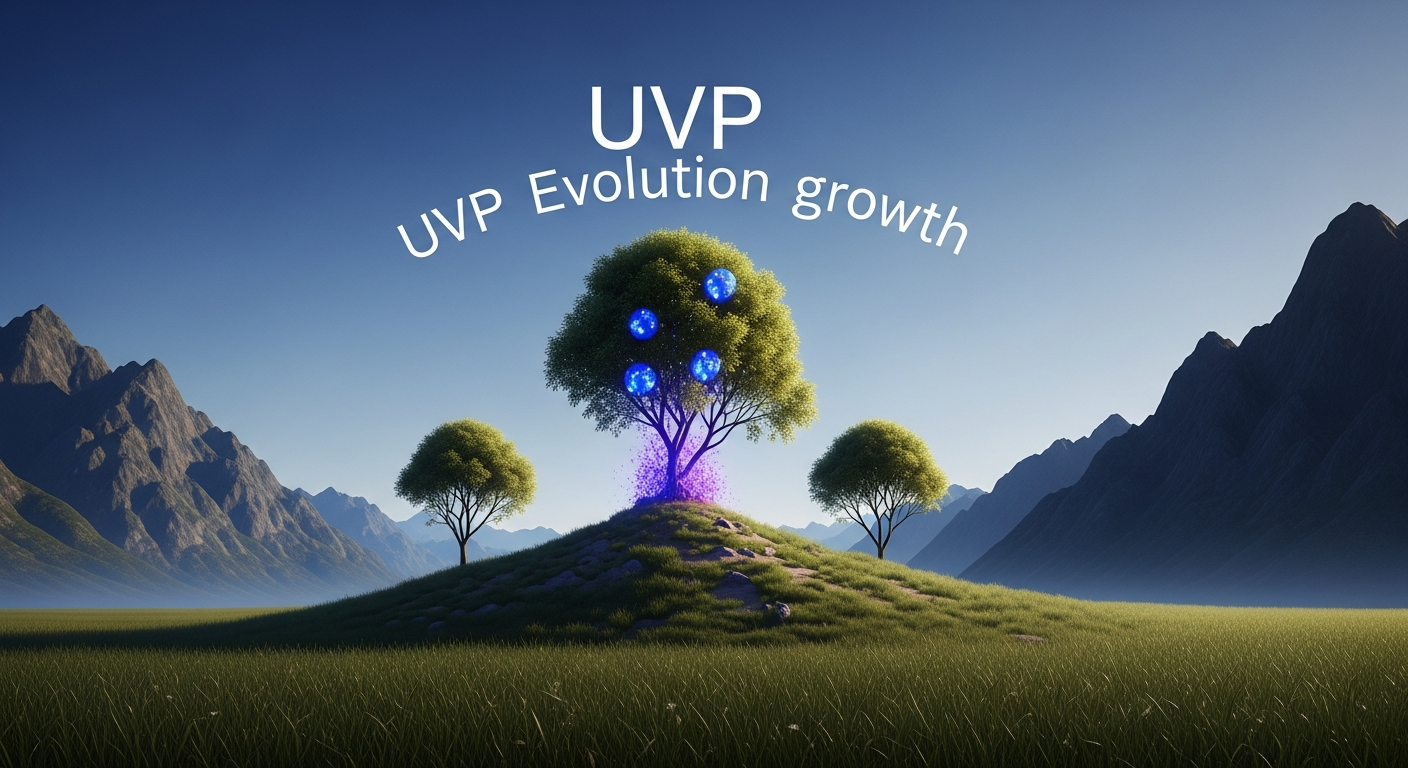
A Unique Value Proposition is not a static declaration carved in stone. It is a living, breathing component of your business strategy that must evolve alongside your company and the market it serves. As your product develops new capabilities, as you begin to target new customer segments, or as the competitive landscape shifts, your UVP may need to be refined, refocused, or even completely overhauled to remain accurate and compelling. Viewing your UVP as an adaptable asset is a sign of strategic maturity and a key factor in long-term, sustainable growth.
Consider how a company like Netflix has evolved. Its initial UVP centered on the convenience of “no late fees” and a massive selection of DVDs by mail, a direct challenge to Blockbuster. As streaming technology became viable, its UVP shifted to focus on instant, on-demand access to a vast library of content. Today, a significant part of its value proposition is its exclusive, original content. Each evolution of its UVP reflected a change in its product, technology, and competitive environment, allowing it to stay relevant and dominant.
Regularly revisiting your UVP—perhaps annually or whenever there is a significant change in your business or market—is a healthy strategic exercise. It forces you to re-validate your assumptions, stay attuned to your customers’ needs, and ensure that your core marketing message is always a sharp, powerful tool that clearly communicates the immense value you provide. Your Unique Value Proposition is the promise you make to your customers; make sure it is always a promise you can keep and one that they will always find compelling.