





In digital marketing, leads are the lifeblood of a business, representing potential revenue, growth, and market expansion. Many businesses, however, fall into the trap of chasing vanity metrics, celebrating a high volume of leads without considering their actual value. A successful growth engine is not built on sheer numbers, but on a sophisticated, multi-faceted lead generation strategy designed to attract, capture, and nurture high-quality prospects who are a genuine fit for your product or service. This isn’t about casting the widest net possible; it’s about using the right bait, in the right waters, to catch the right fish.
Creating a powerful lead generation strategy from scratch can seem daunting. It requires a deep understanding of your customer, a mastery of various marketing channels, and a commitment to data-driven optimization. The payoff, however, is immense: a predictable pipeline of sales-ready opportunities, a higher return on marketing investment, and sustainable, long-term growth. This guide details every critical step, from laying the foundational groundwork of your Ideal Customer Profile (ICP) to implementing advanced nurturing and measurement tactics. We will explore both inbound and outbound methodologies, dissect the anatomy of high-converting assets, and reveal how to build essential alignment between your sales and marketing teams.

At its heart, lead generation is the process of initiating consumer interest or inquiry into a company’s products or services. A modern approach, however, transcends this simple definition. It is a strategic process focused not just on generating interest, but on generating the *right kind* of interest from the *right kind* of people. The ultimate goal is to fill your sales pipeline with prospects who have a high probability of becoming profitable, long-term customers. This requires a fundamental shift in mindset—from a quantity-at-all-costs mentality to a quality-first philosophy.
A high-quality lead, often referred to as a Marketing Qualified Lead (MQL) or Sales Qualified Lead (SQL) at later stages, is more than just a name and an email address. It’s a prospect who exhibits a clear combination of fit and intent.
A high-quality lead sits at the intersection of these two criteria. For example, a marketing director at a 500-person SaaS company (perfect fit) who requests a demo (high intent) is a top-tier lead. Conversely, a student who downloads a general educational ebook might be a lead, but they lack the professional fit to be considered high-quality.
The allure of a large lead database is strong, but it’s often fool’s gold. A strategy focused solely on maximizing lead volume inevitably creates significant problems. Sales teams waste countless hours chasing prospects who will never buy, leading to frustration and plummeting morale. Marketing resources are spread thin creating broad, generic content that fails to resonate deeply with ideal buyers. Ultimately, conversion rates suffer, and the cost to acquire a customer skyrockets.
Prioritizing lead quality flips this dynamic. When marketing delivers well-vetted, high-intent leads, the sales team can focus its energy where it matters most, resulting in shorter sales cycles and higher close rates. A smaller number of high-quality leads will almost always generate more revenue than a massive volume of unqualified ones. Consider this: 100 high-quality leads with a 10% close rate yield 10 new customers. To achieve the same result from 2,000 low-quality leads, you would need a 0.5% close rate, requiring far more effort. Focusing on quality directly improves your return on investment (ROI) and builds a more sustainable model for growth.
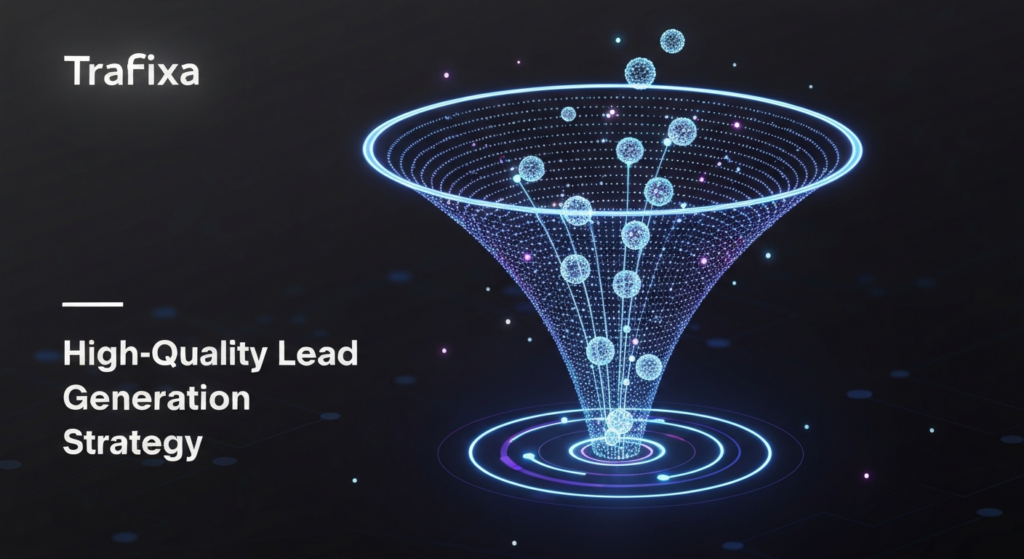
The lead generation funnel is a model that illustrates a prospect’s journey from initial awareness to becoming a customer. Understanding its stages is crucial for creating targeted content and offers.

Before you write a single blog post or launch an ad campaign, you must first answer the most important question in marketing: who are you trying to reach? Without a clear, data-backed answer, your lead generation efforts will be unfocused and ineffective. This foundational step involves creating two distinct but related assets: your Ideal Customer Profile (ICP) and your Buyer Personas.
An Ideal Customer Profile (ICP) is a detailed description of the *company* that is a perfect fit for your product or service. It’s a macro-level view based on firmographics—the blueprint for the type of organization that derives the most value from your offering and provides the most value to you. Key attributes of an ICP often include:
While the ICP defines the target *company*, Buyer Personas are semi-fictional representations of the *people* within those companies who are involved in the purchasing decision. You will likely have multiple personas, such as the end-user, the budget holder, and the technical decision-maker. A well-defined persona goes beyond a job title to include:
To build your ICP and personas, start by analyzing your best existing customers to identify their common characteristics. Conduct interviews with your sales, marketing, and customer success teams to gather their frontline insights. Most importantly, speak directly with your customers to understand their world in their own words. This foundational work is the single most critical step in building a high-quality lead generation strategy, as it informs every subsequent decision you make, from keyword selection to content creation.

Inbound marketing is a methodology centered on attracting customers by creating valuable content and experiences tailored to them. Instead of interrupting people with outbound messages, inbound marketing pulls prospects toward your brand by providing helpful solutions to problems they are actively trying to solve. This approach builds trust, establishes authority, and generates a steady stream of high-quality, engaged leads.
Content is the fuel for your inbound marketing engine. By consistently creating and distributing relevant and valuable content, you can attract your Ideal Customer Profile (ICP) at every stage of their buying journey. The key is to map your content strategy to the lead generation funnel. At the Top of the Funnel (ToFu), your goal is to attract a wide audience with educational content like blog posts and infographics that address their initial pain points, which builds brand awareness and positions you as an expert.
As prospects move to the Middle of the Funnel (MoFu), your content should become more in-depth and designed to capture their contact information in exchange for higher-value assets. This is a primary stage for lead capture. Offer gated content like ebooks, whitepapers, comprehensive guides, and webinars that provide a deeper dive into solving their problems. At the Bottom of the Funnel (BoFu), your content should focus on conversion, helping prospects decide why your solution is the best choice. Case studies, product comparison sheets, and customer testimonials are highly effective at this stage.
Search Engine Optimization (SEO) is the process of optimizing your website and content to rank higher in search engine results for relevant queries. For lead generation, SEO is not just about driving traffic; it’s about capturing high-intent traffic. When a potential customer types a query into a search engine, they are actively looking for information or a solution. By appearing at the top of the results, you place your brand directly in their path at the exact moment of need.
Effective SEO for lead generation starts with strategic keyword research. Go beyond broad, high-volume terms and focus on long-tail keywords that signal specific user intent. For example, instead of targeting the keyword “CRM software” (highly competitive, low intent), a more strategic approach is to target “best CRM for small real estate agencies” (less competitive, high commercial intent). By creating content that thoroughly answers the questions behind these specific queries, you attract visitors who are much further along in the buying cycle and more likely to convert into high-quality leads.
Social media has evolved from a broadcasting tool into a dynamic platform for community building, engagement, and lead generation. The key to success is to shift from a purely promotional mindset to one focused on providing value and fostering genuine connections. Choose the platforms where your buyer personas spend their time. For B2B companies, LinkedIn is often the most powerful channel for sharing insightful articles, participating in industry-specific groups, and connecting directly with decision-makers.
To generate leads, integrate your content marketing with your social media strategy. Share your blog posts and promote your gated lead magnets. Use native platform features like LinkedIn Lead Gen Forms to make it easy for users to provide their information without leaving the site. Beyond direct promotion, use social media to engage in conversations, answer questions, and build a community around your brand’s expertise. This establishes thought leadership and keeps your company top-of-mind, so when a follower is ready to buy, you are their first choice.

A lead magnet is a free, valuable resource offered to prospects in exchange for their contact information, typically an email address. It is the cornerstone of lead capture in an inbound marketing strategy. The effectiveness of a lead magnet lies in its ability to offer a specific solution to a specific problem for a specific audience. A generic “sign up for our newsletter” call-to-action is no longer compelling enough. To succeed, your lead magnet must be so valuable and relevant that your ideal customer feels they are getting an excellent deal by trading their information for it.
The type of lead magnet you offer should align with where your prospect is in their buyer’s journey. A user just beginning their research has different needs than someone ready to make a purchase. Matching the offer to the funnel stage is critical for maximizing conversions.
| Funnel Stage | Lead Magnet Type | Purpose & Example |
|---|---|---|
| Top of the Funnel (ToFu) | Checklists, Templates, Cheat Sheets | Offers quick, actionable value with low commitment. Example: A “10-Point SEO Audit Checklist” for a digital marketing agency. |
| Middle of the Funnel (MoFu) | Ebooks, Whitepapers, Webinars, Case Studies | Provides in-depth information for prospects actively researching solutions. Example: A comprehensive “Guide to B2B Content Marketing” or a webinar on “How to Improve Sales Team Productivity.” |
| Bottom of the Funnel (BoFu) | Free Trials, Demos, Consultations, Quote Generators | Targets high-intent prospects ready to evaluate your specific product or service. Example: A “14-Day Free Trial” of your software or a “Request a Personalized Demo.” |
The most successful lead magnets are contextually relevant to the content a user is already consuming. This alignment creates a seamless and logical next step for the visitor, dramatically increasing the likelihood of conversion. For instance, if a visitor is reading a blog post titled “How to Create a Social Media Content Calendar,” the perfect lead magnet would be a downloadable “Social Media Content Calendar Template.” Offering a generic ebook about marketing in this context would feel disconnected and be far less effective.
To achieve this alignment, think of your lead magnet as a direct upgrade to the content on the page. It should solve the user’s problem more quickly, easily, or comprehensively. Before creating any lead magnet, ask yourself: What specific problem is my ICP trying to solve right now? How can I create a resource that provides an immediate and tangible solution to that problem? The more specific and targeted your lead magnet is to the user’s immediate intent, the more irresistible it will become.

Attracting the right audience and offering a compelling lead magnet is only half the battle. The final step is to make the conversion process as seamless and persuasive as possible. This is where the mechanics of lead capture—your landing pages, forms, and calls-to-action (CTAs)—come into play. Even minor friction or a lack of clarity in this process can cause a potential lead to abandon the effort, wasting all the work that brought them there. Conversion Rate Optimization (CRO) is the practice of perfecting these elements to maximize the percentage of visitors who become leads.
A landing page is a standalone web page created specifically for a marketing or advertising campaign. Its sole purpose is to convert visitors into leads. Unlike a homepage with multiple links and distractions, a high-converting landing page is ruthlessly focused on a single goal. Key elements include:
The form is often the biggest point of friction on a landing page. A long, complicated form can intimidate users and harm your conversion rate. The golden rule is to only ask for the information you absolutely need to qualify and contact the lead. For a top-of-funnel ebook, an email address might be sufficient. For a bottom-of-funnel demo request, you might need more details like company name, size, and job title.
To create a frictionless experience, keep the number of fields to a minimum. Use smart form fields that hide questions a contact has already answered. Leverage progressive profiling, a feature in many marketing automation platforms, to request new information over time as a lead engages with more content. This allows you to build a comprehensive profile without overwhelming them with a massive form on their first interaction. Always ensure your forms are mobile-friendly.
The Call-to-Action is the trigger for conversion—the button or link that tells the user exactly what to do next. Vague, passive CTAs like “Submit” or “Click Here” are ineffective. A compelling CTA is action-oriented, specific, and communicates value. For example, instead of “Download,” use “Get Your Free Ebook Now.” Instead of “Submit,” use “Book My Personalized Demo.”
Make your CTA buttons visually prominent. Use a color that contrasts with the rest of the page to make it stand out. The text on the button should clearly set the expectation of what will happen next. A/B testing different CTA copy, colors, and placements is one of the highest-impact activities you can undertake to improve your landing page conversion rates and capture more high-quality leads.

While inbound marketing is exceptional for building a sustainable, long-term pipeline, outbound and paid strategies provide the means to accelerate lead acquisition, target specific accounts with precision, and generate results more quickly. A well-rounded lead generation strategy effectively balances both inbound and outbound methodologies. Outbound marketing involves proactively reaching out to potential customers and, when done strategically with a focus on relevance and personalization, can be a powerful complement to your inbound efforts.
Pay-Per-Click (PPC) advertising, primarily through platforms like Google Ads, allows you to place your brand at the top of search results for your most important keywords. This provides immediate visibility and is especially effective for capturing high-intent, bottom-of-the-funnel leads who are actively searching for a solution like yours. The key to success with PPC is precise targeting based on keywords, geographic location, demographics, and even past browsing behavior (retargeting).
A successful PPC campaign for lead generation sends traffic to a dedicated, optimized landing page that is highly relevant to the ad copy and keyword. It is also crucial to use negative keywords to filter out irrelevant searches and avoid wasting your budget. For example, if you sell enterprise software, you might add “free” and “template” as negative keywords to exclude searchers not in your target market. PPC provides rapid feedback and a wealth of data, allowing you to quickly test messaging and offers.
Cold email often has a poor reputation due to its association with spam, but when executed strategically, it is one of the most effective B2B outbound tactics. Strategic outreach is the opposite of a mass email blast. It involves building a highly curated list of contacts who fit your Ideal Customer Profile (ICP) and sending them a personalized, relevant, and valuable message. The goal is not to close a deal in the first email, but to start a conversation.
An effective cold email focuses entirely on the recipient. Research their company, their role, and a recent trigger event (like a new funding round or an article they published). Your email should have a compelling subject line, a personalized opening that shows you’ve done your homework, a clear value proposition addressing a likely pain point, and a low-friction call-to-action, such as asking if they’re interested in learning more. This thoughtful approach can open doors to high-value accounts that might not have discovered you through inbound channels.
For B2B companies, LinkedIn is an unparalleled platform for outbound lead generation and social selling, offering detailed professional data on your target personas. LinkedIn Sales Navigator is a premium tool that provides advanced search filters, lead recommendations, and direct messaging capabilities (InMail) to connect with key decision-makers.
Effective social selling on LinkedIn is not about sending generic connection requests and immediately pitching your product; it’s about building relationships and establishing credibility. Start by optimizing your own profile to clearly articulate the value you provide. Share valuable content, engage thoughtfully with your prospects’ posts, and participate in relevant industry groups. By positioning yourself as a helpful expert, you earn the right to initiate a business conversation when the time is right, leading to much higher response and conversion rates.

Capturing a lead is not the end of the marketing journey; it’s the beginning of a crucial new phase: lead nurturing. Research consistently shows that the vast majority of new leads are not yet ready to purchase. They are still in the research and consideration phases. Lead nurturing is the process of building relationships with these prospects by providing them with relevant information at each stage of the sales funnel. The goal is to educate and build trust, keeping your brand top-of-mind so that when they are finally ready to buy, you are their first choice.
Email marketing automation is the engine of modern lead nurturing, allowing you to deliver the right message to the right person at the right time, at scale. When a user downloads a lead magnet, they can be automatically entered into a pre-built email workflow, or nurture sequence. This sequence is a series of emails sent over days or weeks, designed to guide the lead further down the funnel.
A typical nurture sequence might start with a welcome email delivering the promised resource, followed by emails sharing related blog posts, webinar invitations, or a relevant case study. The content should gradually shift from purely educational to more solution-oriented. Automation platforms allow you to set up triggers based on user behavior. For example, if a lead clicks a link to your pricing page, they could be moved to a different, more sales-focused sequence or trigger a follow-up task for a sales rep.
The key to effective lead nurturing is relevance, which is achieved through segmentation and personalization. Sending the same generic message to every lead is a recipe for low engagement and high unsubscribe rates. Segmentation is the practice of dividing your email list into smaller groups based on shared characteristics. You can segment leads by:
Once your list is segmented, you can personalize your communication to be hyper-relevant to each group’s specific needs. Personalization goes far beyond using a contact’s first name; it means sending a case study from their specific industry or sharing content that addresses the unique pain points of their job role. This tailored approach makes your leads feel understood and significantly increases the effectiveness of your nurturing efforts.
Lead scoring is a methodology used to rank prospects on a scale representing their perceived value to the organization. It automates the qualification process by assigning points based on a lead’s attributes (fit) and their engagement with your company (intent). For example, a lead might get +10 points for a “Director” level job title (fit) and +20 points for visiting the pricing page (intent).
In collaboration with your sales team, you set a score threshold. When a lead’s score crosses this threshold, they are automatically flagged as a Marketing Qualified Lead (MQL) and routed to the sales team for follow-up. This system ensures that sales reps spend their valuable time on the most engaged leads who have demonstrated both a strong fit and significant buying intent, improving sales efficiency and conversion rates.

Executing a sophisticated lead generation strategy at scale is nearly impossible without the right technology. A well-integrated tech stack automates repetitive tasks, provides deep performance insights, and enables the personalization required to connect with modern buyers. These tools form the operational backbone of your marketing and sales efforts, allowing your team to work more efficiently and effectively.
A Customer Relationship Management (CRM) platform is the central nervous system of your lead generation strategy, serving as the single source of truth for all prospect and customer data. From the moment a lead is captured, their information is stored in the CRM, and every subsequent interaction—every email opened, web page visited, or sales call—is logged against their contact record. This provides a complete 360-degree view of the customer journey.
This centralized data is invaluable. Marketing can use it to segment audiences for targeted campaigns, and sales has the full context of a lead’s history before making contact. Leading CRM platforms like HubSpot, Salesforce, and Zoho CRM offer robust contact management, deal tracking, and reporting capabilities essential for managing a lead pipeline.
While a CRM is the system of record, a marketing automation platform is the engine of execution. These tools are designed to automate and scale marketing activities, powering email nurture sequences, lead scoring models, and landing pages. With a marketing automation tool, you can build complex workflows that trigger actions based on user behavior, ensuring timely and relevant communication without manual intervention.
Key features to look for include a visual workflow builder, robust email marketing capabilities, landing page and form builders, lead scoring, and detailed analytics. Many modern platforms, such as HubSpot Marketing Hub, Marketo, and Pardot, combine CRM and marketing automation functionalities into a single solution, simplifying your tech stack and ensuring seamless data flow.
Effective optimization relies on accurate measurement. A comprehensive analytics stack is crucial for understanding campaign performance and making data-driven decisions. This starts with web analytics tools like Google Analytics, which provide indispensable data on website traffic, user behavior, and conversion goals. For deeper SEO insights, tools like SEMrush or Ahrefs are essential for tracking keyword rankings and performing competitive research.
To understand how users interact with your landing pages, behavior analytics tools like Hotjar provide heatmaps and session recordings. Finally, to bring all this data together, data visualization and business intelligence (BI) software like Google Data Studio, Tableau, or Power BI allow you to create custom dashboards. These dashboards consolidate key performance indicators (KPIs) from various sources into a single view, making it easy to monitor the health of your lead generation strategy.

A data-driven lead generation strategy is an optimized one. Simply executing campaigns is not enough; you must continuously measure performance, analyze results, and iterate on your approach. Tracking the right Key Performance Indicators (KPIs) allows you to understand what’s working, what isn’t, and where to allocate resources for the greatest impact. This commitment to measurement turns lead generation from a guessing game into a predictable science.
Focusing on a core set of KPIs will provide the most clarity on the health and effectiveness of your strategy. These metrics should cover volume, cost, conversion rates, and revenue impact.
Data collection is only valuable when it leads to action. The purpose of tracking KPIs is to fuel a cycle of continuous improvement. Set up regular review meetings to analyze your dashboards and ask critical questions. If the CPL from an ad campaign is too high, can you refine the targeting or improve the ad copy? If a landing page has a low conversion rate, is it time to A/B test a new headline or form layout?
Look beyond individual metrics and analyze the entire funnel. For example, you might find that organic search generates leads with a lower CPL, but that leads from LinkedIn Ads have a much higher MQL-to-SQL conversion rate. This insight might lead you to invest more in LinkedIn, even with a higher upfront CPL, because those leads are more valuable in the long run. By constantly analyzing performance data and using it to form new hypotheses to test, you can systematically optimize every aspect of your lead generation engine.

Even the most sophisticated lead generation strategy will fail if there is a disconnect between marketing and sales teams. Misalignment creates friction, leads to dropped leads, and ultimately results in lost revenue. When marketing generates leads that sales deems low-quality, or when sales fails to follow up promptly on delivered leads, the entire system breaks down. For a lead generation machine to operate at peak efficiency, sales and marketing must function as a single, unified revenue team with shared goals, shared definitions, and constant communication.
The cornerstone of this alignment is the creation of a Service Level Agreement (SLA), a formal document that clearly defines the commitments each team makes to the other. For marketing, this commitment is typically to deliver a specific number of high-quality Sales Qualified Leads (SQLs) per month. For sales, the commitment is to follow up on every one of those SQLs within a specified timeframe (e.g., within 24 hours). This creates mutual accountability and eliminates finger-pointing.
Crucially, the definition of an SQL must be co-created and agreed upon by both teams. Marketing cannot simply decide what a good lead is and pass it along. Sales and marketing leaders must collaborate to precisely define the demographic, firmographic, and behavioral attributes that constitute a sales-ready lead. This shared definition, often based on your lead scoring model, ensures that marketing is focused on generating leads that sales values.
Finally, establishing a closed-loop feedback system is essential. Sales must have an easy way to provide feedback to marketing on the quality of the leads they are receiving. This can be done through a field in the CRM where sales reps can mark a lead’s status (e.g., “Contacted,” “Qualified,” “Disqualified – Bad Fit”). Marketing can then analyze this data to see which campaigns, channels, and messages are producing the best leads. This continuous feedback loop allows marketing to refine its strategy, ensuring they consistently deliver higher-quality leads over time and creating a virtuous cycle of improvement and growth.