





In the pursuit of digital growth, Conversion Rate Optimization (CRO) has long been a cornerstone of data-driven marketing. For years, the standard for CRO has been the traditional A/B test—a methodical comparison between two versions of a webpage to determine which performs better. While this approach has served businesses well, its limitations are increasingly apparent in today’s fast-paced, hyper-personalized digital landscape. The static nature of classic split testing often leads to slow results, missed opportunities, and insights that are broad rather than deep.
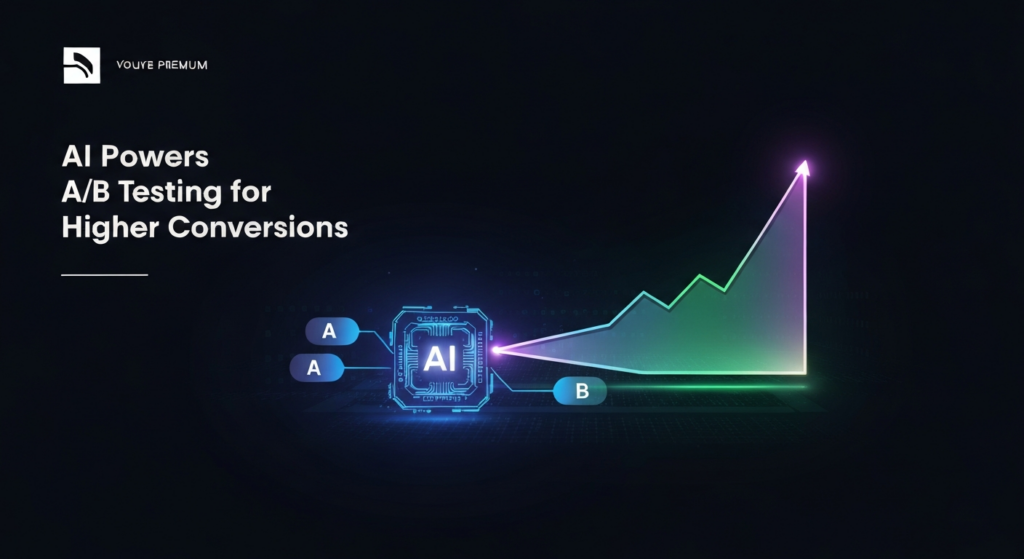
Enter Artificial Intelligence (AI). The technology that powers self-driving cars and personalized recommendations is now revolutionizing digital experimentation. AI-powered A/B testing moves beyond simple A-versus-B comparisons, introducing a paradigm of continuous, automated, and intelligent optimization. By leveraging machine learning models, predictive analytics, and dynamic algorithms, AI not only accelerates the testing process but also uncovers deeper insights and maximizes conversions in real time. This guide explores how AI is reshaping A/B testing, transforming it from a rigid method into a dynamic engine for growth.

For all its contributions to data-informed decision-making, the classic A/B testing model has inherent constraints that can hinder a modern organization’s agility and growth potential. These limitations stem from its rigid statistical foundation and manual processes, which are often out of sync with the dynamic behavior of online audiences.
One of the most significant drawbacks is the time required to reach statistical significance. Traditional tests require a fixed sample size and duration to confidently declare a winner. For websites with moderate or low traffic, this can mean waiting weeks or even months for a single test to conclude. During this period, a substantial portion of users—often 50%—are deliberately sent to a potentially inferior variation. This introduces a significant opportunity cost; every conversion lost on the underperforming page is revenue or a lead that can never be recovered.
Furthermore, traditional A/B testing operates on averages. It declares a single winner for the entire audience, overlooking the nuanced preferences of different user segments. A variation that wins overall might actually perform poorly with a specific high-value segment, such as returning customers or mobile users. Uncovering these granular insights requires a series of subsequent, time-consuming tests, creating a slow and inefficient optimization cycle. The process is also heavily reliant on human intuition to generate hypotheses. While valuable, this reliance can introduce bias and limit testing to incremental changes, potentially causing teams to miss breakthrough discoveries that lie outside conventional wisdom.
AI-powered A/B testing represents a fundamental evolution in how we approach experimentation. It shifts the focus from merely validating a pre-defined hypothesis to discovering the best possible user experience through continuous, automated learning. This new paradigm leverages the computational power of machine learning to analyze vast datasets, identify complex patterns, and make intelligent decisions in real time, far beyond human capacity.
Traditional A/B testing is fundamentally a confirmatory process. A marketer formulates a hypothesis (e.g., “Changing the button color to green will increase clicks”) and runs a test to validate or invalidate it. AI-powered testing, in contrast, is an exploratory process. While it can still be used to test specific hypotheses, its true power lies in its ability to test numerous variations of multiple elements simultaneously. The AI system can then identify winning combinations and hidden user preferences that a human analyst might never have considered, effectively generating data-driven hypotheses dynamically.
The core difference lies in how traffic is managed. Classic split testing uses a static traffic allocation; for instance, in an A/B test, traffic is split 50/50 between the control and the variation for the entire duration of the test. AI-powered testing, particularly using algorithms like the multi-armed bandit, employs dynamic traffic allocation. As the system gathers data and learns which variation is performing better, it intelligently sends more traffic to the current leader. This minimizes the exposure of users to underperforming variations and maximizes conversions *during* the experiment itself, not just after it concludes.
Several key AI and Machine Learning (ML) technologies underpin this advanced approach to experimentation:

Understanding the “how” behind AI-powered testing demystifies the technology and reveals its practical power. At its heart, AI uses sophisticated algorithms to automate and optimize the decision-making process that is traditionally handled manually by CRO professionals. These mechanisms are designed to learn faster, adapt in real time, and achieve better outcomes than static testing methods.
The multi-armed bandit is perhaps the most crucial mechanism in AI-driven testing. The name comes from an analogy of a gambler at a row of slot machines (or “one-armed bandits”). The gambler’s goal is to maximize their winnings by figuring out which machine has the best payout rate and pulling its lever more often. However, to find the best machine, they must spend some money testing all of them. This creates the classic explore/exploit trade-off. If they only exploit the machine that gave them an early win, they might miss out on a different machine with a much higher long-term payout. If they only explore, they waste money on underperforming machines.
A multi-armed bandit algorithm solves this problem mathematically. In A/B testing, each “slot machine” is a variation of your webpage. The algorithm initially allocates a small, even amount of traffic to all variations (explore). As soon as one variation starts showing a higher conversion rate, the algorithm dynamically allocates a larger percentage of traffic to it (exploit). It continues to send a small trickle of traffic to the other variations to ensure it doesn’t prematurely abandon a potential winner. This dynamic allocation ensures that more users see the best-performing experience, directly boosting conversions while the test is still running.
AI models can analyze thousands of data points from early user interactions—such as scroll depth, time on page, mouse movements, and micro-interactions—to predict the probability of a conversion for each variation. These predictive models can often forecast the final outcome of a test with a high degree of confidence long before traditional methods would reach statistical significance. This capability dramatically shortens the learning cycle, allowing teams to make decisions and iterate on their strategies much more quickly.
Reinforcement learning takes optimization a step further by creating a system that continuously learns and refines its strategy over time. In this model, the AI is an “agent” whose goal is to maximize a “reward” (e.g., conversions or revenue). When the agent shows a specific variation to a user, it observes the outcome. If the user converts, the agent receives a positive reward, reinforcing the action of showing that variation to similar users in the future. If the user doesn’t convert, the agent learns from this and adjusts its strategy. This creates a perpetual optimization loop where the system is constantly adapting to shifting user behaviors, market trends, and even seasonality, ensuring the user experience is continuously refined for maximum performance.

Adopting AI in your experimentation program is not just an incremental improvement; it’s a strategic shift that can unlock significant competitive advantages. The benefits extend beyond simply getting faster results, touching every aspect of the optimization lifecycle from ideation to personalization and revenue generation.
By using predictive analytics and Bayesian statistics, AI platforms can often declare a winning variation with far less data than required by traditional frequentist models. This speed is critical in fast-moving markets, enabling teams to implement winning changes sooner and move on to the next optimization opportunity without getting bogged down in lengthy, inconclusive tests.
This is arguably the most compelling financial benefit. With a traditional 50/50 split test, if one variation is significantly worse, you are knowingly sending half your traffic to an experience that costs you money. AI-driven dynamic traffic allocation mitigates this risk by shifting traffic away from losers and towards winners in real time. This approach turns the testing period itself into a profit center rather than a cost center, as the overall conversion rate of the tested page begins to rise almost immediately.
AI excels at handling complexity. While traditional multivariate testing becomes unwieldy with more than a few elements, AI can test dozens or even hundreds of combinations of headlines, images, calls-to-action, and layouts simultaneously. It can identify complex interactions between elements—for example, that a specific headline only works well when paired with a particular image—and find the optimal combination for the entire user base or specific segments.
AI is the engine that drives advanced personalization. An AI system can automatically identify distinct user segments based on behavior, demographics, traffic source, and more. It then learns which variation of an experience resonates best with each segment and serves it to them automatically. This approach moves beyond testing a single page to creating dynamic, personalized customer journeys for different visitors, dramatically increasing relevance and conversion rates.
The latest frontier in AI-powered CRO involves generative AI. These tools can now assist in the creative process itself. By analyzing your brand voice and top-performing content, generative AI can suggest alternative headlines, write new body copy, and even propose different layouts for testing. This automates a significant portion of the manual work involved in setting up experiments, allowing teams to increase their testing velocity and focus on high-level strategy.

To fully appreciate the paradigm shift that AI brings to conversion optimization, it’s helpful to directly compare its characteristics with those of traditional A/B testing. The following table highlights the key differences across several critical dimensions of the experimentation process.
| Feature | Traditional A/B Testing | AI-Powered A/B Testing |
|---|---|---|
| Traffic Allocation | Static and pre-defined (e.g., 50/50 split). It remains fixed throughout the test. | Dynamic and adaptive. Traffic is shifted to better-performing variations in real-time. |
| Primary Goal | To find a single winning variation with statistical confidence after the test concludes. | To maximize conversions during the test and continuously serve the best experience. |
| Test Duration | Often long, determined by the need to reach a pre-calculated sample size for statistical significance. | Typically shorter. AI can predict winners faster and bandit algorithms can run continuously. |
| Handling of Variations | Best suited for a small number of variations (A/B/n testing). Becomes complex with multivariate tests. | Excels at testing a large number of variations and combinations simultaneously. |
| Personalization | Limited. Requires separate, sequential tests to find winners for different user segments. | In-built. AI can automatically identify segments and serve the optimal variation for each one. |
| Opportunity Cost | High. A significant portion of traffic is sent to underperforming variations. | Low. Traffic is quickly moved away from losing variations, minimizing potential revenue loss. |
| Hypothesis Generation | Primarily manual and human-driven, based on research and intuition. | Can be automated. AI discovers winning patterns and combinations, generating data-driven insights. |
| Analysis & Learning | Post-test analysis to determine a single winner for the entire audience. | Real-time learning and continuous optimization, with insights often segmented automatically. |

The theoretical benefits of AI in testing become tangible when applied to real business challenges. Across various industries, companies are leveraging AI to solve complex optimization problems and drive meaningful growth.
An online fashion retailer wants to optimize its product detail pages. Instead of running dozens of separate A/B tests on the product image, description, price display, and “Add to Cart” button, they use an AI platform. The system simultaneously tests 5 image styles, 4 description formats, and 3 button colors. The AI quickly learns that customers arriving from Instagram respond best to a lifestyle video, while those from Google Shopping prefer clean product shots on a white background. Furthermore, it discovers that for items over $100, displaying “or 4 interest-free payments of $25” significantly boosts conversions. The system automatically serves these personalized combinations, leading to a significant increase in add-to-cart rates.
A B2B SaaS company struggles with user churn during its 14-day free trial. They implement an AI-powered testing tool to personalize the onboarding experience. The AI analyzes user data from the sign-up form, such as company size and user role. It then tests different onboarding checklists, in-app tutorials, and welcome emails for each segment. The reinforcement learning model discovers that project managers need to see the collaboration features first, while individual developers are more interested in API documentation. By tailoring the first-run experience, the company increased its trial-to-paid conversion rate by 25%.
A major news publisher uses a multi-armed bandit algorithm to optimize article headlines. When a new article is published, the editorial team provides 5-7 potential headlines. The algorithm displays each headline to a small portion of the initial traffic. Within minutes, it identifies which one is generating the highest click-through rate and begins allocating the vast majority of traffic to the winner. This ensures that content achieves maximum reach, especially during breaking news events. The same principle is applied to test different content layouts, such as the placement of videos and ad units, to maximize both user engagement and ad revenue per session.

As AI-driven optimization has grown in popularity, the market has responded with a new generation of powerful tools. Choosing the right platform is crucial for success and depends on your company’s scale, technical maturity, and specific goals.
The landscape of experimentation tools is diverse. Established players like Optimizely, VWO, and AB Tasty have integrated sophisticated AI features into their platforms, offering capabilities like predictive analytics and multi-armed bandit testing alongside their traditional A/B testing frameworks. Other platforms, such as Dynamic Yield and Intellimize, were built from the ground up with a primary focus on AI-driven personalization and continuous optimization. When evaluating these solutions, it’s important to look beyond the marketing claims and understand the underlying technology and how it aligns with your CRO program’s maturity.
When assessing different platforms, prioritize the following features:
No tool exists in a vacuum. A critical consideration is how well an AI testing platform integrates with your core marketing and data technologies. Seamless integration with your analytics suite (e.g., Google Analytics, Adobe Analytics), Customer Data Platform (CDP), and other marketing automation tools is essential for creating a unified view of the customer and leveraging all available data for personalization.

Transitioning from traditional A/B testing to an AI-driven approach requires a strategic plan. It involves more than just purchasing a new tool; it requires a shift in mindset towards continuous, data-rich experimentation.
Before launching any experiment, be crystal clear about what you want to achieve. Are you focused on increasing revenue per visitor, boosting form submissions, reducing cart abandonment, or improving user engagement? Your primary business goals and Key Performance Indicators (KPIs) will guide your testing strategy and provide the metrics the AI will optimize for. This ensures that your experiments are directly tied to business value.
AI algorithms are only as good as the data they are fed. Before you begin, conduct a thorough audit of your data infrastructure. Ensure that your event tracking is accurate, consistent, and comprehensive. All critical user actions—clicks, sign-ups, purchases, etc.—must be tracked reliably. Clean, high-quality data is the fuel for any successful AI initiative.
Start with a high-impact, high-traffic area of your website, such as the homepage hero section or a key landing page. This will provide the AI with enough data to learn quickly. Instead of a simple A/B test, challenge yourself to create multiple variations of a key element. For example, test five different headlines and three different hero images simultaneously. Let the AI platform manage the traffic allocation and identify the winning combination.
When the experiment concludes or reaches a stable state, dive into the results. A good AI tool will not only tell you *what* won but also provide insights into *who* it won for. Analyze the performance across different user segments. Did a particular variation resonate strongly with mobile users or visitors from a specific country? Use these learnings to inform your next set of experiments and to build a deeper understanding of your audience. AI-powered CRO is a continuous cycle of testing, learning, and iterating.

While the benefits of AI in testing are immense, the path to implementation is not without its challenges. Proactively addressing these potential hurdles is key to a successful program.
One common concern with AI is the “black box” phenomenon—the AI recommends a solution, but the reasoning behind its decision isn’t immediately clear. This can be unsettling for marketers who are used to understanding the ‘why’ behind every result. To counter this, choose platforms that offer explainability features and focus on the practical outcomes. While the exact weighting of the algorithm’s decision may be complex, the data showing that a variation is driving more revenue is concrete. It requires a cultural shift towards trusting the data-driven outcomes while continuing to seek qualitative insights to build a holistic understanding.
Personalization relies on user data, making privacy and compliance paramount. Ensure that your data collection and usage practices for testing are fully compliant with regulations like GDPR and CCPA. Be transparent with users about how their data is used and provide clear opt-out mechanisms. An ethical approach to data is not just a legal requirement; it’s essential for building user trust.
AI-powered platforms are often more expensive than basic A/B testing tools. To secure the necessary budget and get buy-in from stakeholders, you must build a strong business case. Focus on the return on investment (ROI). Model the potential revenue lift from faster testing cycles, the value of maximizing conversions during tests (reduced opportunity cost), and the competitive advantage gained from scalable personalization. Starting with a pilot project on a critical part of the business can be an effective way to demonstrate value and build momentum for wider adoption.

The integration of AI into digital experimentation is still in its early stages, and the future holds even more transformative potential. We are moving beyond optimizing individual pages toward optimizing entire customer journeys. The next wave of AI in CRO will likely focus on several key areas.
First is the rise of **hyper-personalization**, where experiences are not just tailored to segments but to individuals. AI will dynamically assemble webpage components in real time to create a unique layout, with messaging and offers specifically tailored to each visitor’s history and predicted intent.
Second, **generative AI** will play an even larger role. Instead of just suggesting copy, AI may soon be able to generate entire page designs, code them, and run experiments autonomously, presenting marketers with a fully optimized experience based on a simple strategic brief. This will drastically accelerate testing velocity.
Finally, we will see a shift towards **predictive journey optimization**. AI will analyze behavior across all touchpoints—from the first ad a user sees to their post-purchase interactions—and make real-time decisions to guide them along the most effective path to conversion and long-term loyalty. The future of experimentation is not just about finding a better ‘B’; it’s about an AI-driven system that continuously crafts the optimal experience for each user, at every key moment.

The main advantage is its ability to maximize conversions and reduce opportunity cost *during* the testing period. By using dynamic traffic allocation, AI sends more users to the better-performing variation in real time, ensuring you’re not losing revenue by showing a known loser to 50% of your audience. This, combined with the ability to achieve results faster, makes it far more efficient.
A multi-armed bandit algorithm solves the “explore vs. exploit” dilemma. It initially sends a small amount of traffic to all test variations to “explore” their performance. As soon as it gathers enough data to identify a likely winner, it begins to “exploit” that knowledge by dynamically sending a larger share of traffic to that leading variation, all while still sending a tiny fraction to others to ensure it doesn’t miss a late bloomer.
No, most modern AI-powered testing platforms are designed with marketers and CRO professionals in mind. They feature user-friendly interfaces and automated processes that handle the complex data science behind the scenes. While a data-literate mindset is beneficial for interpreting results, you do not need to be a data scientist to run experiments and generate value.
Absolutely. This is one of the core strengths of AI-powered testing. It excels at running complex A/B/n tests (with many variations of a single element) and multivariate tests (with many variations of multiple elements). AI can efficiently analyze the performance of hundreds of combinations to find the optimal experience, a task that is impractical with traditional methods.
Results will vary based on your traffic, industry, and testing maturity. However, common outcomes include significantly shorter testing times, higher overall conversion lift from tests, the discovery of non-obvious winning combinations, and the ability to effectively personalize experiences for different user segments, which often leads to substantial gains in revenue and engagement.
This can be a challenge. AI algorithms, like traditional tests, require data to learn. For very low-traffic sites, it can still take a long time for an AI to confidently identify a winner. However, some modern bandit algorithms are designed to work in lower-data environments. For small businesses, the key is to focus tests on the highest-traffic pages and test for large, impactful changes rather than minor tweaks to get clear signals faster.