



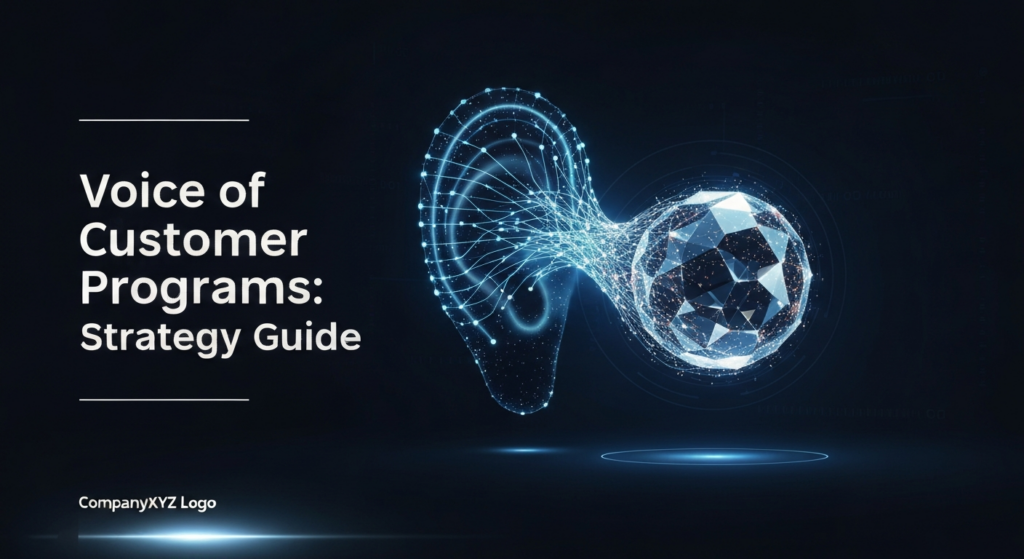

In today’s competitive landscape, understanding your customers is no longer an advantage—it’s a requirement for survival and growth. With more choices than ever, customer expectations for products, services, and experiences are constantly rising. The businesses that thrive are those that listen intently to their customers and use those insights to guide every decision. This is the essence of a Voice of the Customer (VoC) program: a systematic approach to capturing, analyzing, and acting on customer feedback to drive meaningful business improvements.
This guide provides a complete framework for building and implementing a successful VoC program. We will explore its strategic importance, break down its core components, and offer a step-by-step process for turning customer feedback into a valuable asset. Whether you are just beginning or refining an existing program, you will find actionable strategies to foster a truly customer-centric organization.

A Voice of the Customer (VoC) program is a formal methodology for capturing customer expectations, preferences, and aversions. It is a structured process for listening to what customers say about their experiences with your company, products, and services. The goal is to understand the customer’s perspective so deeply that you can anticipate their needs and exceed their expectations, leading to improved satisfaction, loyalty, and overall business performance.
A VoC initiative is not a one-off project or a single survey. It is an ongoing, organization-wide commitment that embeds the customer’s voice into the company’s culture and operations. It involves collecting feedback from multiple channels, analyzing it to identify patterns and root causes, and, most importantly, acting on the insights to drive tangible change. A mature VoC program ensures that business decisions, from product development to marketing, are grounded in real customer data, not internal assumptions.
While customer feedback is the raw material of a VoC program, the program itself is far more comprehensive. Customer feedback can be a passive collection of opinions, comments, and ratings. A VoC program, in contrast, is an active, strategic system. It involves proactively seeking feedback, analyzing it with sophisticated tools and techniques, and integrating the resulting insights into key business processes. VoC transforms isolated comments into a holistic understanding of the customer journey by connecting what customers say to what they do and why. It provides the context behind the data, revealing the emotions, motivations, and pain points that drive customer behavior.
Although VoC and traditional market research both aim to understand customers, they differ significantly in scope, timing, and application. Market research is often project-based, focusing on a specific question or market segment at a single point in time. For example, it might be used to test a new product concept or gauge brand perception. In essence, it is a snapshot.
In contrast, a VoC program is a continuous, real-time process that captures feedback from actual customers as they interact with a brand across various touchpoints. While market research often asks hypothetical questions about potential future behavior, VoC focuses on actual experiences. This makes VoC data highly actionable for improving the current Customer Experience (CX). The two are not mutually exclusive; in fact, they are complementary. Market research can help define the broader market landscape, while VoC provides a deep, ongoing understanding of your existing customer base.
In the modern economy, Customer Experience (CX) has become the key differentiator for brands. A great product or a competitive price is often not enough; customers increasingly choose brands based on the quality of their experience. A VoC program is the engine that powers a successful CX strategy. It provides the direct, unfiltered insights needed to identify friction points, understand customer needs, and design seamless, enjoyable experiences.
Without a formal VoC program, companies often operate on assumptions about what customers want. By systematically listening to and acting on the voice of the customer, businesses can move from a reactive, problem-solving mode to a proactive, experience-enhancing one. This creates a virtuous cycle: better experiences lead to happier, more loyal customers who spend more and advocate for your brand, ultimately driving sustainable business growth.

A well-executed VoC program is not just a customer service initiative; it’s a strategic asset that delivers value across the entire organization. By embedding customer insights into core business functions, a VoC program can drive revenue, reduce costs, and build a powerful competitive advantage. It elevates the customer from a simple transaction to a strategic partner whose feedback helps shape the future of the business.
Investing in VoC provides a deeper understanding of your most important stakeholder: the customer. This understanding yields significant returns, from developing products customers love to crafting marketing messages that resonate. The key strategic benefits of a robust VoC program are detailed below.
It is significantly more expensive to acquire a new customer than to retain an existing one. A VoC program is one of the most effective tools for improving customer retention. By continuously listening to feedback, you can identify at-risk customers and sources of dissatisfaction before they lead to churn. When customers feel heard and see their feedback leading to tangible improvements, their trust and emotional connection to your brand deepen. This process of “closing the feedback loop” is critical for building loyalty. Loyal customers not only stay longer but also tend to spend more and are less sensitive to price changes.
The best ideas for product improvements and new features often come directly from the people who use your products every day. A VoC program provides a direct line to these invaluable insights. By analyzing customer feedback, product teams can understand which features are most valued, what pain points exist, and what unmet needs could be addressed with new solutions. This data-driven approach to product development reduces the risk of building something nobody wants and ensures your roadmap is aligned with real customer desires, leading to higher adoption rates and a more competitive product.
How do your customers describe your product’s value? What language do they use to talk about their problems? A VoC program answers these questions, providing a goldmine of information for marketing and sales teams. By analyzing customer reviews, testimonials, and survey responses, you can uncover the exact words and phrases that resonate with your target audience. This allows you to craft more authentic and persuasive messaging for your website, ad campaigns, and sales pitches. Understanding customer motivations also helps sales teams better qualify leads and tailor conversations to address specific needs, ultimately improving conversion rates.
The impact of a VoC program extends beyond customers to your employees. When employees, especially those on the front lines, have access to direct customer feedback, they gain a clearer understanding of how their work impacts the customer experience. This connection to purpose can be a powerful motivator. Furthermore, empowering employees to use VoC insights to solve customer problems and improve processes increases their sense of ownership and job satisfaction. A customer-centric culture, fueled by a strong VoC program, creates a more engaged workforce aligned around the common goal of delivering exceptional value.

An effective VoC program is not an ad-hoc collection of activities but a structured, cyclical process. This framework is built on four core components that work in a continuous loop: Listen, Analyze, Act, and Monitor. It ensures that customer feedback is collected, understood, acted upon, and measured for impact. Neglecting any of these critical stages can undermine the entire program’s effectiveness.
Think of this framework as an operational blueprint for customer-centricity. It provides a systematic way to manage the flow of customer insights from initial collection through to strategic implementation and performance tracking. By adopting this four-part structure, you can build a scalable and sustainable program that consistently delivers value to both your customers and your business.
The first stage is about gathering customer feedback. A comprehensive listening strategy involves capturing data from multiple sources across the entire customer journey, not just a single annual survey. You should collect feedback at key moments of interaction, or “touchpoints,” such as after a purchase, following a support call, or during product onboarding. The goal is to build a holistic view of the customer experience by combining different types of feedback: direct (surveys, interviews), indirect (social media, reviews), and inferred (behavioral data). The more diverse your listening posts, the richer your understanding will be.
Collecting data is only the first step; the real value is unlocked during analysis. This is where you transform raw feedback into meaningful insights. The goal is to move beyond surface-level comments to understand the “why” behind the feedback. This involves a mix of qualitative and quantitative analysis. Technologies like text and sentiment analysis can help process large volumes of unstructured data (e.g., open-ended survey responses) to identify key themes and emotions. By connecting feedback with operational metrics (e.g., churn rates, support ticket volume), you can identify the root causes of problems and pinpoint areas for improvement.
Insights are useless if they do not lead to action. The “Act” stage is where your VoC program drives real change. This involves two critical activities: prioritizing identified issues based on their potential impact and empowering cross-functional teams to implement improvements. This could involve fixing a software bug, redesigning a confusing webpage, or retraining a support team. A crucial part of this stage is “closing the feedback loop”—communicating back to customers and employees about what you have heard and what you are doing. This demonstrates that you value their input and fosters a stronger relationship.
The final stage is to monitor the results of your actions and measure the overall impact of your VoC program. This is essential for demonstrating ROI and ensuring continuous improvement. Key metrics to track include Customer Satisfaction (CSAT), Net Promoter Score (NPS), and Customer Effort Score (CES). You should also monitor operational metrics related to the changes you’ve implemented. For instance, if you improved your checkout process, did the cart abandonment rate decrease? This stage feeds back into the “Listen” phase, creating a continuous cycle of listening, learning, and improving.

The foundation of any VoC program is its ability to listen effectively. A robust listening strategy does not rely on a single channel; it deploys a variety of methods to capture feedback across the customer journey. By combining different feedback types, you can create a multi-dimensional view of the customer experience, capturing what customers say directly to you, what they say about you to others, and what their behavior reveals. This multi-channel approach helps mitigate bias and provides a more complete picture than any single source could offer.
The key is to meet customers where they are and make it easy for them to share their thoughts. This means strategically placing listening posts at critical touchpoints, such as after a purchase or following a support interaction. The three main categories of feedback to collect are direct, indirect, and inferred.
Direct feedback is information you proactively request and receive from your customers. This is the most common form of VoC data collection. Methods include:
Direct feedback is valuable because it allows you to ask targeted questions and gather structured data on specific areas of interest.
Indirect feedback is unsolicited feedback that customers share publicly on channels you do not own. It represents the authentic, unfiltered voice of your customers. Sources include:
This type of feedback is powerful because it is spontaneous and often reveals issues or sentiments you might not have thought to ask about, providing crucial context about your brand’s public reputation.
Inferred feedback is not explicitly stated by the customer but is derived from analyzing their behavior and operational data. It focuses on what customers *do*, not just what they *say*. Sources include:
Inferred data provides objective evidence that can validate or challenge the insights gathered from direct and indirect feedback.
| Feedback Type | Definition | Examples | Pros | Cons |
|---|---|---|---|---|
| Direct | Feedback you proactively solicit from customers. | Surveys (NPS, CSAT), interviews, focus groups, feedback forms. | Structured, targeted, allows for deep dives on specific topics. | Can be subject to survey fatigue and response bias; may not capture spontaneous thoughts. |
| Indirect | Unsolicited feedback shared publicly by customers. | Social media mentions, online reviews, forum discussions. | Authentic, unfiltered, reveals unexpected issues and brand perception. | Unstructured, can be difficult to analyze at scale, may not be representative of your entire customer base. |
| Inferred | Insights derived from analyzing customer behavior and operational data. | Website analytics, support ticket data, purchase history, product usage data. | Objective, based on actual behavior, highly scalable. | Lacks the “why” behind the behavior; requires interpretation and connection to other data sources. |

Collecting vast amounts of customer feedback is only half the battle. The true power of a VoC program lies in its ability to transform this raw data into clear, actionable insights that the business can use to make smarter decisions. The analysis phase is where you connect the dots, identify patterns, and uncover the root causes of customer satisfaction and dissatisfaction. This requires a systematic approach that combines analytical techniques to make sense of diverse data types, from structured survey scores to unstructured text.
A modern VoC analysis process leverages both human expertise and technology. While automated tools can process data at scale, human analysts are crucial for interpreting nuances, understanding context, and translating findings into compelling stories that inspire action. The goal is to move beyond simply reporting on metrics and start explaining what is driving them.
VoC data comes in two main forms: quantitative and qualitative. Effective analysis requires using both.
The most powerful insights emerge from combining the two. For example, you might see a drop in your CSAT score (quantitative) and then analyze open-ended comments from that period to understand the specific reasons for the decline (qualitative).
Manually analyzing thousands of customer comments is an impossible task. This is where technology like text analytics and sentiment analysis becomes indispensable. Text Analytics uses natural language processing (NLP) to automatically categorize unstructured text and identify key topics and themes. For example, it can quickly tell you that 20% of negative comments in the last month were related to “slow delivery.” Sentiment Analysis goes a step further by automatically determining the emotional tone behind the text, classifying it as positive, negative, or neutral. These tools allow you to quantify qualitative feedback at scale, making it easier to spot emerging trends and prioritize issues.
A key goal of VoC analysis is to move from individual data points to broader themes. By grouping similar feedback, you can identify the most significant drivers of the customer experience. For instance, you might discover that “ease of use,” “support responsiveness,” and “product reliability” are the top three themes influencing your NPS score. It is also critical to analyze feedback by customer segment. Do new customers have a different experience than long-term ones? Do high-value customers have unique pain points? Segmenting your VoC data by demographics, purchase history, or user behavior allows you to tailor your improvement efforts.
To make VoC insights truly strategic, you must connect them to business outcomes. This means linking customer feedback data to operational and financial metrics. For example, can you show a correlation between a low Customer Effort Score (CES) for support interactions and a higher customer churn rate? Can you demonstrate that customers who mention a specific positive feature in reviews have a higher Customer Lifetime Value (CLV)? By linking VoC metrics to key performance indicators (KPIs) like revenue, cost-to-serve, and retention, you can build a powerful business case for customer experience investments and demonstrate the financial ROI of your program.

The most common failure point for VoC programs occurs not in data collection or analysis, but in the failure to act. An insight that does not drive improvement is a wasted resource. The “Act” phase is where the strategic value of your program is realized. It involves creating a systematic process for translating insights into concrete actions, assigning ownership, and ensuring that changes are implemented effectively. This stage is also about demonstrating to customers that their feedback matters, which is crucial for building trust and encouraging continued participation.
Successfully acting on insights requires a structured approach to prioritization, clear communication channels, and the integration of VoC into your organization’s daily workflows. It transforms the VoC program from a listening exercise into an engine for continuous improvement.
You will likely uncover more opportunities for improvement than you have resources to address, making effective prioritization critical. A common method is to use an impact-effort matrix. For each potential improvement, you assess:
Plotting these opportunities on a matrix helps you identify the “quick wins” (high impact, low effort) that should be tackled first. This allows you to build momentum and demonstrate the value of the VoC program early. High-impact, high-effort initiatives should be planned as longer-term strategic projects.
Closing the feedback loop is one of the most important, yet often overlooked, parts of a VoC program. It involves communicating the actions you have taken as a result of feedback to both customers and employees.
Closing the loop shows respect for the customer’s time and effort, strengthens their relationship with your brand, and encourages them to provide feedback in the future.
For a VoC program to be sustainable, it must be embedded into the core operating rhythm of your business, not siloed within a single department. This means integrating VoC insights into key decision-making processes across the organization. For example:
When the voice of the customer becomes a routine consideration in daily work, you have successfully built a truly customer-centric culture.

Launching a VoC program can seem daunting, but a structured, step-by-step approach ensures you can build a program that delivers tangible results. The key is to start with a clear plan, secure support, and focus on delivering value incrementally. You can begin with a limited budget and simple tools, scaling your efforts as the program proves its worth. A successful program is built on a foundation of clear objectives and cross-functional collaboration.
This section outlines the essential steps for establishing your VoC program, from defining your goals and getting leadership on board to assembling the right team and planning for growth. This practical roadmap will help you navigate the initial stages and set your program up for long-term success.
Before collecting any feedback, you must define what you want to achieve. What business problem are you trying to solve? Are you focused on reducing churn, improving product adoption, or increasing loyalty? Your objectives should be specific, measurable, achievable, relevant, and time-bound (SMART). For example, a clear objective might be: “Reduce customer churn by 10% over the next 12 months by identifying and addressing the top three drivers of dissatisfaction.”
Once you have objectives, define the key metrics you will use to measure success. These will likely include a mix of VoC metrics (NPS, CSAT) and operational metrics (churn rate, support ticket volume). Clear goals and metrics are crucial for focusing your efforts and demonstrating the program’s value.
A VoC program cannot succeed as a grassroots effort alone; it requires visible support and investment from senior leadership. To gain executive buy-in, build a compelling business case. Do not just talk about making customers “happier”; frame the program in terms of business outcomes. Use industry benchmarks and data to show how improving the customer experience can impact revenue, costs, and profitability. Connect your proposed VoC objectives to the company’s overall strategic goals. Present a clear, phased plan that outlines the required resources (people, budget, technology) and the expected return on investment (ROI). Securing an executive sponsor to champion the program is a critical step.
Avoid trying to boil the ocean. You do not need to listen to every customer on every channel from day one. Start with a focused pilot project. For example, you could begin by implementing a post-support transaction survey to understand and improve the service experience. Or you could focus on a single customer journey, like the onboarding process for new users.
Starting small allows you to learn and refine your processes in a controlled environment. It helps you achieve quick wins that can be used to demonstrate the program’s value and build momentum. Once you have proven the concept and established a solid workflow, you can strategically scale your efforts to include more touchpoints, channels, and customer segments.
While a single person or small team might lead the VoC program, its success depends on cross-functional collaboration. The voice of the customer should not be siloed within one department. Your core VoC team should act as a centralized hub, but you must involve stakeholders from across the organization.
Create a cross-functional team with representatives from key departments like Product, Marketing, Sales, Customer Support, and Operations. This team will be responsible for reviewing insights, prioritizing actions, and driving change within their respective departments. This collaborative approach ensures that insights are shared widely and that all parts of the business feel a sense of ownership in improving the customer experience.
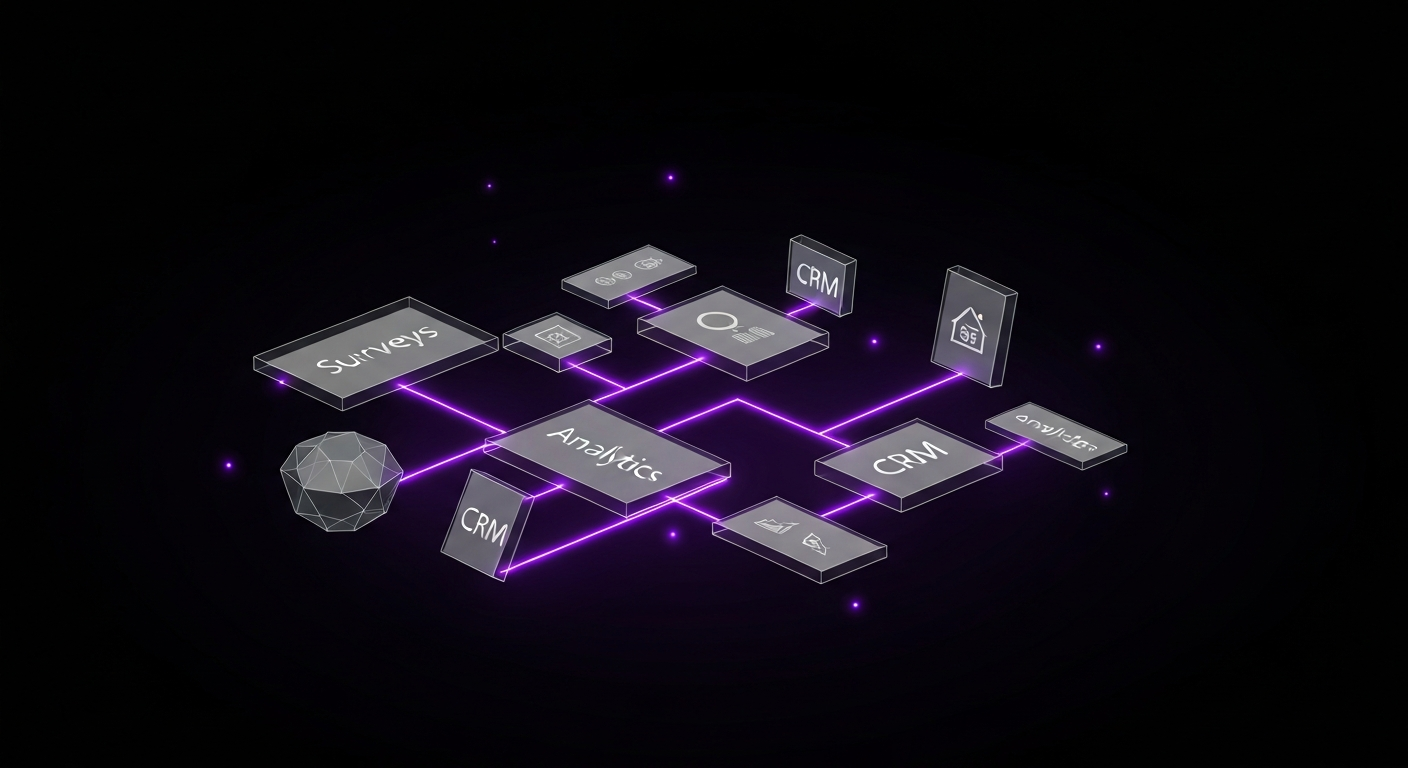
While the strategy and processes behind your VoC program are paramount, the right technology stack can significantly enhance your ability to listen, analyze, and act at scale. The VoC technology market is vast, with tools ranging from simple survey platforms to comprehensive experience management suites. The key is to select tools that match your program’s maturity, objectives, and budget. As your program grows, your technology needs will likely evolve.
Your “VoC stack” is the combination of technologies you use to manage your program. A well-integrated stack ensures a seamless flow of data from collection to analysis to action. Here are the core categories of tools to consider when building out your technology capabilities.
These tools help you execute the “Listen” phase of your VoC framework by creating, distributing, and managing feedback collection across various channels. Examples include tools for:
When choosing a tool, consider its ease of use, integration capabilities, and ability to target specific customer segments.
These tools power the “Analyze” phase, helping you make sense of the data you have collected. While some feedback tools have built-in analytics, you may need more powerful platforms as your data volume grows. This category includes:
Your CRM (e.g., Salesforce, HubSpot) is the central repository of customer data and a critical component of your VoC stack. Integrating your feedback and analysis tools with your CRM is essential. This integration allows you to:
For mature VoC programs, all-in-one Experience Management (XM) platforms like Qualtrics, Medallia, or Forsta offer a comprehensive solution. These platforms combine many of the functions mentioned above into a single, integrated system. They provide tools for multi-channel feedback collection, advanced analytics (including text and predictive analytics), dashboarding, and workflow automation for closing the loop. While they represent a significant investment, they can provide a powerful, enterprise-wide solution for managing your VoC program.
| Tool Category | Primary Function | Examples | Key Consideration |
|---|---|---|---|
| Survey & Feedback Collection | Gathering direct and indirect customer feedback. | SurveyMonkey, Typeform, Hotjar, Brandwatch | Ease of use, channel support, targeting capabilities. |
| Analytics & BI | Analyzing quantitative and qualitative data to find insights. | Tableau, Power BI, Thematic, MonkeyLearn | Analytical depth, visualization options, AI capabilities. |
| CRM Systems | Centralizing customer data and managing relationships. | Salesforce, HubSpot, Zoho CRM | Integration capabilities with other VoC tools. |
| Experience Management (XM) | Providing an all-in-one solution for VoC program management. | Qualtrics, Medallia, Forsta, InMoment | Scalability, comprehensiveness, budget. |

To ensure the long-term viability of your VoC program, you must demonstrate its value to the business. This requires connecting your efforts to tangible financial outcomes, not just tracking customer happiness. Measuring the Return on Investment (ROI) involves tracking a combination of customer experience metrics and key business performance indicators. By showing a clear link between improved customer experience and positive business results, you can justify continued investment and elevate the strategic importance of VoC within your organization.
A balanced scorecard of metrics is essential. While high-level perception metrics like NPS are important, they should be complemented by transactional metrics like CSAT and CES, as well as hard business metrics like customer churn and lifetime value.
Net Promoter Score is a widely used metric that measures customer loyalty. It is based on a single question: “On a scale of 0-10, how likely are you to recommend our company/product/service to a friend or colleague?” Respondents are grouped into:
NPS is calculated by subtracting the percentage of Detractors from the percentage of Promoters. It provides a high-level view of customer loyalty and is a strong predictor of future growth.
Customer Satisfaction measures a customer’s satisfaction with a specific interaction, product, or service. It is typically measured with a question like, “How satisfied were you with your recent support experience?” on a scale of 1-5 (from “very unsatisfied” to “very satisfied”). CSAT is a transactional metric that is excellent for pinpointing specific strengths and weaknesses in the customer journey. By measuring CSAT at key touchpoints, you can get immediate feedback on the quality of your service and processes.
Customer Effort Score measures how much effort a customer had to exert to get an issue resolved, a request fulfilled, or a question answered. The question is typically phrased, “To what extent do you agree or disagree with the following statement: The company made it easy for me to handle my issue.” Research shows that reducing customer effort is a powerful driver of loyalty. A high CES (indicating high effort) is a strong predictor of customer churn. This metric is particularly useful for evaluating and improving the efficiency of your customer service and support processes.
These are the ultimate bottom-line metrics for your VoC program. By correlating changes in your CX metrics (NPS, CSAT, CES) with these financial outcomes, you can calculate a direct ROI.

Building a successful VoC program involves more than just implementing the right processes and tools; it requires a strategic mindset and a deep commitment to customer-centricity. While the potential rewards are significant, common challenges can derail even well-intentioned programs. By understanding and applying best practices while actively avoiding these pitfalls, you can maximize your program’s impact and ensure its long-term success.
Technology and processes are enablers, but a VoC program truly thrives when supported by a customer-centric culture. This means every employee, from the CEO to the front lines, understands the importance of the customer experience and feels empowered to improve it. Leadership must consistently communicate the value of customer feedback and celebrate successes. Customer stories and insights should be shared widely and regularly to keep the customer’s voice top-of-mind across the organization.
VoC insights should not be confined to a single team or a series of static reports. To drive action, you need to get the right insights to the right people at the right time. Use dashboards and automated reporting to provide teams across the organization with access to the feedback most relevant to their roles. A product manager should be able to easily see feedback related to their product, while a support manager should have a real-time view of CSAT scores. When employees have direct access to customer insights, they are better equipped to make informed, customer-focused decisions.
This is perhaps the most critical pitfall. Many companies invest heavily in collecting feedback but lack a clear process for analyzing it and, more importantly, acting on it. This not only wastes resources but can also be detrimental. If customers take the time to provide feedback and see no changes, they will feel ignored and become less likely to offer feedback in the future. Before you launch any feedback initiative, ensure you have a clear plan and dedicated resources for analysis and action. Start small if necessary, but always be prepared to act on what you learn.
In their enthusiasm to gather feedback, some companies bombard customers with surveys. This can lead to “survey fatigue,” where customers become annoyed and stop responding, or they provide low-quality, rushed answers. This diminishes the value of your data. Be strategic and respectful of your customers’ time. Use a coordinated approach to manage how often you survey individual customers. Prioritize transactional surveys at the most critical touchpoints and supplement them with indirect and inferred feedback to get a holistic view without overwhelming your customers.

The Voice of the Customer field is constantly evolving, driven by technological advancements and rising customer expectations. While the core principles—listen, analyze, act—remain constant, the tools for executing them are becoming increasingly sophisticated. The future of VoC lies in moving from a reactive, historical view of feedback to a proactive, predictive, and personalized approach. Companies that embrace these trends can better anticipate customer needs, prevent problems, and deliver highly individualized experiences.
Artificial Intelligence (AI) and machine learning are at the heart of this evolution. AI enhances VoC programs by automating complex analysis at a scale previously unimaginable. It can analyze millions of data points—from survey comments and call transcripts to social media posts and product usage data—to uncover subtle patterns and predict future customer behavior. For example, predictive analytics models can identify customers who are at high risk of churning based on their feedback and behavior, allowing companies to intervene proactively with targeted retention offers.
This capability leads to a new level of personalization. By combining rich VoC insights with behavioral data, companies can move beyond one-size-fits-all solutions. They can tailor communications, product recommendations, and support interactions to the unique needs and preferences of each customer. The future of VoC is not just about understanding the collective voice of the customer, but about understanding and responding to the voice of *each* customer, creating experiences that feel personal, relevant, and effortless.

Customer feedback is the raw data—the comments, scores, and opinions customers share. A Voice of the Customer (VoC) program is the overarching strategy and system for systematically collecting, analyzing, and acting on that feedback to drive business improvements. Feedback is the input; VoC is the entire process that turns that input into actionable intelligence and organizational change.
To get executive buy-in, frame your proposal in terms of business value. Create a clear business case that connects VoC initiatives to key financial outcomes. Use data and industry benchmarks to show how improving customer experience metrics like NPS can lead to increased customer retention, higher lifetime value, and reduced operational costs. Start with a small, focused pilot project to demonstrate tangible results and build a case for a larger investment.
The best first step is to start small and focused. You do not need expensive software to begin. Identify one critical customer touchpoint that has a significant impact on the business (e.g., the post-purchase experience or a customer support interaction). Use a free or low-cost survey tool to collect targeted feedback at that single point. Focus on analyzing that data and, most importantly, acting on it to make a demonstrable improvement. This initial success will provide the foundation and justification for expanding your program.
While complete elimination of bias is difficult, you can minimize it by using a multi-channel listening approach. Do not rely solely on surveys, which can attract only the most satisfied or dissatisfied customers. Incorporate indirect feedback (like online reviews) and inferred feedback (like behavioral data) to get a more balanced view. Also, pay close attention to your survey design: use neutral language, avoid leading questions, and ensure your sample is representative of your overall customer base.
A successful VoC program should track a balanced set of metrics. Start with core CX perception metrics like Net Promoter Score (NPS) for loyalty, Customer Satisfaction (CSAT) for transactional interactions, and Customer Effort Score (CES) for ease of experience. Crucially, you must connect these to business outcome metrics like Customer Churn Rate, Customer Retention Rate, and Customer Lifetime Value (CLV) to demonstrate the program’s financial ROI.
AI, particularly through Natural Language Processing (NLP), revolutionizes VoC analysis by automating the processing of large volumes of unstructured data like open-ended comments. AI-powered text and sentiment analysis can quickly identify key themes, topics, and emotions from thousands of customer comments, a task that would be impossible to do manually. AI can also power predictive analytics to identify at-risk customers before they churn, enabling proactive intervention.