








While acquiring new customers is a celebrated victory in business, retaining existing ones is crucial for long-term growth. The departure of existing customers, known as churn or attrition, represents the rate at which customers stop doing business with a company. Although a certain level of churn is inevitable, high rates can severely damage profitability and market position.
The financial implications are stark. According to a widely cited business axiom, acquiring a new customer can be five to 25 times more expensive than retaining an existing one. This disparity arises from the significant investments in marketing, sales, and onboarding needed to convert new leads. Retained customers, having already passed these stages, are more likely to make repeat purchases, spend more over time, and require less marketing. This principle is captured by the Customer Lifetime Value (CLV) metric, which shows that a loyal customer is an appreciating asset.
Beyond the direct revenue loss, churn has other detrimental effects. A departing customer might share negative experiences, damaging the brand’s reputation and deterring potential clients. High churn rates can also demoralize employees, especially in customer-facing roles. This creates a perpetual acquisition cycle, forcing a company to work hard just to maintain its size instead of achieving sustainable growth. Therefore, understanding and mitigating churn is not merely a defensive tactic; it is a fundamental pillar of a sound business strategy that builds a stable revenue base and fosters brand loyalty.

For decades, businesses have tried to understand why customers leave, but their methods were often limited and reactive. The arrival of Artificial Intelligence (AI) and Machine Learning has transformed this effort, shifting it from historical analysis to predictive science. AI-powered churn prediction uses sophisticated algorithms to analyze vast amounts of customer data, identifying subtle patterns that indicate a customer is at risk of leaving long before they decide to do so.
Traditional churn analysis was a manual, often imprecise process. Analysts would examine spreadsheets for obvious trends or rely on anecdotal evidence from sales teams. A company might use simple rules, like flagging a customer who has not made a purchase in 90 days. While this approach has some value, it has severe limitations. It cannot effectively handle the volume and variety of modern customer data, which ranges from website clicks to support ticket sentiment. Spreadsheets also fail to uncover complex, non-linear relationships among hundreds of variables, leading to oversimplified conclusions and missed opportunities to identify the true drivers of churn.
The most significant advantage of AI in this domain is the shift from a reactive to a proactive approach to customer retention. Traditionally, businesses only learn that a customer has churned after a subscription is canceled or an account goes dormant. At that point, winning them back is difficult, expensive, and often unsuccessful. AI fundamentally changes this dynamic. By analyzing real-time behavioral data, machine learning models can assign a ‘churn score’ to each customer, quantifying their likelihood of leaving. This foresight allows customer success, marketing, and sales teams to intervene precisely when it matters most—while the customer is still engaged but may be wavering. Instead of sending a “We miss you!” email after the fact, a company can proactively offer support, a personalized discount, or a training session to address the customer’s unspoken needs and reinforce their loyalty.

AI-powered churn prediction is a systematic process of learning from data. Machine Learning (ML), a subset of AI, trains algorithms to recognize patterns in historical data and then use those patterns to make predictions about new data. In the context of churn, the model learns the characteristics of a ‘churning’ customer by analyzing the behavior of thousands of past customers.
Historical data serves as the textbook from which a machine learning model learns. To be effective, a model requires a rich dataset covering a large group of customers over time, with a clear label indicating who churned and who remained. This dataset provides the ground truth. The algorithm analyzes this information, comparing the attributes and actions of customers who churned with those who stayed. Without sufficient, high-quality historical data, the model has no foundation for learning, and its predictions will be unreliable. The more comprehensive and accurate the data, the more nuanced the model’s predictions will be.
In data science, individual data points used for prediction—such as age, purchase frequency, or last login date—are called ‘features.’ A crucial step in building a predictive model is identifying which features are the most powerful indicators of churn. This process, known as feature engineering, involves selecting, transforming, and creating variables for the model. For a SaaS company, key features might include decreased login frequency, a drop in the usage of key functions, or an increase in support tickets. For an e-commerce business, they could be a longer-than-average time since the last purchase or a decline in average order value. The ML model analyzes the statistical relationship between these features and the outcome (churn or no churn) to determine their predictive power.
Building a model is an iterative process of training and validation. The historical dataset is typically split into a training set and a testing set. The model is ‘trained’ on the larger training set, where it learns the complex patterns and relationships between features and the churn outcome. After training, the model’s performance is evaluated on the testing set—data it has not previously seen. This validation step is critical to ensure the model can generalize its findings to new customers and is not simply ‘memorizing’ the training data. Data scientists use metrics like accuracy, precision, and recall to measure performance. If the results are unsatisfactory, they may refine the features, try a different algorithm, or tune the model’s parameters to achieve the desired predictive power.

The accuracy of a machine learning model depends entirely on the quality of its data. To build a robust churn prediction system, businesses must consolidate data from various sources to create a comprehensive, 360-degree view of each customer. The more diverse the data, the more subtle the patterns the AI can detect. Key data sources fall into four main categories.
This foundational data provides context about who the customer is. For a Business-to-Consumer (B2C) company, this includes demographic information like age, gender, and geographic location. For a Business-to-Business (B2B) company, this is firmographic data, such as the customer’s industry, company size, and annual revenue. This information helps segment customers and can reveal broad trends, such as whether customers in a particular industry or region are more prone to churn.
This is often the most predictive category of data, as it reflects how a customer actively engages with a product or service. For a SaaS platform, this includes metrics like login frequency, session duration, specific features used, and the number of active users per account. For an e-commerce site, this would be data on website visits, pages viewed per session, and cart abandonment rates. A decline in engagement is one of the strongest early warning signs of potential churn.
This data provides a clear picture of a customer’s financial relationship with the company. Key metrics include purchase frequency, recency of the last purchase, and the monetary value of transactions (often summarized as RFM analysis). Other important data points are subscription renewal dates, plan upgrades or downgrades, and payment history. A customer who was once a frequent buyer but has not purchased in months, or a subscriber who downgrades their plan, is signaling a change in their relationship with the brand.
Interactions with customer support are a goldmine of information about customer health. This data includes the volume of support tickets, resolution times, and the nature of the problems being reported. Modern AI can go further by applying sentiment analysis to support emails, chat logs, and call transcripts to gauge customer frustration or satisfaction. Additionally, direct feedback from Net Promoter Score (NPS) surveys, Customer Satisfaction (CSAT) scores, and product reviews provides an explicit measure of customer sentiment that is highly predictive of loyalty.
| Data Category | B2C Examples | B2B Examples | Why It’s Important |
|---|---|---|---|
| Demographic/Firmographic | Age, Location, Gender | Industry, Company Size, Revenue | Provides context and helps in customer segmentation. |
| Behavioral/Usage | Website visits, App logins, Time on page | Feature adoption, Login frequency, Number of active seats | Directly measures engagement and is a leading indicator of churn. |
| Transactional | Purchase frequency, Average order value, Last purchase date | Subscription tier, Renewal date, Upsell/downgrade history | Tracks the financial health and commitment of the customer relationship. |
| Support/Feedback | NPS score, Product reviews, Support chat sentiment | Number of support tickets, Resolution time, CSAT score | Captures the customer’s explicit and implicit satisfaction levels. |

Once the data is prepared, the next step is to choose the right machine learning algorithm. Different algorithms have unique strengths and are suited for different types of problems and datasets. While data scientists have a vast toolkit, a few models have proven particularly effective for churn prediction.
Logistic Regression is one of the most fundamental algorithms for classification problems like churn prediction (where the outcome is binary: churn or not churn). It works by calculating the probability of an event occurring based on input features. Its primary advantages are simplicity and interpretability. The model’s output clearly shows how each feature contributes to the churn probability, making it an excellent baseline and a great starting point for any churn prediction project.
A Decision Tree model splits data into smaller subsets based on a series of if-then questions, creating a tree-like structure that leads to a prediction. While intuitive, a single decision tree can be prone to overfitting (performing poorly on new data). This is where Random Forests excel. A Random Forest is an ‘ensemble’ method that builds hundreds of individual decision trees on different subsets of the data and then averages their predictions. This approach dramatically improves accuracy and robustness, making Random Forests a popular and powerful choice for churn prediction.
Gradient Boosting Machines (GBMs) are an advanced type of ensemble method. Like Random Forests, they combine multiple weak models (typically decision trees) to create a single strong one. However, GBMs build them sequentially, with each new tree trained to correct the errors of the previous ones. This iterative refinement makes gradient boosting models, particularly implementations like XGBoost, LightGBM, and CatBoost, the state-of-the-art for many tabular data problems. They consistently achieve top-tier accuracy, making them the gold standard for businesses that need the highest possible predictive power.
Inspired by the human brain, Neural Networks consist of interconnected layers of ‘neurons’ that can learn extremely intricate patterns. For most typical churn prediction problems with structured, tabular data, models like XGBoost often perform just as well or better and are simpler to implement. However, when dealing with massive datasets or incorporating unstructured data like text from support calls, neural networks can offer superior performance. Their main drawback is that they are often ‘black box’ models, making their internal decision-making process difficult to interpret.
| Algorithm | Complexity | Interpretability | Typical Accuracy | Best For |
|---|---|---|---|---|
| Logistic Regression | Low | High | Good | Baseline models and situations where interpretability is key. |
| Random Forest | Medium | Medium | Very Good | Most churn prediction use cases with structured data. |
| XGBoost | High | Low | Excellent | Situations requiring the highest possible accuracy. |
| Neural Networks | Very High | Very Low | Excellent | Very large, complex datasets or those with unstructured data. |

Moving from the concept of AI churn prediction to a functioning system requires a structured, methodical approach that combines business strategy, data engineering, and data science. Following a clear process ensures the final model is technically sound, aligned with business goals, and capable of driving real-world action.
Before any technical work begins, you must clearly define what ‘churn’ means for your business and the project’s objective. Is the goal to reduce churn by 10% next quarter, or to identify high-value customers for proactive outreach? The definition of a churn event must be precise and measurable. For a SaaS company, it might be a subscription cancellation. For a mobile app, it could be 30 consecutive days of inactivity. This definition becomes the target variable for the machine learning model and frames the entire project.
This is often the most time-consuming yet critical phase. Data for churn prediction typically resides in multiple silos: a CRM, a transactional database, product analytics tools, and customer support platforms. The first task is to consolidate this data into a single, unified view for each customer. The next step is rigorous data cleaning, which involves handling missing values, correcting inconsistencies, and removing duplicates. The principle of ‘garbage in, garbage out’ applies forcefully here; model quality is entirely dependent on data quality.
Once the data is prepared, the data science team can begin building the model. This step involves using the prepared data for feature engineering, selecting an appropriate algorithm, and then splitting the dataset for training and testing. The model learns from the training data and is then evaluated against the test data to gauge its predictive performance. This is an iterative process of tuning and refinement, with the goal of producing a model that is not only accurate but also reliable and stable over time.
A predictive model has no business value until it is operationalized. This final step involves deploying the model into a production environment where it can regularly score all active customers, generating an up-to-date churn probability for each. These scores must then be integrated into the workflows of the teams who can act on them. For example, a high churn score could automatically create a task in the CRM for a customer success manager, enroll the customer in a personalized marketing campaign, or trigger an in-app survey. Closing this loop between prediction and action is what turns a data science project into a powerful customer retention engine.

Identifying a customer at risk of churning is only half the battle. The true value of a predictive model is realized when its insights drive targeted, effective retention strategies. A churn score is not a final verdict; it is a call to action. By understanding who is at risk and why, businesses can move from a one-size-fits-all approach to a personalized and proactive retention playbook.
Instead of sending generic promotions to the entire customer base, AI allows for surgical precision. Customers with a high churn score can be automatically segmented and enrolled in specific re-engagement campaigns. This could involve an email series highlighting unused product features, showcasing recent improvements, or sharing relevant case studies. The key is personalization; the message should address their potential pain points, which can often be inferred from the same features that led to their high churn score.
For high-value B2B or VIP B2C customers, an automated email is often not enough. When the model flags a key account as high-risk, it should trigger an alert for their dedicated Customer Success Manager (CSM) or account manager. Armed with this insight, the CSM can initiate a proactive check-in. This is a consultative conversation to understand their challenges, offer strategic advice, provide additional training, or reinforce the value of the partnership. This data-guided human touch can be incredibly effective at mending a deteriorating relationship.
While indiscriminate discounting can erode margins, offering a timely incentive to an at-risk customer can be a highly profitable intervention. The churn score can trigger a special offer, such as a discount on their next renewal, bonus credits, or a temporary upgrade to a premium tier. This can serve as a powerful nudge to remind them of the value they receive and encourage them to re-engage, breaking the cycle of disinterest that often precedes churn.
Insights from a churn model can create a valuable feedback loop for the product team. By analyzing the features that are most predictive of churn, companies can identify product weaknesses. For example, if customers who fail to adopt a specific ‘sticky’ feature are highly likely to churn, it signals a problem with that feature’s onboarding, usability, or perceived value. This data-driven insight allows product managers to prioritize improvements that will have the most significant impact on long-term retention, fixing the root cause of churn rather than just treating the symptoms.

The application of AI for churn prediction delivers tangible results for companies across numerous industries. By leveraging predictive analytics, businesses are transforming their customer retention efforts, leading to increased revenue, higher customer satisfaction, and a stronger competitive edge.
The telecommunications industry, characterized by intense competition and low switching costs, was an early adopter of churn prediction. Telecom companies analyze massive datasets—including call records, data usage patterns, and customer service interactions—to predict which subscribers are likely to switch providers. This allows them to proactively offer these customers personalized retention deals, such as a discounted plan or a handset upgrade, effectively preventing churn and preserving millions in recurring revenue.
For Software as a Service (SaaS) companies, customer retention is the lifeblood of their recurring revenue model. SaaS businesses use AI to monitor user engagement in real-time by tracking dozens of behavioral signals like login frequency and feature adoption. When a customer’s engagement drops, their churn probability rises, triggering automated workflows. These can range from in-app guides suggesting new features to a personal email from a customer success manager. This proactive approach helps SaaS companies reduce churn and maximize customer lifetime value.
In the e-commerce and retail sectors, AI helps businesses identify customers who are drifting away. Models analyze purchase history, browsing behavior, and responses to marketing campaigns. A customer who was once a weekly shopper but has not visited the site in a month is a clear churn risk. The system can automatically target this customer with a personalized offer, like a discount on a previously viewed product, luring them back before they are lost to a competitor.
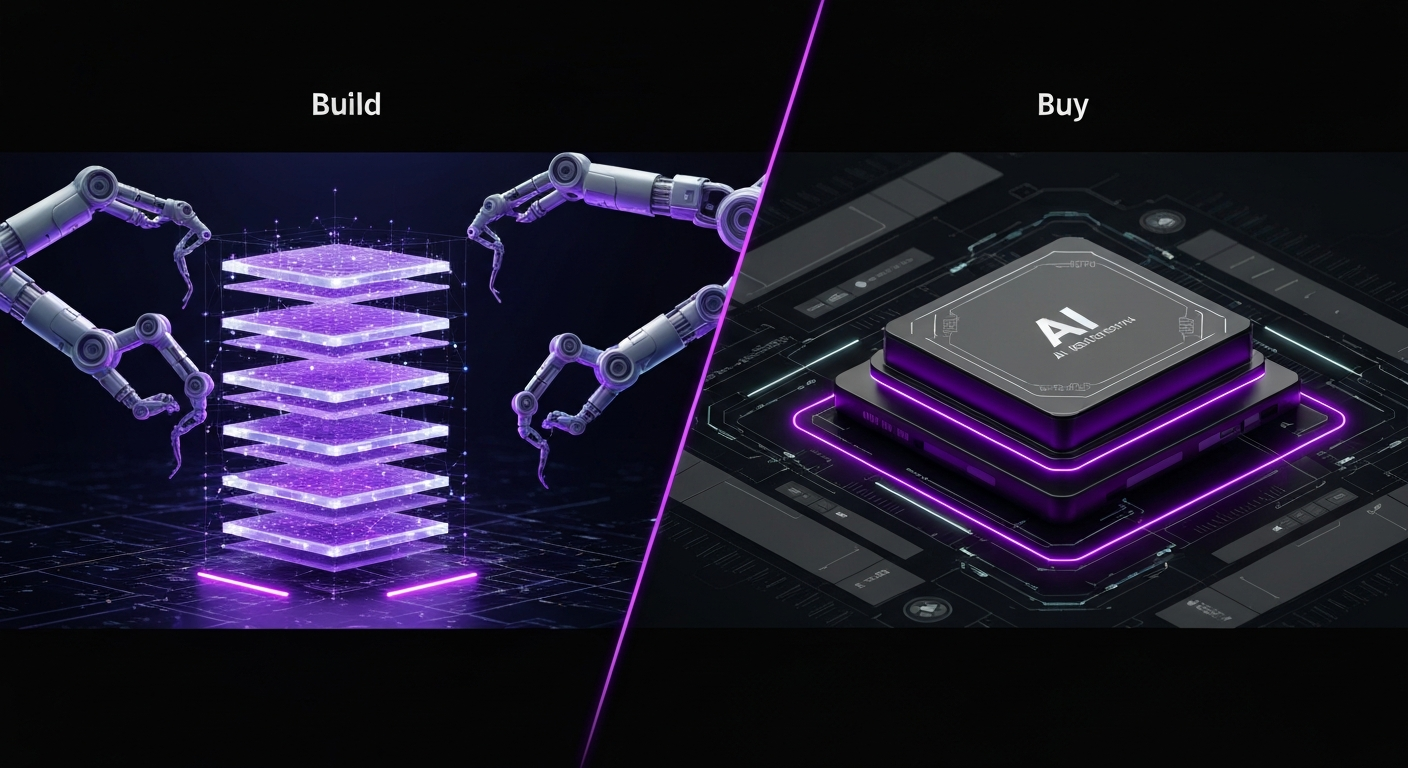
Once a business decides to invest in AI-powered churn prediction, a critical strategic question arises: should we build a custom solution in-house or purchase an off-the-shelf platform? Both paths have distinct advantages and disadvantages, and the right choice depends on the company’s size, resources, timeline, and specific needs.
Building a solution from scratch offers maximum customization and control. An in-house team can tailor models to the company’s unique data, business logic, and workflows. However, this path is resource-intensive. It requires hiring expensive talent, including data scientists and engineers, and the development process can take many months. Furthermore, the responsibility for maintaining and updating the model falls entirely on the internal team.
Buying a solution from a specialized vendor offers a much faster path to value. These platforms come with pre-built connectors to common data sources, proven algorithms, and user-friendly dashboards. Implementation can take weeks rather than months, and the company benefits from the vendor’s expertise. The primary downsides are recurring subscription costs and potential limitations in customization. The business may also have concerns about data privacy when using a third-party service.
| Factor | Build (In-House) | Buy (Off-the-Shelf) |
|---|---|---|
| Time to Value | Slow (6-18 months) | Fast (weeks to a few months) |
| Upfront Cost | High (salaries, infrastructure) | Low to Medium (setup fees) |
| Ongoing Cost | Medium (salaries, maintenance) | High (subscription fees) |
| Customization | Very High | Low to Medium |
| Control | Full control over data and IP | Limited control, reliant on vendor |
| Required Expertise | Requires dedicated data science team | Minimal in-house expertise needed |

Implementing an AI churn prediction system is a powerful endeavor, but it is not without challenges. Being aware of these potential hurdles can help businesses navigate them effectively. From data issues to human factors, a proactive strategy is key to overcoming these common obstacles.
The most frequent challenge is poor data quality. Incomplete, inaccurate, or inconsistent data will lead to unreliable predictions. The solution is to invest in data governance and engineering upfront. This means establishing clear processes for data collection, creating a centralized data warehouse, and implementing automated data cleaning and validation checks. Alongside quality, data privacy is paramount. Businesses must ensure their data handling practices comply with regulations like GDPR and CCPA.
Some of the most accurate machine learning models, like neural networks, can be ‘black boxes,’ meaning it is difficult to understand the reasoning behind a specific prediction. This lack of interpretability is a problem when a team needs to understand *why* a customer is flagged as a churn risk. To overcome this, businesses can either use simpler, more interpretable models like logistic regression or apply modern techniques like SHAP and LIME, which provide insights into how each feature contributed to a prediction.
An AI project is a significant business investment that requires buy-in from across the organization. Stakeholders may be skeptical or hesitant to allocate the necessary budget. The key is to build a strong business case focused on return on investment (ROI). Start with a small-scale pilot project to demonstrate value quickly. Frame the project in financial terms by calculating the current cost of churn and projecting the potential savings from even a modest reduction. Communicating the bottom-line impact is the most effective way to secure support.

Using AI to predict customer churn is just the beginning. As the technology evolves, its role in customer retention will become more sophisticated, integrated, and impactful. The focus is shifting from simply predicting churn to intelligently preventing it in real-time and personalizing the entire customer experience.
The next era is one of hyper-personalization, where retention efforts are tailored to the individual. Future AI systems will not only predict risk but also prescribe the single best action for that specific person at that moment—a shift from predictive to prescriptive analytics. The system might recommend sending a personalized email, triggering an in-app message, or scheduling a support call, all based on the individual’s unique behavioral profile.
Furthermore, these AI-driven retention actions will become increasingly automated and integrated directly into the customer journey. A churn score will evolve from a static report into a live signal that automatically triggers actions across marketing, sales, and product platforms. This creates a seamless, continuously optimizing system that proactively nurtures customer relationships. Ultimately, AI will empower businesses to move beyond saving at-risk customers to building deeper, more resilient relationships, transforming customer retention from a defensive tactic into a primary engine for sustainable growth.