







In the complex and ever-evolving world of business, success is rarely a matter of chance. It is the result of deliberate choices, careful planning, and relentless execution. At the core of this endeavor lies competitive strategy, the discipline that defines how an organization will compete to win in its chosen marketplace. Without a clear strategy, a company is like a ship without a rudder, vulnerable to the unpredictable currents of market forces, competitor actions, and shifting customer demands.
A competitive strategy is a long-term action plan for gaining a competitive advantage over rivals. It is about being different—deliberately choosing a distinct set of activities to deliver a unique mix of value. This process involves making difficult trade-offs, deciding not only what to do but also what not to do. At its core, a competitive strategy answers fundamental questions: Who are our target customers? What unique value do we offer? And how will we create and deliver this value in a way that is difficult for competitors to replicate?
This approach should not be confused with operational effectiveness, which is about doing the same things as competitors, only better. While operational efficiency is critical, it is not a substitute for strategy. True strategic positioning comes from performing different activities than rivals or performing similar activities in different ways. This unique position is what allows a company to establish a profitable and defensible space in the market.
The ultimate goal of any for-profit enterprise is to achieve sustained profitability, and a robust competitive strategy is the primary driver of this outcome. By establishing a unique competitive position, a company creates a protective barrier against competitive forces. This barrier, known as a sustainable competitive advantage, allows the firm to command higher prices, achieve lower costs, or both, leading to superior long-term financial performance.
Without a clear strategy, companies are often forced to compete on price alone—a battle that erodes margins and rarely leads to long-term success. They become trapped in a reactive cycle, constantly chasing the latest trends or responding to competitors’ moves. A well-defined strategy, in contrast, provides a proactive framework for decision-making across the organization, from product development and marketing to supply chain management and customer service. It aligns all activities toward a common goal, creating a powerful synergy that rivals cannot easily untangle or imitate, thereby securing the company’s profitability for years to come.

Before a company can choose how to compete, it must first understand the arena in which it operates. The most enduring and influential tool for this purpose is Porter’s Five Forces framework, developed by Harvard Business School professor Michael Porter. This framework helps organizations analyze an industry’s structure to determine its overall attractiveness and potential profitability. It moves beyond simple competitor analysis to assess the five fundamental forces that shape competition.
This force examines how easy or difficult it is for new competitors to enter the market. If barriers to entry are low, the threat is high, which can quickly erode the profits of existing firms. Key barriers include:
Powerful buyers can exert pressure on a business by demanding lower prices, higher quality, or more services, all of which can squeeze industry profitability. Buyer power is high when:
Conversely, powerful suppliers can capture more of the value for themselves by charging higher prices, limiting quality, or shifting costs to industry participants. Supplier power is high when:
This force assesses the availability of products or services from other industries that can satisfy the same basic customer need. Substitutes place a ceiling on the prices an industry can profitably charge. For example, video conferencing services like Zoom are a powerful substitute for business air travel. The threat of substitutes is high when an alternative offers an attractive price-performance trade-off and the buyer’s cost of switching to it is low.
This is the central force, representing the degree of competition among existing firms. Intense rivalry can lead to price wars, costly advertising battles, and product innovation races, all of which can depress profits. Rivalry is most intense when:

After analyzing the industry landscape with the Five Forces, a company must decide on its strategic position. Michael Porter proposed three generic competitive strategies that a firm can use to achieve a sustainable competitive advantage. They are called “generic” because they can be applied to any industry and any size of company. The choice of strategy is a fundamental decision that shapes every subsequent action.
The goal of a cost leadership strategy is to become the lowest-cost producer in the industry. This is not simply about offering the lowest price but about having the lowest cost structure. Companies pursuing this strategy are relentless in their focus on operational efficiency, process optimization, economies of scale, and tight cost controls throughout their value chain. By having the lowest costs, a firm can either charge industry-average prices and earn higher margins than its rivals, or it can charge lower prices to gain market share while still maintaining profitability. Examples of cost leaders include Walmart, known for its powerful supply chain logistics, and McDonald’s, with its highly standardized and efficient processes.
A differentiation strategy involves creating a product or service that is perceived as unique and superior by customers, which allows the company to command a premium price. Differentiation can be based on various attributes, such as product quality, design, brand image, technology, or customer service. The key is that the chosen attribute must be highly valued by customers. Successful differentiators invest heavily in research and development, branding, and marketing to build and communicate their unique value proposition. Apple is a classic example, differentiating through design, user experience, and a powerful brand ecosystem. Starbucks differentiates through the quality of its coffee and the customer experience it provides.
A focus strategy involves concentrating on a narrow segment of the market and serving that segment’s specific needs better than anyone else. Instead of competing industry-wide, the company focuses on a particular buyer group, geographic market, or segment of the product line. This strategy has two variants:
The essence of the focus strategy is that by catering to a specific niche, the firm can serve its target customers more effectively or efficiently than competitors who are trying to serve the broader market.
| Strategy | Basis of Advantage | Target Market | Key Requirements | Example |
|---|---|---|---|---|
| Cost Leadership | Lowest cost structure | Broad industry-wide | Scale, process engineering, supply chain management | Walmart |
| Differentiation | Perceived uniqueness | Broad industry-wide | R&D, branding, quality, customer service | Apple |
| Focus | Serving a niche better | Narrow market segment | Deep understanding of the niche’s needs | Rolls-Royce (Differentiation Focus) |

While Porter’s frameworks help analyze the external environment and choose a market position, the SWOT Analysis is a foundational tool for looking both outward and inward. It provides a simple yet comprehensive snapshot of a company’s strategic situation by examining its Strengths, Weaknesses, Opportunities, and Threats. This framework is crucial for strategic planning, as it helps align a company’s resources and capabilities with the competitive environment.
The first step in a SWOT analysis is to identify internal Strengths—the unique resources, capabilities, or attributes that give the company an advantage—and external Opportunities—favorable trends or conditions in the market that the company could exploit. The real strategic value comes from matching these two elements. A company should aim to develop strategies that use its strengths to capitalize on opportunities. For instance, a software company with a strong team of AI developers (Strength) can leverage the growing demand for AI-powered business analytics tools (Opportunity) by launching a new product line. This proactive approach allows a company to be on the offense, shaping the market rather than just reacting to it.
The other side of the SWOT analysis involves identifying internal Weaknesses—areas where the company is at a disadvantage relative to competitors—and external Threats—unfavorable trends or conditions that could harm the business. An effective strategy must include plans to mitigate these risks. This involves either correcting weaknesses to better defend against threats or developing strategies that minimize the impact of a threat on a known weakness. For example, a traditional brick-and-mortar retailer with an outdated e-commerce platform (Weakness) faces a significant danger from the rise of agile online competitors (Threat). A strategic imperative would be to invest heavily in upgrading its digital capabilities to neutralize this vulnerability and remain competitive.

While Porter’s strategies focus on competing within existing industry structures, the Blue Ocean Strategy offers a different perspective. Developed by W. Chan Kim and Renée Mauborgne, this framework encourages companies to make the competition irrelevant by creating entirely new markets, or “blue oceans.” This strategy focuses on creating new demand in an uncontested market space rather than fighting over existing demand in a crowded one.
The core metaphor of the strategy contrasts red oceans with blue oceans. Red oceans represent all the industries in existence today—the known market space. In red oceans, industry boundaries are defined, and the competitive rules are well understood. As the market space gets crowded, companies compete fiercely for a greater share of existing demand, turning the ocean bloody with rivalry. Blue oceans, in contrast, denote all industries not in existence today—the unknown market space, untainted by competition. In blue oceans, demand is created rather than fought over, providing ample opportunity for growth that is both profitable and rapid.
| Attribute | Red Ocean Strategy | Blue Ocean Strategy |
|---|---|---|
| Competition | Compete in existing market space | Create uncontested market space |
| Goal | Beat the competition | Make the competition irrelevant |
| Demand | Exploit existing demand | Create and capture new demand |
| Value/Cost | Make the value-cost trade-off | Break the value-cost trade-off |
| Alignment | Align the whole system with either differentiation or low cost | Align the whole system in pursuit of both differentiation and low cost |
The cornerstone of Blue Ocean Strategy is Value Innovation—the simultaneous pursuit of differentiation and low cost. Unlike traditional strategies that accept a trade-off between value and cost, value innovation seeks to achieve both by reshaping an industry’s fundamental structure. It is achieved through the Four Actions Framework:
A prime example is Cirque du Soleil. Instead of competing with traditional circuses like Ringling Bros., it created a new market that combined elements of circus and theater. It eliminated costly animal acts and star performers (Eliminate/Reduce). It raised the sophistication of the experience with unique venues and artistic themes (Raise). And it created a new form of entertainment with a storyline, artistic music, and dance that appealed to an adult audience willing to pay a premium price (Create).
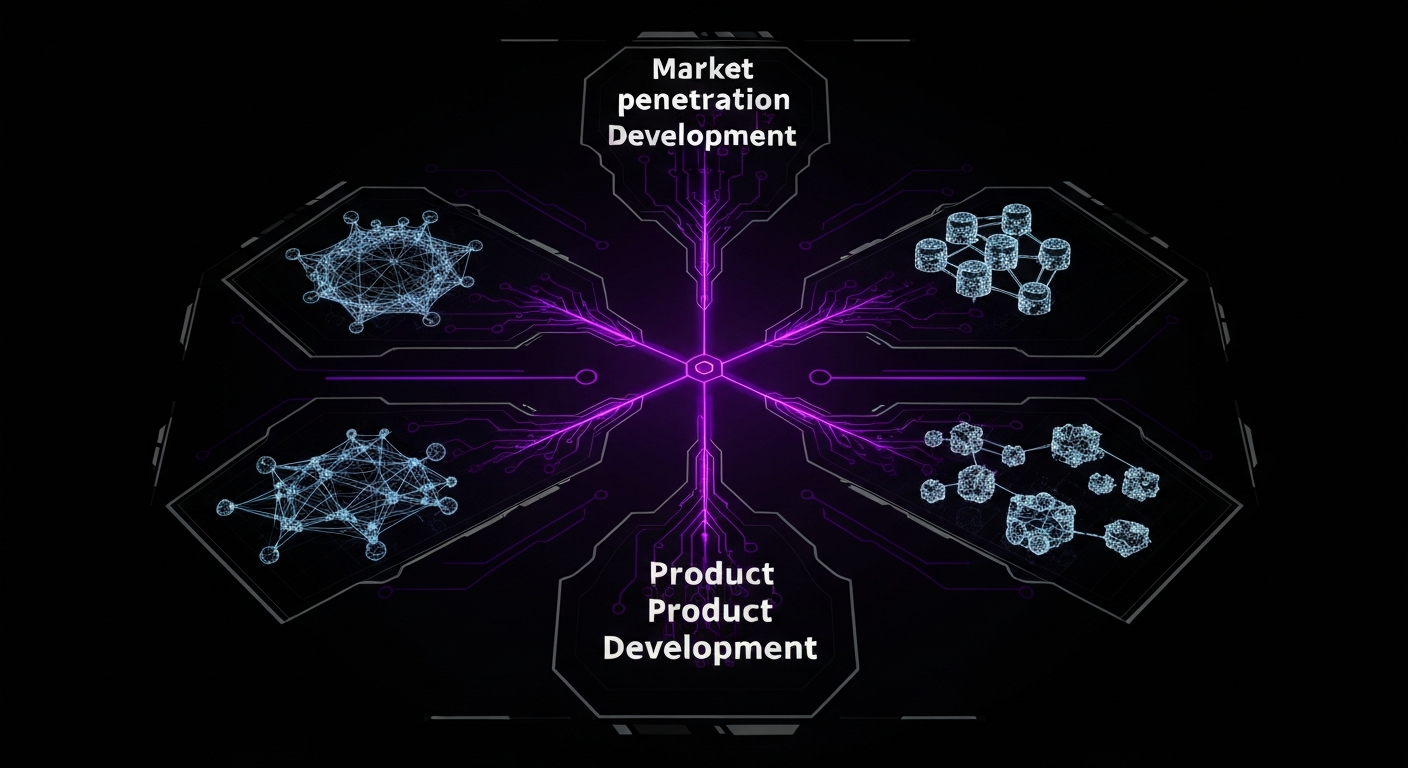
Once a company has established its competitive position, it must consider how to grow. The Ansoff Matrix, also known as the Product/Market Expansion Grid, is a classic strategic tool for identifying growth opportunities. It presents four growth strategies based on whether a company is offering existing or new products in existing or new markets.
This strategy, the least risky, focuses on increasing sales of existing products within an existing market. The goal is to increase market share through tactics like more aggressive marketing campaigns, pricing adjustments, loyalty programs, or expanded distribution channels. For example, a coffee chain might introduce a loyalty app to encourage existing customers to visit more frequently.
This strategy involves selling existing products in new markets. The new market could be a new geographic area (e.g., a domestic company starting to export) or a new customer segment. For instance, a company that has traditionally sold athletic apparel to professional athletes might start targeting casual fitness enthusiasts. This strategy carries more risk, as the company may be unfamiliar with the new market’s dynamics.
This strategy focuses on creating new products for an existing market. It is often used by companies with a strong understanding of their customer base who can leverage that knowledge to offer new solutions. Apple is a master of this, regularly introducing new products like the Apple Watch and AirPods to its loyal base of iPhone users. The risk lies in the investment required for research and development.
This strategy, the most risky, involves developing new products for new markets. It requires the company to enter unfamiliar territory on both the product and market fronts. Diversification can be related (leveraging existing capabilities in a new context) or unrelated (entering a completely new industry). A successful example of related diversification is Amazon leveraging its expertise in logistics and web infrastructure to launch Amazon Web Services (AWS), a cloud computing business serving a new market of developers and enterprises.

While frameworks like Porter’s Five Forces focus on the external industry environment, the Resource-Based View (RBV) of strategy argues that a firm’s internal resources are the primary drivers of its competitive advantage. This perspective suggests that firms are unique bundles of resources and capabilities, and that the key to profitability is to develop and exploit those that are valuable, rare, and difficult for competitors to imitate.
Resources can be tangible (e.g., physical assets, technology, capital) or intangible (e.g., brand reputation, intellectual property, organizational culture). According to RBV, not all resources are strategically equal. To provide a basis for sustainable competitive advantage, a resource must be:
The VRIO framework is a practical tool for applying the RBV. It adds a fourth criterion: Organization. This refers to whether the firm is organized to capture the value of its resources, with the necessary systems, processes, and culture in place. A resource or capability that meets all four VRIO criteria can be the source of a sustained competitive advantage.
| Valuable? | Rare? | Inimitable? | Organized to Capture Value? | Competitive Implication |
|---|---|---|---|---|
| No | – | – | – | Competitive Disadvantage |
| Yes | No | – | – | Competitive Parity |
| Yes | Yes | No | – | Temporary Competitive Advantage |
| Yes | Yes | Yes | No | Unused Competitive Advantage |
| Yes | Yes | Yes | Yes | Sustainable Competitive Advantage |
For example, Google’s search algorithm is valuable, rare, and inimitable due to its complexity and continuous improvement. Crucially, Google is also highly organized to capture its value through its advertising business model, making the algorithm a source of sustainable competitive advantage.

With a diverse array of powerful frameworks available, the challenge for leaders is to select the right tools for their specific situation. The goal is not to find the one “best” framework, but to use the right combination of tools to generate the most insightful and actionable strategic plan.
Your business context is paramount. A startup in an emerging, undefined industry might find the Blue Ocean Strategy invaluable for carving out a new market. In contrast, an established company in a mature, highly competitive industry like automotive manufacturing would benefit greatly from a deep analysis using Porter’s Five Forces and Generic Strategies to refine its position. A small business with limited resources might use the Focus strategy to dominate a local niche that larger competitors overlook.
Your strategic objectives should guide your choice of framework. If the primary goal is growth, the Ansoff Matrix provides a clear map of potential pathways. If the objective is to understand why profitability in your industry is declining, Porter’s Five Forces is the ideal diagnostic tool. If you believe your company’s unique culture or technology is its greatest asset, the Resource-Based View and VRIO framework will help you analyze and leverage it. A SWOT analysis is a versatile starting point for any strategic planning session, providing a general overview to guide deeper investigation.
The most effective strategic analysis rarely relies on a single framework. These tools are complementary and should be used in combination to build a comprehensive, multi-faceted view of the competitive landscape. A powerful approach could look like this:

A brilliant strategy is worthless if it remains a document on a shelf. The transition from strategic planning to successful execution is where most companies falter. Effective implementation is a disciplined process that requires clear planning, robust communication, and diligent measurement.
A high-level strategy must be translated into a concrete action plan. This involves breaking down strategic goals into specific initiatives, projects, and tasks. Each initiative requires clear objectives, assigned ownership, realistic timelines, and allocated resources (budget, personnel, technology). Using frameworks like SMART (Specific, Measurable, Achievable, Relevant, Time-bound) goals ensures that objectives are clear and actionable for everyone involved.
Successful implementation requires that every employee understands the strategy and their role in achieving it. Leaders must communicate the strategy clearly, consistently, and compellingly. This goes beyond a single company-wide email; it involves town hall meetings, team briefings, and integrating the strategy into performance management systems. When people understand the ‘why’ behind their work and see how their daily actions contribute to the company’s larger goals, they become more engaged, motivated, and aligned.
To manage the strategy, one must measure it. Tracking progress and ensuring the strategy is on course requires establishing Key Performance Indicators (KPIs). These metrics must be directly linked to strategic goals. For a company pursuing a Cost Leadership strategy, KPIs might include cost per unit, inventory turnover, and operational efficiency. For a Differentiation strategy, metrics like Net Promoter Score (NPS), brand equity, and customer retention rate would be more relevant. Regularly reviewing these KPIs allows for course correction and ensures accountability.

Achieving a competitive advantage is a significant accomplishment, but sustaining it is the ultimate challenge. In today’s fast-paced business environment, no advantage is permanent. Markets shift, technologies evolve, and competitors adapt. Long-term success requires a commitment to continuous improvement, adaptability, and a forward-looking mindset.
Complacency is the enemy of sustained advantage. Companies that rest on their laurels are eventually overtaken by more innovative rivals. Sustaining an edge requires a relentless focus on innovation—not just in products and services, but also in business models, processes, and customer experiences. This means fostering a culture that encourages experimentation, learns from failure, and is always seeking better ways to create value for customers.
A competitive strategy should be a living document, not a rigid plan set in stone. Organizations must develop strategic agility—the ability to monitor the competitive environment and adapt quickly to changes. This involves continuously scanning for emerging trends, new technologies, and shifts in customer behavior. It also means anticipating and responding to competitor moves, understanding that the competitive landscape is a dynamic game of action and reaction. The ability to pivot and adjust the strategy in response to new information is critical for long-term survival and success.
Ultimately, the most durable competitive advantage is an organization’s culture. Sustaining success is not solely the responsibility of the executive team; it requires a culture of strategic thinking that permeates every level of the company. When employees are empowered to think like owners, understand the competitive landscape, and contribute ideas for improving the company’s position, the organization becomes more resilient, innovative, and adaptive. This collective strategic capability is the hardest asset for any competitor to replicate and is the true foundation of a lasting market advantage.