




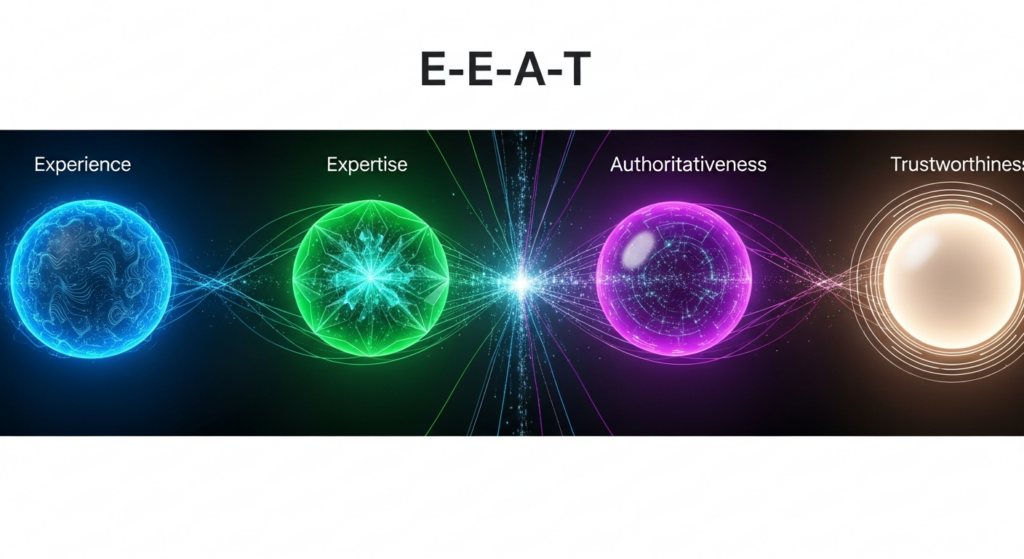


In the evolving landscape of search engine optimization, E-E-A-T has become a foundational concept. The acronym, which stands for Experience, Expertise, Authoritativeness, and Trustworthiness, outlines the core principles Google uses to evaluate content quality. While not a direct ranking factor like page speed, E-E-A-T is a conceptual framework that underpins Google’s goal of surfacing helpful, accurate, and reliable information. For anyone serious about achieving sustainable SEO success, understanding and implementing these principles is the bedrock of a modern content strategy.
E-E-A-T originates from Google’s Search Quality Rater Guidelines, a document used by thousands of human evaluators to assess search result quality. Their feedback helps train and refine Google’s ranking algorithms. While your site may never be manually reviewed, the principles from these guidelines are embedded in the automated systems that rank your pages, including Google’s Helpful Content System and core updates. Therefore, aligning your content with E-E-A-T is a direct way to align your website with the qualities Google’s algorithms are designed to reward.
This framework’s importance has intensified amid the spread of misinformation and the proliferation of AI-generated content. Google’s primary goal is to satisfy users with trustworthy answers, and E-E-A-T serves as a litmus test for credibility. It helps Google distinguish content from a genuine expert with real-world experience from content that merely rehashes information without adding unique value. For businesses and creators, this means search success is increasingly tied to demonstrating genuine credibility. E-E-A-T is essentially Google’s way of asking, “Why should our users trust you?”

For years, the guiding framework for quality content was E-A-T: Expertise, Authoritativeness, and Trustworthiness. However, in a December 2022 update to its Search Quality Rater Guidelines, Google introduced a new letter, transforming the acronym into E-E-A-T. The addition of the first ‘E’ for ‘Experience’ was a deliberate move, reflecting a shift in how Google perceives content value.
The original E-A-T framework was effective but had a blind spot: it could favor content from credentialed experts over content from individuals with invaluable, real-world experience. For example, a detailed review of a hiking backpack by a journalist who only researched its specs might seem expert-level. However, a review from an avid hiker who has taken that same backpack on a dozen treks offers a different, and often more useful, type of value. ‘Experience’ was designed to fill this gap.
Google’s rationale for adding ‘Experience’ was to more explicitly reward content where the creator demonstrates first-hand knowledge or life experience with the topic. It signals a preference for authenticity. Google wants to know if the author has actually used a product, visited a location, or navigated a process they are writing about. This change encourages creators to move beyond theoretical knowledge to share practical insights and unique perspectives that can only come from direct involvement. The evolution to E-E-A-T underscores Google’s commitment to surfacing content that is not just factually correct, but also genuinely helpful and relatable.

To effectively implement this framework, it’s essential to understand each component. While interconnected, each pillar has a distinct role in establishing the quality and credibility of your content and website. Trustworthiness is the ultimate goal, built upon the foundation of the other three pillars.
Experience refers to the creator’s direct, first-hand involvement with the subject matter. It is the practical side of knowledge. For a product review, this means using the product. For a travel guide, it means having visited the destination. For a tutorial on fixing a leaky faucet, it means having performed the repair yourself. This pillar is about proving you have ‘walked the walk,’ not just ‘talked the talk,’ adding a layer of authenticity that cannot be replicated by summarizing information found elsewhere.
Expertise relates to the creator’s level of skill and knowledge in a specific field, often associated with formal qualifications, education, and professional background. For example, medical advice should come from a qualified healthcare professional, while financial advice should come from a certified financial planner. For less formal topics, expertise can be shown through a history of creating high-quality, in-depth content that demonstrates a deep understanding of the subject. It’s the ‘book smarts’ to Experience’s ‘street smarts’.
Authoritativeness is about reputation—how you, your content, and your website are recognized as a go-to source within your industry. Authority is primarily built by external signals. When other respected experts, websites, and organizations in your field cite, reference, or link to your content, they are vouching for your authority. It is a measure of your influence and standing within the broader community related to your topic.
Trustworthiness is the most critical component and the central pillar of E-E-A-T. It encompasses the accuracy of your content, the security of your website, and the transparency of your organization. A trustworthy site presents information honestly, provides sources for its claims, makes it easy for users to find contact information, and secures user data. Without trust, even the highest levels of experience, expertise, and authority are meaningless.
| Pillar | Definition | How to Demonstrate It | Example |
|---|---|---|---|
| Experience | First-hand, real-world involvement with the topic. | Original photos/videos, personal stories, case studies, detailed product usage notes. | A food blogger sharing photos of their own attempt at a recipe, noting specific challenges. |
| Expertise | Demonstrated skill and deep knowledge in a field. | Author credentials, certifications, in-depth explanations, citing data and research. | A certified mechanic writing a detailed guide on diagnosing engine problems. |
| Authoritativeness | Reputation as a recognized leader or source in the niche. | High-quality backlinks, mentions from industry publications, expert collaborations. | A university’s climate science department being cited by major news outlets. |
| Trustworthiness | The overall credibility, safety, and transparency of the site. | HTTPS, clear privacy policies, accessible contact info, positive reviews, accurate content. | An e-commerce site with a secure checkout, clear return policy, and visible customer service number. |

The addition of ‘Experience’ requires creators to prove their first-hand knowledge by showing, not just telling. Generic content that lacks a personal touch is no longer sufficient. To align with E-E-A-T, you must infuse your content with signals of genuine, lived experience to stand out and demonstrate value.
One of the most powerful ways to demonstrate experience is by weaving personal anecdotes and detailed case studies into your narrative. Instead of writing a generic guide to starting a small business, share your own journey—the specific challenges you faced, the solutions you discovered, and the results you achieved. A case study detailing how you helped a client increase their traffic by 300% with specific, replicable steps is far more valuable than a simple list of SEO tips. These stories provide context, build a connection with the reader, and serve as proof of your hands-on experience.
Stock photos are the enemy of ‘Experience.’ To prove you’ve used a product, visited a location, or completed a project, use original media. If you’re reviewing a new camera, include photos you’ve taken with it in various settings. If you’re writing a travel guide for Paris, showcase your own photos of the landmarks and cafes you discovered. Videos are even more powerful. A video walkthrough of a software, a tutorial showing your hands performing a task, or a vlog from a travel destination provides irrefutable evidence of your direct involvement.
Experience doesn’t always have to be your own. You can demonstrate the collective experience of your audience by incorporating testimonials and reviews into your product or service pages. Feature user-submitted photos or stories. If you run a community forum, highlighting insightful discussions can showcase a wealth of shared experience on your domain. This not only builds social proof but also enriches your content with diverse perspectives, reinforcing that your platform is a hub of real-world knowledge.

While experience demonstrates practical application, expertise showcases your deep, foundational knowledge of a subject. It’s about proving you have the necessary skills, qualifications, and understanding to speak on a topic with authority. For Google, especially on complex or high-stakes subjects, expertise is a critical signal of content quality.
Surface-level articles that barely scratch the surface of a topic do not demonstrate expertise. True experts can explore a subject from multiple angles, explain complex concepts simply, and anticipate a user’s follow-up questions. Your content should aim to be the most comprehensive resource on the topic. This means going beyond the basics to include detailed explanations, explore nuances, and provide actionable insights. A truly expert piece of content leaves the reader feeling fully informed.
Clearly communicate who is behind your content and why they are qualified. Every article should feature a clear author with a detailed bio. This bio should include their name, a professional photo, job title, relevant degrees or certifications, and a summary of their experience. Link to their professional profiles, such as LinkedIn or a personal portfolio, to allow users and search engines to verify their credentials and build confidence in the information presented.
Experts build on the knowledge of others and support their claims with evidence. When you make a factual claim or present data, link out to the original, authoritative source, such as a scientific study, a government report, or an article from a well-respected news organization. Citing sources shows that you have done your research and are committed to accuracy. It also allows curious readers to dig deeper, further enhancing the helpfulness of your content.

Authoritativeness is your website’s reputation within its industry. While expertise is about what you know, authoritativeness is about how you are perceived by others in your field. It’s an external validation of your expertise, built over time through consistent quality and recognition. Google looks for signals that your site is a widely respected authority on your chosen topics.
Backlinks remain a powerful signal of authority. When another website links to yours, it is essentially casting a vote of confidence in your content. However, not all links are created equal. A single link from a highly respected, relevant site in your industry is far more valuable than hundreds of links from low-quality directories. A strong backlink profile, earned naturally through the creation of exceptional content, is a cornerstone of authoritativeness.
Authority isn’t just about links. Google also pays attention to unlinked brand mentions. When your brand, website, or authors are mentioned in a positive context on other reputable sites, forums, and social media, it contributes to your perceived authority. Other forms of recognition, such as winning industry awards or speaking at major conferences, all serve as powerful signals that you are a recognized leader in your field.
You can build authority by association. Collaborate with other established experts in your niche by co-authoring a white paper, hosting a joint webinar, featuring an expert quote in your article, or appearing as a guest on a respected industry podcast. These collaborations not only expose your brand to a new audience but also create a clear association between your site and other authoritative figures, enhancing your own reputation.

Trust is the ultimate goal of the E-E-A-T framework. All the experience, expertise, and authority in the world are rendered useless if users and Google don’t trust your website. Trust is the foundation upon which your online presence is built, encompassing website security, business transparency, and content accuracy.
The most basic technical signal of trust is a secure website. Using HTTPS (via an SSL certificate) is non-negotiable. It encrypts data between your server and the user’s browser, protecting their information. Beyond security, legal transparency is key. Your website must have easily accessible and clearly written Privacy Policy and Terms of Service pages. These documents show that you are a legitimate entity that respects user privacy and operates within legal boundaries.
Users want to know who is behind the information they are consuming. A detailed ‘About Us‘ page that tells your story, introduces your team, and explains your mission is essential for building a human connection and establishing credibility. Furthermore, make it easy for users to contact you. Provide a physical address (if applicable), a phone number, an email address, or a contact form. Hiding contact information is a major red flag that erodes trust.
What others say about you is often more powerful than what you say about yourself. Positive reviews on third-party platforms like Google Business Profile, Trustpilot, or industry-specific review sites are strong trust signals. Encourage satisfied customers to leave reviews and respond professionally to all feedback. Showcasing curated testimonials on your website can also be effective, but independent, third-party reviews carry the most weight because they are perceived as more objective.

While E-E-A-T is important for all content, its significance is magnified for a category of topics Google calls “Your Money or Your Life” (YMYL). These are subjects that can have a direct and significant impact on a person’s health, financial stability, safety, or happiness. The stakes are incredibly high, and Google applies its most rigorous E-E-A-T standards to this content.
YMYL categories include, but are not limited to:
For these topics, Google’s algorithms and human raters scrutinize content with the highest level of rigor. Experience and expertise must come from demonstrably qualified sources. Medical advice must be written or reviewed by accredited medical professionals. Financial advice must come from certified experts. The website’s authoritativeness must be beyond reproach, and trustworthiness must be absolute. Publishing low-quality YMYL content can cause real-world harm, and Google’s systems are designed to demote it to protect users. If you operate in a YMYL niche, treating E-E-A-T as the core of your strategy is essential.

Applying the principles of E-E-A-T requires a conscious, multi-faceted effort. It involves optimizing your content, author profiles, and your site as a whole. Use this checklist to audit and improve your website’s E-E-A-T signals.

Integrating E-E-A-T requires a fundamental shift in how you approach content creation. It’s about moving from a keyword-centric model to a people-centric one, prioritizing genuine value and user trust above all else.
First, root your content planning in your genuine areas of experience and expertise. Instead of chasing every high-volume keyword, focus on topics where you or your team can provide unique, first-hand insights that competitors cannot easily replicate. Conduct an honest assessment of your strengths. What have you actually done? What are you a true expert in? Build your content pillars around these core competencies.
Second, author selection becomes a strategic decision. Match the topic of an article with an author who possesses the appropriate E-E-A-T for that subject. For a technical article, use an engineer. For a financial guide, use a certified planner. If you don’t have the expertise in-house, consider commissioning content from credible external experts. Always feature these authors prominently, allowing their credibility to transfer to your content.
Third, your content creation process must be geared towards demonstrating E-E-A-T. Mandate the inclusion of original research, proprietary data, personal stories, and unique images or videos. Create a rigorous fact-checking and review process, especially for YMYL topics. Your goal for every piece of content should be to make it the most helpful, reliable, and authentic resource available. Finally, E-E-A-T is an ongoing process. Implement a regular content audit and update schedule. Information becomes outdated, so your content must evolve to remain accurate and trustworthy.

One of the biggest challenges with E-E-A-T is that it isn’t a single score you can find in an analytics tool. There is no “E-E-A-T score.” Instead, you must monitor a collection of proxy metrics and qualitative signals that can indicate how Google and users perceive your site’s credibility.
The most direct feedback can come from your performance during Google’s core updates. These broad updates often involve adjustments to how Google’s systems assess quality signals like E-E-A-T. If your site sees significant ranking volatility after a core update, it may indicate a need to re-evaluate your alignment with E-E-A-T. Monitor your organic traffic and keyword rankings closely, paying special attention to your most important pages.
Off-page signals are also critical. Track the growth of your backlink profile using tools like Ahrefs or Semrush, noting if you are gaining links from more authoritative domains over time. Monitor your brand’s search volume; an increase suggests growing brand recognition and authority. Keep a close eye on your online reputation. What are people saying about you on review sites, social media, and forums? Positive sentiment is a strong qualitative indicator of trust. While on-page engagement metrics can be unreliable, a consistent pattern of users spending significant time with your content may suggest they find it valuable.

The rise of powerful generative AI models has introduced a new variable into the content equation, making it possible to create vast amounts of content quickly. However, this development makes the E-E-A-T framework more important than ever. E-E-A-T, particularly the ‘Experience’ component, is Google’s primary defense against a potential flood of generic, unhelpful AI-generated content.
AI models are trained on existing web data and, by their nature, cannot have real-world, first-hand experiences. An AI cannot test a product, travel to a city, or feel the emotional impact of a life event. This is where human creators have a distinct advantage. The future of successful content creation lies not in replacing humans with AI, but in leveraging AI as a tool to enhance human expertise and experience. AI can assist with research and drafting, but the final content must be infused with unique human insights, original perspectives, and authentic stories to meet E-E-A-T standards.
As Google continues to refine its algorithms, its ability to detect signals of genuine experience and deep expertise will only improve. Websites that invest in building real authority and proving their credibility will be the long-term winners. Those who rely on shortcuts or low-quality content, whether human or AI-generated, will find it increasingly difficult to compete. E-E-A-T is not just a guideline for today; it is the blueprint for a sustainable and successful future in search.

No, E-E-A-T itself is not a direct, technical ranking factor like keywords in a title tag. It is a framework outlined in Google’s Search Quality Rater Guidelines. The concepts of E-E-A-T are used to build and train various algorithms and systems, like the Helpful Content System, which are part of the overall ranking process. While you won’t find an ‘E-E-A-T score’ in a tool, aligning your website with its principles directly influences how these ranking systems perceive your site’s quality.
Experience is about first-hand, practical knowledge, while Expertise is about learned, theoretical, or formal knowledge. For example, a professional food critic who has studied culinary arts for years has ‘Expertise’ in food. A home cook who has made a specific lasagna recipe 100 times has ‘Experience’ with that dish. Both are valuable. Experience is about ‘doing,’ while Expertise is about ‘knowing.’ The ideal content often demonstrates a combination of the two.
For a new website, building E-E-A-T can seem daunting, but it is achievable. Start by focusing on a specific niche where you have demonstrable experience or expertise. Create highly detailed author bios for your writers, showcasing their qualifications. Be transparent with a comprehensive ‘About Us’ page and clear contact information. Actively seek early customer testimonials. Focus on creating truly exceptional, in-depth content that is better than anything currently available. It takes time, but starting with a strong foundation of transparency and quality is key.
Yes, E-E-A-T applies to all content, but the standards are applied differently depending on the topic. The most stringent E-E-A-T evaluation is reserved for YMYL (Your Money or Your Life) topics like health and finance, where expertise and trust are paramount. For a less critical topic, like a fan site for a TV show, the standards are much lower. Here, demonstrating experience as a fan (e.g., writing detailed episode reviews) might be more important than formal expertise.
An effective author bio should act as a miniature resume that builds credibility. It must include the author’s full, real name and a clear, professional headshot. List relevant credentials, such as degrees, certifications, or years of industry experience. Briefly describe their area of expertise and what makes them qualified to write on the topic. Crucially, link to their other professional online presences, such as a personal website or a LinkedIn profile. This allows both users and Google to verify their identity and expertise.
On its own, purely AI-generated content struggles to meet E-E-A-T standards, especially the ‘Experience’ component, because AI cannot have first-hand experiences. While it can summarize existing information to create content that sounds expert, it lacks originality and authentic insights. AI can be used as a tool to assist in content creation—for brainstorming, outlining, or drafting. However, to meet E-E-A-T criteria, that content must be heavily edited, fact-checked, and enriched by a human expert who adds their own unique experience, analysis, and perspective.